McLaren “Mushroom”
Innovative Rear Suspension 2014
The Innovation
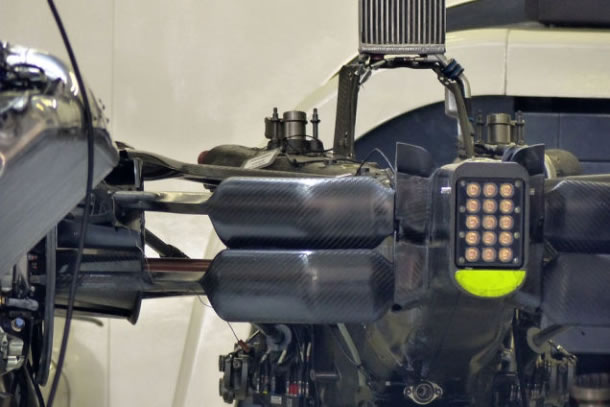
One of the main technical talking points of the first pre-season test at Jerez was McLaren’s rear suspension. A closer look reveals that this is an area where McLaren clearly did not take a conservative approach. Instead, they produced something that is very difficult to compare with anything previously seen on a Formula 1 car. They created the first true innovation of the year by designing rear suspension wishbones that differ radically from the norm. Normally, wishbone suspension elements are built as horizontal teardrop shapes, almost parallel to the reference plane, in order to minimise drag. McLaren’s version is completely different and does not appear designed to reduce drag at all – quite the opposite.
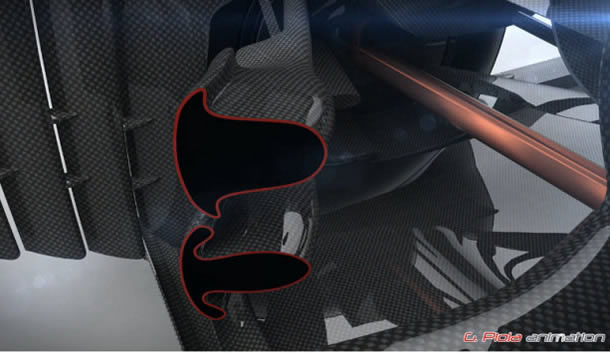
McLaren created wishbones in the shape of a mushroom lying on its side with the “umbrella” facing downstream. The team used unusually profiled rear sections on the upper and lower rear arms of the rear suspension, which actually block the free flow of air through the Coke bottle area – an area where, until then, engineers had tried to keep airflow as clean as possible without any obstruction. It appears that McLaren found a rule-bending innovation that other teams would soon be scrambling to duplicate. Some teams prepared protests against it while simultaneously preparing their own versions in their wind tunnels. Such is the nature of Formula 1. Various technical commentators dubbed them “mushrooms,” “butterflies,” or “blockers.”
Visual Description
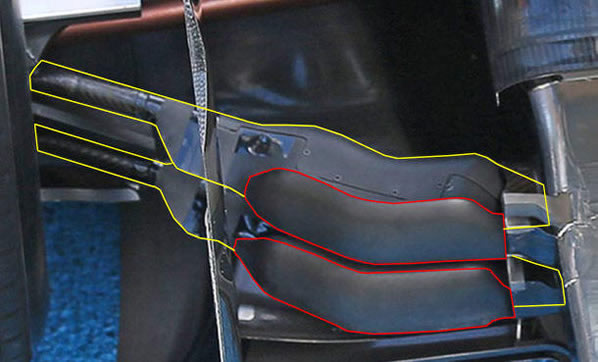
In the images, two structures are visible in front of the rear wing (highlighted in red). Because a two-dimensional image lacks depth of field, these structures appear as though the suspension wishbones have been flipped vertically. In reality, the team designed rear arms with a much boxier trailing-edge version, a normal thinner leading edge, and a profile that narrows outboard at the point in line with the rear wing endplate (highlighted in yellow). These boxier portions are the mushrooms or blockers.
How They Work
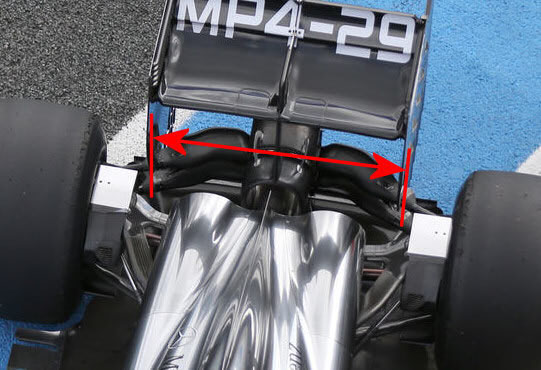
This concept is designed both to provide more downforce at low speed and reduce drag at high speed. The rear beam wing previously performed this function, but the 2014 regulations banned it, prompting teams to find new solutions. The mushrooms are designed to restrict and choke the airflow emerging from the Coke bottle area as it reaches the upper side of the diffuser. As air flows around these pieces located above and forward of the diffuser, a low-pressure area is created behind the mushroom umbrella and above the diffuser. This helps to pump more air through the diffuser, speeds up the air underneath the car, increases the mass flow out of the rear diffuser, and generates more downforce from the undertray and diffuser. The primary function is not to generate downforce on their own but to help the undertray and diffuser create it, and to allow the team to be more aggressive with the diffuser while preventing it from stalling at lower ride heights. These two elements also create a degree of drag from airflow blockage, which increases fuel consumption over a race distance.
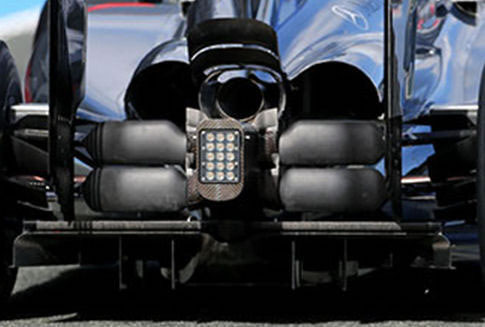
Aerodynamic Detail
To make the system aerodynamically more interesting, the horizontal axis of the mushroom is rotated by 5 degrees (front side up), so that the back of the mushroom umbrella pulls air upwards instead of being aerodynamically neutral. Each mushroom arm generates a stagnation point ahead of the vertical flap and creates a vortex behind it. Importantly, the entire system only works because the flow is constrained in the “box” between the endplates of the rear wing, the rear wing on top, and the diffuser at the bottom. Combined with an extra wing profile spanning the diffuser width and a very short chord wing mounted just ahead of the diffuser, this creates an upwash that helps reduce the pressure behind the suspension, assisting the diffuser in extracting more air from under the floor.
Speed-Sensitive Behaviour
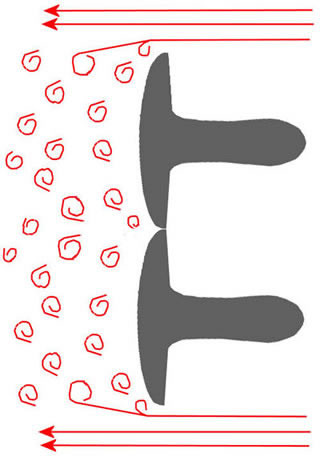
Interestingly, the airflow around these “blockers” changes with the speed of the car. When the car runs at lower speed and higher ride height, downforce is reduced and the suspension is uncompressed. In this state, the mushrooms almost completely close the gap between them, forming an almost solid wall at the top of the diffuser, reducing pressure and helping it work at low speed to generate additional downforce.
Conversely, when the car is at higher speed and the suspension is compressed, a gap opens between the mushrooms, reducing drag. This provides
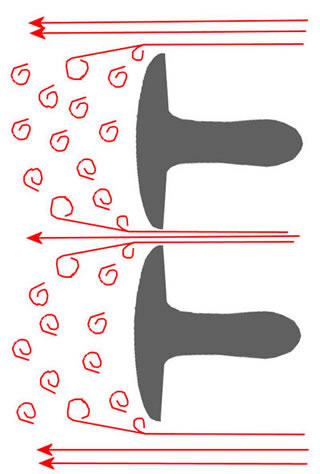
more downforce under braking and in slower corners, and less drag at high speed.
Difficulty of Copying
This could have been McLaren’s secret weapon because, if effective, it is not something easily copied, as it depends on numerous design parameters at the rear of the car. McLaren designed their rear suspension so that the rear wishbones are positioned as far back as possible, with attachments at the very rear of the gearbox housing. They were also unable to enclose the driveshaft with the lower wishbones as Red Bull and Ferrari had done. It is precisely this suspension geometry that would make it extremely difficult for other teams to simply copy the design, as it would require redesigning the gearbox, the rear suspension mountings, and the suspension wishbones – creating a combined impact on aerodynamics and mechanical behaviour that would take considerable time to verify and optimise.
Season Performance
After the beginning of the season, it was not clear whether the design had given McLaren the rear-end downforce that every team sought under the 2014 rules, now that smaller rear wings and the absence of blown diffusers had made the rear of the cars more unstable. The cost in terms of drag appeared quite high. McLaren’s unique suspension design was investigated by other teams, who could see the downforce it produced but also the significant amounts of drag, so none adopted it.
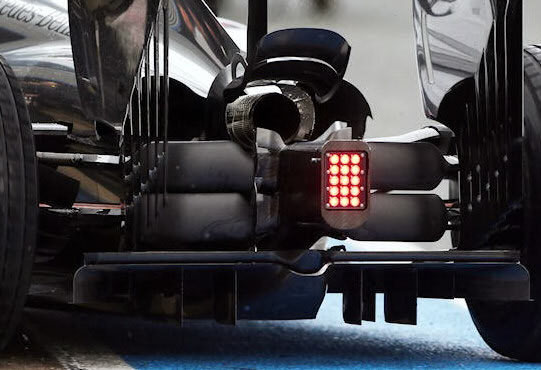
Additionally, the use of the “suspension blockers” meant the team had to place cooling outlets higher than is desirable. The hot, slow-moving airflow dispatched by the cooling outlets can be destructive to the rear wing airflow, reducing the effect of the low-pressure airflow under the wing, unbalancing the car during braking and cornering.
Legality Questions
The rear suspension of the McLaren MP4-29 came under close scrutiny. At least one team asked the governing body for clarification that the design complied with the regulations relating to the maximum number of arms in the rear suspension. The FIA’s technical department headed by Charlie Whiting accepted that it was within the rules. However, several other teams considered protesting it at the first race, because Whiting could only express an opinion – he is not the final arbiter of legality, and his opinion had been overturned before. A formal protest would be required for official action.
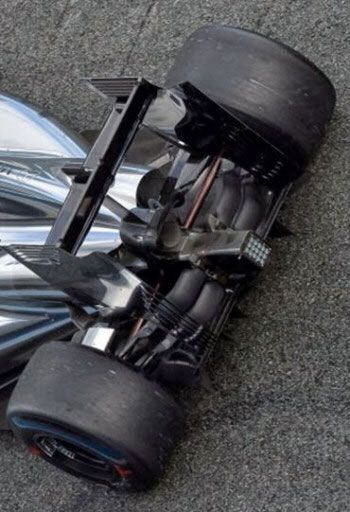
The exact purpose and mechanism of the mushrooms was not completely clear, but their purpose was certainly aerodynamic.
The legality question centred on whether, given that the primary purpose of suspension is to suspend the car and keep the wheels attached, the secondary purpose could be aerodynamic gain. They clearly provided aerodynamic benefit, which could be considered in contravention of the spirit of the regulations. Given that a suspension part would not normally feature a box-shaped element, this calls into question whether the primary purpose is suspension or aerodynamic.
Regulatory Analysis
These elements would be illegal if they were simple covers attached to the suspension elements. However, if they are structural parts of the wishbones, they can be legal. The seemingly clear Article 10.3.4 states:
***10.3.4 **Non-structural parts of suspension members are considered bodywork. *
The critical consideration is that the wishbones are moving elements and the gap between both elements changes based on the attitude of the car. This means the entire shape must be structural; otherwise the thick fairing would be considered banned moving bodywork under Article 10.3.4 of the Technical Regulations. McLaren would not have overlooked this.
If the “mushrooms” are considered bodywork, then Article 3.15 comes into force:
***3.15 Aerodynamic influence : ***
*With the exception of the driver adjustable bodywork described in Article 3.18 **(DRS) **(in addition to minimal parts solely associated with its actuation) and the ducts described in Article 11.4 (BRAKE DUCTS), any specific part of the car influencing its aerodynamic performance : *
*a) Must comply with the rules relating to bodywork. *
*b) Must be rigidly secured to the entirely sprung part of the car (rigidly secured means not having any degree of freedom). *
*c) Must remain immobile in relation to the sprung part of the car. *
*Any device or construction that is designed to bridge the gap between the sprung part of the car and the ground is prohibited under all circumstances. *
*No part having an aerodynamic influence and no part of the bodywork, with the exception of the skid block in 3.13 above, may under any circumstances be located below the reference plane. *
With the exception of the parts necessary for the adjustment described in Article 3.18, any car system, device or procedure which uses driver movement as a means of altering the aerodynamic characteristics of the car is prohibited.
The “mushrooms,” being mounted to the wishbones, are clearly unsprung and clearly move. However, there was speculation in the paddock that McLaren had found a loophole in the regulations meaning these devices were not bodywork and thus Article 3.15 did not apply.
Further complexity arises if the mushrooms are considered part of the suspension rather than bodywork, as they would need to comply with Article 10.3.1, which stipulates limitations to the cross section of the suspension arms:
***10.3 Suspension members : ***
***10.3.1 ****With the exception of minimal local changes of section for the passage of hydraulic brake lines, electrical wiring and wheel tethers or the attachment of flexures, rod ends and spherical bearings, the cross-sections of each member of every suspension component, when taken normal to a straight line between the inner and outer attachment points, must : *
*a) Intersect the straight line between the inner and outer attachment points. *
*b) Have a major axis no greater than 100mm. *
*c) Have an aspect ratio no greater than 3.5:1. *
*d) Be nominally symmetrical about its major axis. *
*The major axis will be defined as the largest dimension of any such cross-section. *
***10.3.2 ****Suspension members having shared attachment points will be considered by a virtual dissection into discrete members. *
***10.3.3 ***No major axis of a cross section of a suspension member, when assessed in accordance with Article 10.3.1, may subtend an angle greater than 5° to the reference plane when projected onto, and normal to, a vertical plane on the car centre line with the car set to the nominal design ride height. The major axis will be defined as the largest axis of symmetry of any such cross-section. The length of the intersection of this axis with the cross-section must not be less than 95% of the maximum dimension of the section.
The length is likely very close to or exactly 100mm, while the height appears to be of similar dimension. This means the section has an aspect ratio close to 1:1, well below the maximum allowed 3.5:1, making the entire part legal.
The design was described by some engineers in the paddock as a head-scratcher in terms of how it could comply with either 3.15 or 10.3.1, but many were already thinking about implementing their own versions. If the FIA deemed it legal, all teams would attempt to implement a similar solution. The only way to determine definitively how the McLaren design was legal may have been to protest the car, something that could have occurred at the Australian Grand Prix in March 2014.