Limited-Slip Differential
Overview
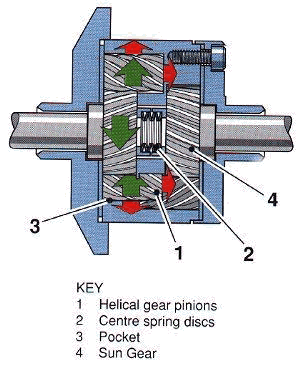
Unlike traction control, which reduces power to all wheels equally, a Limited-Slip Differential (LSD) prevents tyres from spinning by transferring torque to the tyres that have grip. This occurs typically during cornering but also during acceleration. Because traction control works by cutting fuel during wheel spin (thereby reducing the power output of the engine), it is always preferable to use the Limited-Slip Differential first to attempt to stop wheel spin by transferring power to the wheel with better grip. If that phase is unsuccessful and spin cannot be controlled in this way, traction control takes over.
Acceleration and Deceleration Modes
During acceleration, the LSD reduces tyre spin, which in turn reduces understeer in rear-wheel-drive F1 cars or reduces oversteer in front-engined road cars.
During deceleration, the LSD reduces tyre spin under braking. In this mode, it functions as part of the engine braking system or, after 2008, independently. After the FIA introduced a common ECU for the 2008 championship, the engine braking system was banned.
Electronic Control in Formula 1
![[Limited slip differential]](/Images/differential_limited_slip.jpg)
Like most components on a Formula 1 car, the LSD is electronically controlled and can be programmed into the car. Until the practice was banned, a button on the steering wheel allowed drivers to manually lock or release the differential at will, enabling better traction out of corners and operation closer to the edges of the traction circle. Electro-hydraulic devices are used in F1 to constantly vary the torque acting on both drive wheels at different stages of a corner. This torque relationship can be adjusted to help steer the car through corners or prevent the inside rear wheel from spinning under hard acceleration out of a bend. The FIA permits these devices provided their characteristics are fixed once the car is on track and the settings cannot be changed by the driver.