Lift and Coast
Introduction
One subject has dominated the airwaves – or at least what we got to hear of them – since the 2014 engine rule change, which limited cars to 100 kg of fuel during races and a maximum fuel-flow rate of 100 kg per hour: fuel saving. These regulations forced drivers to “lift and coast” to conserve fuel throughout the race, especially at circuits where fuel usage is high, like the Canadian Grand Prix. It’s not just the fans who are becoming fed up with “lift and coast” – drivers and team bosses are also unimpressed.
|
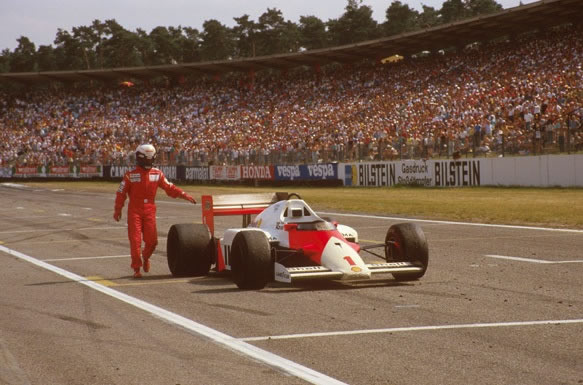
German GP 1986, Hockenheim, Alain Prost ran out of fuel on the penultimate lap, pushing the car home. (McLaren MP42C TAG Porsche). He dropped from 3rd to 6th position. |
Historical Context
Fuel saving has always been a factor in racing, but the term “lift and coast” has become a common talking point in Formula One in recent years. It was also used during the V8 and V10 era but became more prominent at fuel-limited races following the ban on in-race refuelling from 2011. That is when teams started carrying a fuel load for the entire race – and carrying less means the car will be faster from the start.
It is now more common because, under the 100 kg race fuel allowance, teams would never fuel a car to go flat out every lap – that is simply not the quickest way to run a race. A team will always plan to start the car as light as possible, go flat out, and then save fuel later once the race order settles down after the pit stops. Additionally, radio communications between car and pit wall are now widely broadcasted, and fans can clearly hear fuel-saving instructions. In earlier times, all communications were encrypted and closely guarded, so fans had no insight into what was actually going on.
Advances in telemetry ensure teams have a much more accurate understanding of fuel usage than in the 1980s, when there was an element of guesswork involved and cars parked by the side of the track with empty tanks were a common sight. Drivers have always had to save fuel, but perhaps not to the extent witnessed in the modern era. And there is no point in leading with one lap to go only to stop without fuel. The objective is to finish the race as fast as possible. Weight is the key.
|
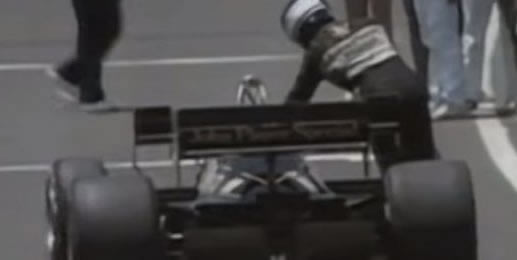
Nigel Mansell collapsed as tried to push his Lotus over the line at the Dallas Grand Prix in 1984 |
Not a New Practice
The concern that too much fuel saving is bad for racing is not new to F1, nor was this practice absent under the previous engine regulations. In the last season with V8 engines, some teams would fill their cars with up to 10% less fuel than they needed to complete a race distance, then “lift and coast” to make savings when needed. Fuel saving was and will always be a priority in F1.
What Is “Lift and Coast”?
“Lift and coast” is the most effective technique for driving flat out while doing so in an efficient manner that enables fuel consumption targets to be maintained, while minimising time loss and reducing the opportunity for rivals to take advantage. It involves releasing the accelerator and using engine braking to save fuel during the race, as opposed to flat-out driving. F1 drivers do not “lift and coast” during qualifying but do use the technique during races. This approach achieves a faster overall race time than would be possible by carrying additional fuel and driving flat out from start to finish.
|
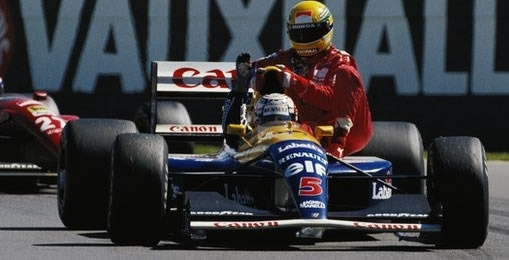
Nigel Mansell driving the No5 Canon Williams Renault FW14 V10 gave a lift to Ayrton Senna when the Brazilian’s McLaren ran out of fuel at the 1991 British GP |
Just as important is what “lift and coast” is not. It is not coasting into a corner well below the theoretical limit of performance. The car is still always on the limit through the corner or extremely close to it.
The Weight Trade-Off
The basic principle is this: running less fuel saves weight, and a lighter car is a faster car. If a driver has 100 kg of fuel to complete a race but can run half the distance with “lift and coast,” it may be possible to use 3 kg less. If starting that race 3 kg lighter enables the driver to go a tenth of a second per lap quicker without any “lift and coast,” by the time 30 laps have passed the driver might be three seconds further up the road. This could buy a position at the pit stops, gaining vital track position, and the driver can then save fuel later to compensate. Teams use “lift and coast” strategically to produce the most effective race strategy.
Driver Perspectives
In his BBC Sport column in March 2014, Hamilton explained what it means:
“You save most fuel by lifting and coasting in the heavy braking zones at the end of long straights into slow corners.
“When you’re driving absolutely flat out, such as on a qualifying lap, you would brake at, say, 80m from the corner, come straight off the throttle and get on the brakes, almost instantly together.
“But on a fuel-saving lap in the race you’ll lift at, say, 200m, and coast to the braking zone.”
His colleague Nico Rosberg pointed out:
“Lift and coast is the most efficient way to save fuel - they even did it in the 80s,” said the Mercedes driver. “I remember my Dad (Keke) doing it when he was racing with Alain Prost at McLaren. They had to save fuel because everybody was running out at the end of races. So nothing has changed there, just that it’s become more professional, more accurate, and more detailed.”
|
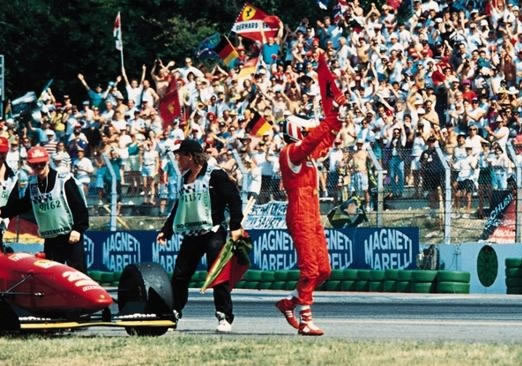
Berger salutes the fans after his car runs out of fuel returning to Parc Ferme, German GP 1994, Ferrari 412T1 |
Fuel Management Across Eras
Tyres, brakes, and fuel have always been limiting factors for F1 drivers. Lifting and coasting did not appear overnight, as drivers and engineers have used the tactic for years. In qualifying trim, a driver chooses a braking point based on the maximum apex speed that can be carried. During a race, the penalty of carrying additional fuel on lap time (“fuel effect”) means that engineers calculate how little fuel a driver can get away with by doing some “lift and coast” throughout the race.
During the V8 era, there was no upper limit on fuel weight, and teams generally ran between 120-160 kg depending on the circuit. Those engines were much hungrier, often consuming slightly more than 2 kg per lap, so with more fuel onboard but also higher consumption, the drivers still needed to manage their fuel to complete the race distance. Every kilogram of fuel carried costs lap time. The enemy of any race car driver or engineer is weight, which means carrying more fuel than needed is not optimal. Approximately 10 kg of fuel costs around three to four tenths in lap time, creating a strategic offset whereby it is sometimes actually better to be slower and save fuel than to race flat out with more fuel on board. If teams fill the full allocation of fuel, they increase the starting weight of the car by over 14%. More fuel makes it easier to reach the end of the race, but that extra weight means slower lap times and higher demand on tyres and brakes.
|
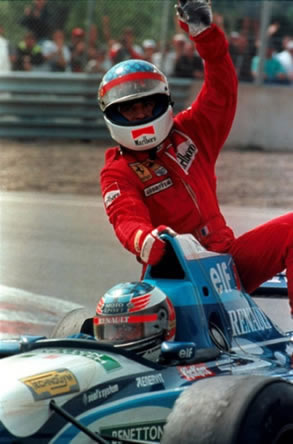
Jean Alesi parked the car run out of the fuel. Whilst being given a lift back to the pits by Michael Schumacher, he celebrates his only victory in Formula One for Ferrari. Montreal, 11 June 1995 |
The Technical Mechanics
Once a car has accelerated to full speed, it runs at the maximum fuel flow rate of 100 kg/hr as permitted under the regulations, meaning the engine is producing maximum power output for that period. The driver then lifts off the throttle and slams the brakes into the braking zone, through the corner apex, and accelerates out again. Apex speed remains exactly the same and the latter part of the braking curve is identical, so there is no further loss. This produces the fastest theoretical lap time.
In terms of fuel consumption, however, the most effective way to use less fuel on a straight is to reach top speed as quickly as possible and then lift off the throttle towards the end of the straight, before the natural braking point. At this point, fuel consumption falls to practically zero. During this period between full power and the apex of the corner, the car decelerates purely from aerodynamic and tyre drag – and quite rapidly. When a car is travelling at 300 km/h, the drag force produces a deceleration of approximately 1.1g.
When a driver deploys “lift and coast” for an additional 50 m, for example, the car is completely off throttle for that period – consuming 0 kg/hr instead of 100 kg/hr. In terms of the time taken to cover 50 m at 300 km/h versus 280 km/h, the difference is mere hundredths of a second. But the fuel saving is significant – approximately ten grams each time. Once the coasting distance has been covered, the driver picks up the original braking profile. This is far more than simply coasting into a corner. The driver is rejoining the same trajectory normally followed.
Overall, the effect on lap time (time penalty) when doing small amounts of “lift and coast” is practically zero. It is only when deploying higher levels, as seen at the end of the Canadian Grand Prix 2014, that it becomes noticeable. Even in the most extreme cases, such as Montreal (a fuel-limited track), the maximum loss is around three tenths of a second per lap. Generally, when a driver is asked to lift and coast, the loss is in the region of half a tenth to a tenth.
|
From Epic Formula 1: The day when everyone ran out of fuel, 1985 San Marino Grand Prix, Imolahttp://epic-formula1.blogspot.com/The only normal thing about this race was the fact that Senna started on pole. Towards the end, from lap 57 or so, cars started coming to a halt all of a sudden. One driver would take the lead, and then a few laps later, retirement. It was a bizarre spectacle, to say the least. Senna ran out of fuel in his Lotus, allowing Stefan Johansson to take the lead in his debut race for Ferrari. Because Imola is in Italy, the tifosi went bonkers. If you watch this video, you can hear an audible roar from the crowd when Senna is forced to pull over. And then another audible gasp is heard from them as Johansson is forced to pull over. This went on, one after another, with drivers getting into first and then promptly running out of gas. It went on even after the race, as Alain Prost crossed the finish line first, and ran out of fuel on the parade lap. And then he was disqualified, as his car was under the official minimum allowed weight.Thierry Boutsen came in third in the most freakish way possible, when his car ran out of fuel right before the finish line. As the rules specify that the car must cross the line, but not how, he simply pushed it across. And with Prost disqualified, he officially came in second. Without a working engine. Of 26 drivers that started the race weekend, only five officially managed to finish the race. Elio de Angelis, in his Lotus, was declared the winner of the race, making it one of the weirdest races ever. |
Additional Benefits
Another reason lift and coast featured prominently in Montreal is that it is very effective for saving brakes. When travelling at high speed, energy increases as the square of the speed – doubling the speed produces four times the energy. When a driver lifts off rather than hitting the brakes, the air absorbs some of that energy as drag on the car and the tyres, without putting any energy into the brakes. That initial phase of braking, when the car is travelling at the highest speed, is where energy levels are greatest. Lift and coast is therefore also incredibly effective at managing brake temperatures, as well as reducing strain on the engine and helping bring engine temperatures down.
Impact on Energy Recovery
One might argue that saving brakes and lifting and coasting will compromise energy harvesting on the MGU-K (the process by which the battery is charged when the motor works as a generator), because for a period of the potential maximum braking zone the car is coasting. Lifting off rather than braking does mean that some charge is lost, but the net energy benefits are always going to be positive. The MGU-K has a certain power capacity and harvests as a function of how long that power is generated under braking. There are few circuits where a driver will struggle to harvest the full 2 MJ/lap energy allocation from the MGU-K.
An Engineering Reality
However much the fans might not enjoy it, fuel saving has always been part of Formula 1 and always will be. This has very little to do with the fact that the current regulations include a fuel restriction. It will always be quicker to start a car with less fuel and ask the driver to fuel-save at some point than to fill it with enough fuel to drive flat out to the end. That is because of the extra weight of the fuel. It does not matter what the engine rules are, how much fuel the teams are allowed, or how long the races are. That is simply engineering reality. Fuel saving would not disappear if refuelling were reintroduced either. In IndyCar, where refuelling is allowed, drivers are often heard being given their fuel mileage figures so they can stretch their fuel between stints to make fewer pit stops. Fuel saving was a factor in Formula 1 even when refuelling was permitted.