Left Foot Braking
Overview
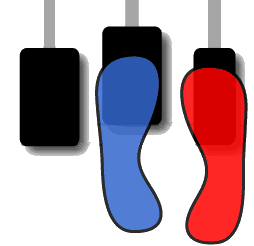
Left-foot braking is primarily used in front-wheel-drive cars and is particularly effective during cornering at high speeds. The story is that left-foot braking was invented by rally drivers, and I believe in that story.
Left-foot braking is used mostly and frequently in rallying, but can be equally useful on the road or track in the following situations:
Non gear-change corners:
Left-foot brake all the way to the apex (trail braking) and the right foot can immediately get back on the throttle. This eliminates the delay in getting on the power.
Slower corners:
Significant gains in late braking are available, as with the left foot already over the brake, the driver can go from power to braking immediately.
Medium-speed corners:
With most road cars, the improved handling response with a little drag on the brakes makes corner entry faster and more accurate. Pressing lightly on the brake with or without the power on improves the poise of the car because of weight transfer to the front.
Fast corners:
With softly sprung road cars in fast bends, going from braking to accelerating upsets the car. The driver can balance the car by using both the throttle and brake together. On the way in, apply the brakes and keep the throttle down, release the throttle more and apply more brakes to slow and balance the car, never fully lift off the throttle, then accelerate at the apex keeping some brake on, only releasing them completely when the car is balanced again.
Ultra-fast corners:
A dab on the brakes keeps the engine pulling and is better than a lift off the throttle (particularly when running curbs).
Gear-change corners:
Left-foot brake all the way to the apex and blip the right foot to change gear (only works in higher gears; 3rd to 2nd is trickier) and get back on the throttle.
Unknown corners, corrections, and emergencies:
When charging around unfamiliar corners, a left foot poised over the brake can allow for a dab on the brakes to improve turn-in, shed speed, or come to a full stop when things have gone badly wrong.
There is no doubt that left-foot braking is better in emergencies if the foot is already covering the brakes. A heavy tug on the gear lever puts the car into neutral while the left foot is already braking.
Up someone’s rear:
Keep the left foot covering the brake, in case of emergencies. When preparing to overtake, press the throttle and balance the speed on the brake; when going to pull out, release the brake and press the throttle all the way down.
Someone’s up your rear:
Dab your left foot on the brake just enough to light up the brake lights. Great fun, especially under heavy acceleration – really confuses them.
Removing pedal transfer time between accelerator and brake:
Using the left foot to brake removes the pedal transition time from brake to accelerator and vice versa. This can shave fractions of a second off a lap time when done well, but cannot be used when it is necessary to change down a gear (unless the clutch is not used).
|
|
How It Works in Front-Wheel-Drive Cars
When driven under acceleration with no brakes applied, a front-wheel-drive car will understeer when the front wheels are turned. To overcome this problem, left-foot braking is used to shift brake bias (brake balance) to the rear. By using a combination of throttle and brake, the driver can change from understeer to neutral steer to oversteer.
Rally drivers can use various means of biasing the brakes to the rear, such as a brake bias control valve or installing more powerful brakes on the rear wheels. That works well on a circuit, but on a rally it is difficult to change brake bias in the middle of a turn that suddenly changes from dry dirt with good grip to wet mud with no grip. That is why they use left-foot braking.
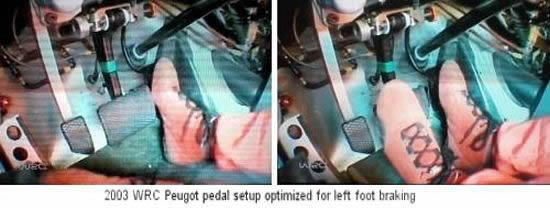
Most initial attempts at left-foot braking alarm drivers enough to discourage further attempts. It is an advanced technique and should only be attempted after extensive practice. When learning, drivers initially press the pedal far too hard, being accustomed to the action of pressing a clutch all the way to the floor. It takes time to reprogramme the muscle memory of the left foot and leg, and a safe area of empty tarmac is recommended for practice.
To make use of left-foot braking, the throttle must be controlled at the same time. On a faster empty straight road, gently left-foot braking and blipping the throttle repeatedly helps develop the feel and understand the effect.
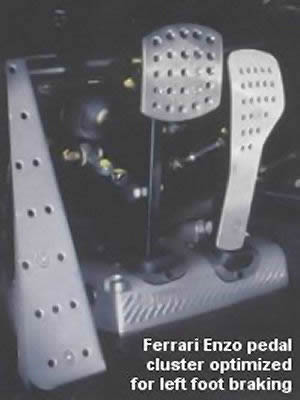
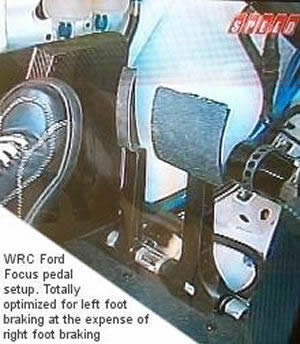
Aftermarket pedal optimized for left foot braking
The Physics
When the accelerator is pressed, the body moves toward the rear wheels due to weight transfer. When braking, the body moves forward. By using the basic rules of weight transfer and a combination of throttle and left-foot braking, the driver can maintain control when the unexpected happens.
Brake bias in normal street cars is toward the front wheels for safety reasons. If a hand brake is pulled when turning on a wet road and the car spins, the reason is clear: biasing the brakes to the rear causes oversteer, which is not what a typical driver wants.
A severe problem affecting most front-wheel-drive cars is understeer during fast cornering. Understeer generally means that during cornering at high speed, the car has a tendency to keep moving straight toward the outer edge of the curving road rather than following the direction in which the wheels are pointed. To cancel out understeer, there should be more grip at the front wheels than at the rear. The left-foot braking technique helps achieve exactly that. Applying a bit of brake during acceleration transfers the car’s weight to the front, causing the front wheels to have more grip than the rear tyres. The car then starts to oversteer. Essentially, the driver is changing brake bias. This can be adjusted by either adding power or brake pressure (also called “modulating”).
Nice example of left foot braking and heel and toe technique.
Practical Application
By applying brake with the throttle at the same time in a front-wheel-drive car, two things happen. First, the front wheels keep turning. Second, the rear wheels try to lock up. If the car is in a turn, the back starts to slide toward the outside. To control or stop the slide, less brake and more power should be applied. This changes oversteer toward understeer and stops the rear wheels from sliding outward. The reverse is also true: if the turn tightens, more oversteer can be induced by increasing brake pressure against the throttle. By balancing the brake and throttle, neutral steer can be achieved.
The driver must then keep the car in control by steering in the desired direction, and applying more or less throttle and braking as needed. Both pedals must be used simultaneously, which requires practice. Lifting off the accelerator causes more oversteer and flicks the car’s rear out further. Applying more throttle while easing off the brakes reduces oversteer and straightens the car. This balancing act allows the driver to smoothly clear the corner at high speed, making small corrections to the steering throughout. At the exit, the brake is simply released and full power applied.
When proficient at this technique, a driver should be able to keep the accelerator fully floored and control the car’s direction using just the brake pedal and steering wheel. Understeer is eliminated if done correctly, and the corner is cleared at a higher speed than in normal driving.
With a typical race-car gearbox, a driver can even begin braking with the left foot instead of the right without using the clutch pedal. When braking, the throttle can be blipped (so-called rev-matching) between gear changes. Most normal gearboxes cannot cope with such treatment, so it is generally best not to attempt this with a standard road car unless prepared for expensive repairs. Many modern cars are also equipped with computer-controlled stability systems that use brakes to stabilise the car by changing brake bias automatically through the ABS system. With sufficient practice, a skilled driver can control the car more precisely with the stability system turned off.
History in Formula 1
|
|
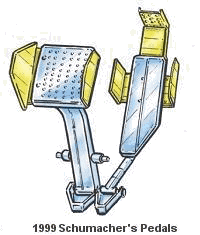
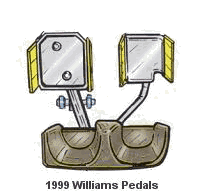
In Formula 1, left-foot braking was introduced at the beginning of the 1970s. A new breed of young and talented drivers were learning their trade in karting, often before reaching the age that permitted them to drive a car on the road. With only two pedals, distributed one to each side of the steering column, only the left foot could be used for braking. Without preconceived ideas about how to drive fast, these young drivers discovered that by using the throttle and brakes at the same time, it was possible to tune the brake balance and alter the balance of the kart as they braked and turned into a corner. By applying power to the rear axle, the front tyres did more of the braking than the rear. This stabilised the kart under braking and prevented it from wanting to oversteer during the critical turn-in phase.
When the young Ronnie Peterson rose through the lower racing ranks and joined Team Lotus in 1973, he found that Colin Chapman was receptive to his ideas about using left-foot braking in Formula 1. Lotus already had some experience with two-pedal race cars in the T56B gas-turbine Formula 1 car of 1971. Being a four-wheel-drive car, power was not applied while the left foot was used for braking to adjust brake balance, as this would not have worked in the same way. Instead, the driver had to keep the throttle open during braking to maintain RPM in the gas generator section of the two-shaft turbine, so that power was available when needed in a corner. Without this, there would be a lag of several seconds.
Chapman’s answer to Peterson’s requests was to design the 1974 Lotus T76 with a Y-shaped brake pedal, the branches of which lay either side of the steering column. Thus the brakes were available to either foot. The clutch pedal was retained but used only for starting. Thereafter, gearshifts were performed using a button on the gear lever to activate the clutch via an electrohydraulic actuation system. Chapman had the Lotus road cars allocated to Peterson and Jackie Ickx fitted with identical systems for practice.
Although Peterson was particularly enthusiastic about the potential of the system, the car proved problematic. Chapman did not give up easily. By the time Peterson rejoined Lotus in 1977, after a brief period at March, Chapman had revived the Lotus “queerbox” – a tiny gearbox concept that, in theory at least, did not require use of the clutch to shift gears. It appeared briefly on the T78 but gave the drivers such a severe case of tennis elbow, due to vibrations fed back through the lever during attempted shifts, that it was abandoned so as not to compromise the new car.
The Electronic Era
In the 1980s, computer-controlled electrohydraulic control systems arrived in Formula 1. Initially applied to gear shifting and active suspensions, the control system and software engineers involved were soon looking for new applications. With the almost unlimited braking capacity of carbon-carbon brake materials and the high level of downforce available prior to 1994, the only limitation on braking performance was the effort the driver could apply to the brake pedal and the ability to control the 5g-plus deceleration that resulted. Left-foot braking became more widely used with sophisticated bias adjustment and better modulation capabilities of electronically controlled systems. Designers naturally sought to provide the most sophisticated controls and systems they could devise, within the regulations, to assist the driver in getting the most from the car under braking.
Because inside the tight F1 chassis there is not enough space for a left-foot rest pedal (as in a rally car), drivers’ feet are always on the pedals. That is why braces are fitted on the sides of each pedal to prevent any movement of the foot during the race.
Michael Schumacher’s Mastery
During the 1990s, Michael Schumacher entered the F1 world and was the first Formula 1 driver to exploit the full potential of left-foot braking. During his first and second years in F1, engineers and drivers on other teams were surprised to hear his car passing through corners with full throttle applied. He was controlling the speed and brake bias of the car using only the brakes. His control of the car through corners was remarkable.