Keel
Overview
Suspension design in Formula 1 has been seemingly stagnant in recent years. Double-wishbone A-arm suspension has been the norm, with the suspension arms manufactured from carbon fibre for many years. Carbon fibre suspensions maintain minimal flexure, which is important for predicting the car’s response as it travels over undulating surfaces. Traditional low nose cone designs allowed the lower suspension arms to be directly attached to the main structural parts of the car.
However, since the move to high nose cone designs – which allow better use of airflow underneath the car and improved efficiency of the front wing – the location of these lower arms has proven problematic.
For ideal suspension geometry and maximum mechanical grip, the lower arms should be long and nearly parallel with the road. As there is no longer any structural bodywork in these low positions, extensions were developed to allow the suspension to be mounted with correct geometry.
Tyrrell 019 and Tyrrell 019 B pioneered the high nose design
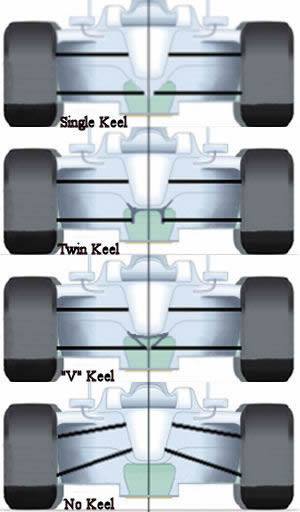
Since the advent of high nose designs in the early 1990s, pioneered on the Tyrrell 019 Formula 1 car, three major keel designs have emerged to solve this problem:
Single Keel
Single keel
The original and simplest solution was to place a single keel below the nose cone to which the suspension could be attached. Below the nose cone is fitted a protruding plate where the lower suspension arms are mounted. The single keel design has a couple of advantages. It is a straightforward design with ample surface area, allowing designers to experiment with arm placement for maximum suspension and mechanical grip performance. The main drawback is that the keel disrupts airflow below the nose cone. Having gone to the trouble of raising the nose to increase front wing downforce, the last thing a designer wants is something disrupting the aerodynamics and negating the downforce advantage. Ferrari maintained the single-keel design until 2007 and had considerable success with it.
Twin Keel
Twin keel
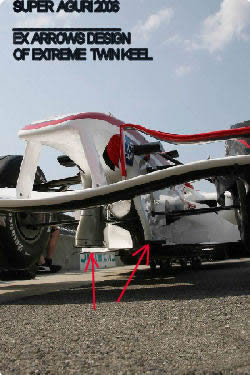
Extreme twin keel design by BMW
The second solution is the twin keel design. As the name suggests, it has not one but two plates protruding from the bottom of the nose on which the suspension arms are attached. The twin-keel concept was conceived by Harvey Postlethwaite in 2000 during his time at Honda Racing Developments. It made its racing debut in Formula 1 the following year on the Sauber car, where it was introduced by designer Sergio Rinland. Adrian Newey adopted the twin keel feature in 2002 on the McLaren MP4-17.
The keels are positioned on the edges of the nose sides and protrude less than in the single keel design (though there were exceptions, such as the 2002 Arrows design, later used in 2006 by Super Aguri). A twin keel adds engineering complexity and weight to the suspension. Because of flexing problems, engineers must reinforce the pylons (keels), which increases weight further. Although the design improves airflow below the nose, the suspension set-up is compromised, and post-design suspension adjustments are more difficult. Nevertheless, the aerodynamic benefits outweighed these concerns, and in the early part of the 2000s nearly all teams ran some variation of the twin keel design, with the exception of Ferrari.
Teams continued to innovate around the twin keel design. McLaren and BMW, for instance, elected to have the keels protruding outwards to improve airflow.
| Super Aguri started their racing history in 2006 at the Bahrain GP with the four-year-old Arrows A23 F1 car, driven by Takuma Sato and Yuji Ide.The team’s last race was the 2008 Spanish GP due to financial difficulties. In that final race, Anthony Davidson did not finish and Takuma Sato finished 13th. |
V-Keel
V-keel
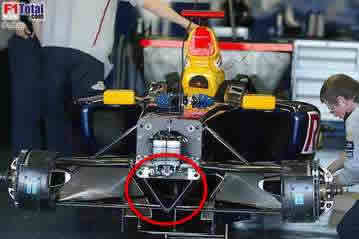 Only Renault and Red Bull RB2 in 2006 adopted a V-keel concept. This was a hybrid between a single and twin keel, with two plates emerging from the bottom edge of the nose before meeting in a V shape. The belief was that this layout allowed greater suspension flexibility and more mechanical grip with minimal cost to the car’s aerodynamic package. Benefits included a reduction in disturbance to underbody airflow compared to a single-keel design, with fewer geometry, flexing, and weight restrictions than those associated with twin keels. The V-keel suspension fixing point is also stiffer than in a single keel because of its angled supports.
This concept also allowed relatively free passage of air behind the front wing.
Some publications have suggested that the V-keel has the same aerodynamic benefit as a zero-keel design, but that is not entirely accurate because the V-structure still introduces some disruption to airflow.
Zero Keel
Zero keel
**
**
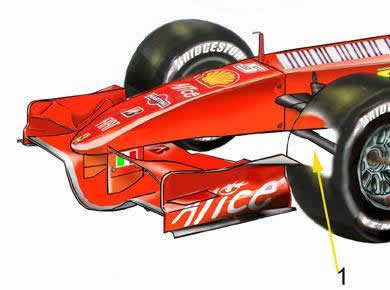
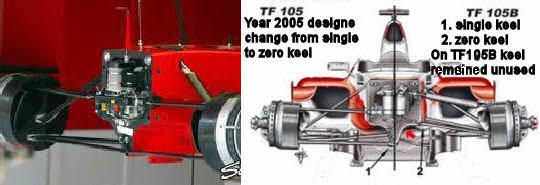
The most recent innovation has been the zero keel design, where there is no keel at all. One limitation of any keel design is that, while the keel’s influence may vary, the suspension linkages themselves still disrupt underbody airflow. In the zero keel design, the suspension is mounted directly onto the body of the car. This approach emerged largely because of FIA regulation changes that mandated a more elevated front wing position, reducing the available front downforce. To maximise downforce, designers moved to a zero keel suspension arrangement to free airflow as much as possible, accepting a penalty in mechanical grip in exchange for improved aerodynamic efficiency.
As the nose cone is in a raised position, the suspension arms take a distinctly inclined angle relative to the road surface, reducing suspension efficiency.
The zero keel design became standard in F1. By 2007, all teams ran such a design except Red Bull, who under Adrian Newey opted for a twin keel layout. Renault continued with their V-keel solution until 2008, when they switched to a zero keel configuration.