J-Damper (Inerter)
The Problem It Solves
The increasingly complex suspension in an F1 car incorporates a number of devices to counter loads fed into the chassis, in order to maintain the ideal tyre contact patch with the track. Springs and dampers are easy to understand, but the spring effects from the high-profile tyres are not so easy to control. Their spring effect goes undamped and is largely outside the teams’ control when setting up the car. Being able to counteract these uncontrolled forces in the suspension allows the tyre to maintain better contact with the ground for more consistent grip.
What Is the J-Damper?
During development of the inerter, McLaren invented a decoy name (the “J-damper”) to keep the technology secret from its competitors for as long as possible. The letter “J” stands for “jounce,” an amalgamation of “jump” and “bounce.”
The J-damper is the legal version of the mass damper and is found in the third, transverse damper on the rear suspension of the cars. Reacting to the acceleration of the suspension, the inerter absorbs loads that would otherwise not be controlled by the velocity-sensitive conventional dampers.
The J-damper absorbs excess energy from tyres and suspension to make the load through the contact patch more predictable and hence more stable at the point in time when stability is most crucial. A normal damper dissipates energy mostly through heat, whereas the J-damper absorbs energy.
The mass inside the J-damper is attached to a threaded shaft within the transverse damper, so it is effectively hidden from view.
The Inerter Concept
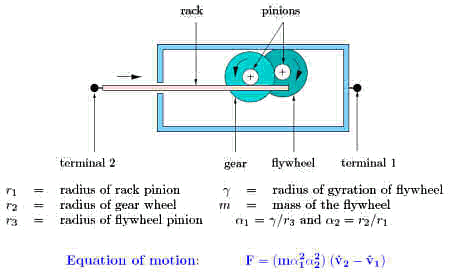
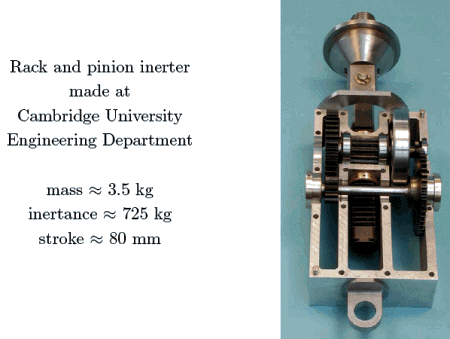
The inerter is a device that provides a force proportional to the relative acceleration between its attachment points (“terminals”), which must be freely and independently movable in space. A typical realisation incorporates a flywheel that rotates in proportion to the relative displacement between the terminals. The first publication on the subject, in which the word “inerter” was coined, was “Synthesis of Mechanical Networks: The Inerter” (M.C. Smith, IEEE Transactions on Automatic Control, Volume 47, Number 10, Pages 1648-1662, October 2002). A patent on the device had previously been filed by Cambridge University.
Theoretical Foundation
One of the principal motivations for the introduction of the inerter is the synthesis of passive mechanical networks. The fact that the mass element, together with the spring and damper, is insufficient to realise the totality of passive mechanical impedances can be demonstrated using the force-current analogy between mechanical and electrical circuits. The standard analogies between mechanical and electrical networks are:
- spring = inductor
- damper = resistor
- mass = capacitor
where force relates to current and velocity to voltage. The correspondence is perfect in the case of the spring and damper. However, for the mass element, there is a restriction: all the above elements except the mass have two terminals (attachment points that should be freely and independently movable in space). The mass element has only one such terminal – the centre of mass. It turns out that the mass element is analogous to a grounded electrical capacitor.
How It Works
The J-damper is a spinning mass on the damper rod inside a damper body. The inerter looks superficially like a conventional shock absorber, with an attachment point at each end. For example, one end may be attached to the car body and the other to the suspension assembly. A plunger slides in and out of the main body as the car moves up and down. This causes a flywheel inside the device to rotate in proportion to the relative displacement between the attachment points.
The result is that the flywheel stores rotational energy as it spins. In combination with the springs and dampers, the inerter reduces the effect of oscillations and thus helps the car retain better grip on the road.
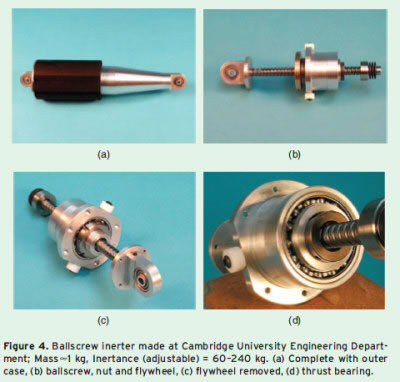
Looks like no springs or hydraulics or MR fluid is involved. It works much like the Renault mass damper in absorbing energy from tyre movement to maximise the contact patch, area, and load. As a recognisable part of the suspension (fitted in place of the third damper) that works to improve tyre usage and responds only to suspension loads, it may be seen as legal. The fact that the device is light, small, and well contained compared to the bigger masses placed in the nose cone of the Renault probably means this will remain legal.
The J-damper cannot work without the rest of the suspension system (dampers and springs).
Suspension Context
Standard suspension systems are based around two components: springs and shock absorbers (dampers). Together, these contribute to the car’s ride and handling.
No matter how the system is tuned, there is always a compromise between handling, comfort, and grip. Even in F1 cars, where comfort is not a priority, the suspension needs to be set to allow both sensitive handling (which requires a harder suspension) and good mechanical grip (for which the suspension would normally be softer). The result is residual oscillation as the load on the tyres varies, which impedes grip and therefore slows the car down.
The car’s suspension reaction to the ground can be understood as acting in a sine wave motion. The wave would be damped over time by itself, but not quickly enough. The ground reaction causes the J-damper rotating mass to react in its own sine wave motion (speeding up its rotation), which also damps over time. The two reactions do not coincide, so they counteract each other. Although the car’s reaction through the suspension outweighs the mass reaction, the spinning mass still dampens the car’s response to the ground through its countering force (an offset sine wave).
Sine wave with a dampening effect
Development History
The suspension device for use in F1, code-named the J-Damper, was developed in secret by McLaren and Cambridge University from 2005 under a confidential arrangement between the team and university.
The device was first conceived by its creator, Professor Malcolm Smith, as early as 1997 and raced for the first time by McLaren on 8 May 2005, when Kimi Raikkonen achieved victory at the Spanish Grand Prix, Circuit de Catalunya, Barcelona.
It is used not only to improve mechanical grip but can offer greater flexibility in a vehicle’s suspension system. Looks like at the same time Ferrari was developing the same system by themselves, and without any outside help.
The Spy Scandal
The J-damper first entered public discussion after the McLaren/Ferrari and McLaren/Renault espionage affairs during 2007.
In one version of events, among the Ferrari technical design files found in McLaren’s possession was a drawing of Ferrari’s version of the J-damper. Former Ferrari chief mechanic Nigel Stepney allegedly handed over a 780-page dossier of information (technical data, drawings, and set-up data) to McLaren’s former chief designer Mike Coughlan. Only a very small portion of these drawings ended up in Renault’s hands, and the Renault engineering team reportedly failed to understand the device’s proper function.
In a second version, the drawings found in Renault’s possession were actually original McLaren/Cambridge University project drawings, and again the Renault engineering team failed to understand the purpose of the device. The FIA World Motor Sport Council considered this matter at a hearing in December 2007. According to the Council’s finding, a drawing of McLaren’s J-damper was used by Renault to try to have the system declared illegal. This failed because Renault had fundamental misunderstandings about the operation of the J-damper system. A full transcript of the decision is available on the FIA website.
The fact that the J-damper is an inerter was revealed in an Autosport article by Craig Scarborough. Autosport ran the article on 29 May 2008, which revealed the Cambridge connection and that the J-damper was an inerter.
Cambridge Enterprise, the commercialisation office of the University of Cambridge, subsequently entered into a licence agreement with Penske Racing Shocks, enabling Penske to supply inerters to any team in Formula 1.
Ferrari’s Version
Ferrari’s version of the inerter device appears to have been first used in a race during the Monza GP in 2007. During that weekend’s practice and race, both Ferrari drivers had accidents attributed to problems with the rear suspension where the J-damper was mounted in place of the third shock absorber.
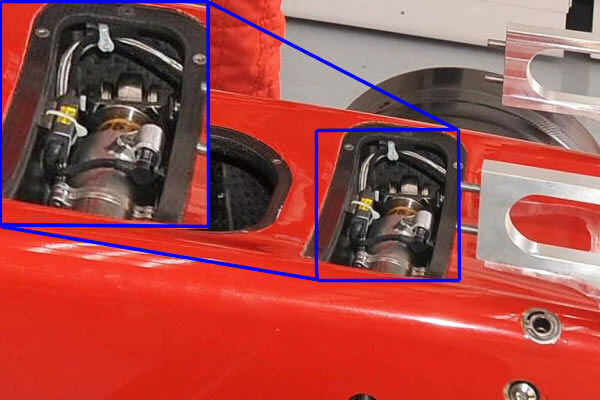
Ferrari inerter fitted on the F10 car, 2010: