Heel and Toe Driving Technique
What Is Heel and Toe?
“Heel and toe” refers to the right foot position as it operates both the accelerator and the brake pedal at the same time. There are individual variations in position based on foot size, type of shoe, seating position, pedal placement, and other factors. It is important to give preference to the brake pedal for safety reasons, and because the brakes require more accurate control feel than the engine speed.
First off, the heel-and-toe technique only applies to vehicles with a regular manual transmission. Got an automatic or, by some stroke of amazing fortune, a Ferrari 599 GTB Fiorano with a steering wheel paddle-shift automated sequential manual? No point in reading any further.
Purpose and Application
This driving technique is used mostly in performance driving, although some drivers, me included, use it on the road in everyday conditions for smoother driving. It involves operating the throttle and brake pedals simultaneously with the right foot, while facilitating normal activation of the clutch with the left foot. It is used when braking and downshifting simultaneously (prior to entering a turn), and allows the driver to “blip” the throttle to raise the engine speed and smoothly engage the lower gear.
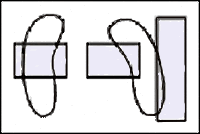
When I’m doing it, my foot is in approximately the eleven o’clock position, as in the upper picture. In this position I can firmly apply the brakes, and the control feel is pretty much the same as if I were operating the brake pedal alone. By rocking my foot, I can apply the throttle without varying the pressure on the brake pedal (this is one part in particular that takes practice). When I’m done braking, I slide my foot over so that it’s directly on the accelerator pedal. The heel-and-toe downshift entails precise actions on all three pedals, movement of the shifter, and listening to the sound of the engine. It all happens simultaneously and very fast.
Pedal Setup
Performance vehicles are usually factory equipped or modified (if necessary) so that the heights of the brake and accelerator pedals are closely matched and the pedals are not too far apart, to permit easy use of heel and toe.
Aftermarket pedal optimized for left foot braking and heel and toe technique
Aftermarket pedal covers can benefit some cars and foot sizes by bringing the edges of the pedals closer together and by changing the height relationship between them. On some cars with hanging accelerator pedals, the pedal can be bent to a more favourable position. I don’t recommend trying to bend the brake pedal. Also be aware that pedal covers can reduce the space for a larger foot to fit between the brake pedal and the centre console.
I would suggest that people spend a significant amount of time experimenting with foot positioning before trying to reposition the pedals or investing in pedal covers. Maybe you can get used to your original pedal arrangement.
Why Heel and Toe?
One basic situation is starting up hill. Heel and toe allows a smooth transition from brake to accelerator while operating the clutch with the left foot so that the car does not roll backwards.
Many people also use the term “heel and toe” to refer to rev-matching while shifting and/or double clutching and braking, but it is actually just one component of these processes.
Rev-Matching
Rev-matching refers to matching the engine speed to the transmission input speed before re-engaging the clutch. This is particularly desirable when downshifting for a corner. In a hard corner, the suspension needs to be stable and the tyres need to be loaded so that all of their traction is being used to generate cornering force. If the engine is at a different speed than the transmission input when the clutch is re-engaged, this generates a force on the driveline that upsets the stability of the suspension (weight transfer) and causes the tyres to exceed their traction capability if the corner is being taken near the limit. Rev-matching is necessary if a corner is to be taken near the limit. It is not necessary for slower corners, but it will make them smoother.
Another benefit is that heel-and-toeing allows the driver to downshift at the last moment before entering the turn, after braking has begun and the car has slowed, so the engine speed when the lower gear is engaged will not be too high.
As the power band of most rally cars is high in the rev range, this technique can also be used to ensure that engine rpm does not drop below the power band while under braking (WRC braking technique). If this happened, there would be a delay between the driver accelerating after the corner and the car responding; this is especially true in turbocharged cars. This technique ensures that maximum power can be reached the instant the brake pedal is released and the accelerator is fully depressed.
Mastering the Technique
The heel-and-toe downshift is a fundamental technique for driving fast through corners. During a heel-and-toe downshift, the driver steers with the left hand, shifts with the right hand, clutches with the left foot, and works both the brake and accelerator pedals with the right foot – all at exactly the same time.
It takes some time getting used to, and it takes repetitive practice to become smooth and have it be second nature. At first it takes a lot of concentration. You’re doing a lot of things at the same time. Besides working on all the controls, you also need to be sensitive to tyre grip during braking, you have to be watching your reference points heading into a corner, and to make matters worse, if you’re racing, you might have to be looking for traffic. However, after a couple of weekends of practice, you’ll get the hang of it, and in no time you’ll be able to forget about your hands and feet and concentrate on the track.
So, how to do it properly?
| The downshift begins with a full throttle acceleration towards a corner. |
| Lift the right foot from the gas pedal and press the brake pedal. |
| Just before the braking is done, the left foot depresses the clutch pedal. The right hand begins the downshift. The right foot is still applying, but easing up on the brake pressure as the car approaches the turn-in, then the foot rotates so the heel is above the corner of the gas pedal. As the shift passes through neutral, the right heel gives a quick push of the gas pedal to rev the engine quickly (the ball of the foot is still on the brake easing up even more). |
| The left foot releases the clutch, the right foot rotates off the gas. Done correctly the RPMs generated by the throttle blip above matches the RPMs needed, and as the clutch is released the engine engages smoothly with the current wheel speed. There should be no forward or braking lurch when the clutch is let go. |
| The right foot completes the braking with a smooth release. |
| The right foot moves over to the gas pedal to assume the normal position at first only to maintain the pressure needed to sustain the vehicle speed throught the first part of the corner. Then pressure is gradually applied to accelerate out of the turn apex. |


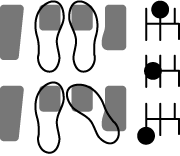



The whole sequence from the second step to the last takes approximately half a second.
Double-Clutching
The description above assumes the use of a street car and a street transmission with synchros. For a true race transmission without synchros, the shifting procedure must be modified with a double-clutch technique. To do this, the clutch is pressed in, the shifter moved to neutral, and the clutch released. Then the accelerator is blipped while the shifter is in neutral (again with the heel, while the ball of the foot continues to brake), the clutch pressed back in, the shifter placed in the lower gear, and the clutch released.
This is required for maximum longevity of the transmission. Practising this shifting technique with a street car is a good idea for anyone who expects to drive a race car with such a transmission, even though it is technically not necessary on a synchromesh gearbox.
Example of heel and toe