HANS
Head and Neck Restraint System (Frontal-Head Restraint)
Invention and Development
HANS was invented in the early 1980s by two biomechanical experts, Jim Downing and Bob Hubbard. They recognised that racers were receiving serious head and neck injuries in crashes.
They designed the HANS device so that when a driver’s torso is restrained by safety belts, the device restrains the head from swinging forward, greatly reducing neck loads during frontal impacts and preventing basal skull fracture injuries. Basal skull fracture is the lethal aspect of a head-on collision. They began selling HANS in 1990, before the racing community fully recognised and understood the significance of head and neck injuries in biomechanical terms.
The first HANS device was large and fit only a limited number of drivers and cockpits. In 1997, development began on the current version, which was smaller, lighter, and fit nearly all cockpits and racers. In both sled crash testing and on racetracks, HANS has consistently reduced injuries in accidents. Many racers have acknowledged that HANS saved their lives.
Adoption in Formula 1
Several F1 drivers were initially reluctant to use the device, but by the end of the first proper test day of the 2003 World Championship, most drivers had accepted the mandatory HANS Head and Neck Support system. The device has likely saved several drivers in head-on impacts since its introduction. Felipe Massa became the first driver to race with HANS in a Grand Prix at Monza in 2002, and his crash in the 2004 Canadian Grand Prix – when the Brazilian hit the tyre barriers at 150 km/h at the hairpin – was probably the first time HANS made a difference and potentially saved a driver’s life.
There was resistance from other drivers, including Jacques Villeneuve, Juan Pablo Montoya, and Nick Heidfeld.
Villeneuve was concerned about the way HANS might react in certain types of accident. Montoya and Heidfeld were uncomfortable because both preferred to steer using not just their wrists but their shoulders, and the HANS device inhibited that movement. However, teams are allowed to modify the original Hubbard-Downing design, and several have done so.
In 2002, Heidfeld said: “I did one lap with the old version at Barcelona recently, and got a headache. But with the modified version I did a whole day at Imola without any problem. I still feel better without it, but at least I can use it now.”
Christian Fittipaldi used HANS in his days racing for Newman-Haas in CART, and now in NASCAR, and says: “If you see a crash test with and without HANS, you don’t need to be a rocket scientist to see that you ought to be wearing this thing.”
How HANS Works
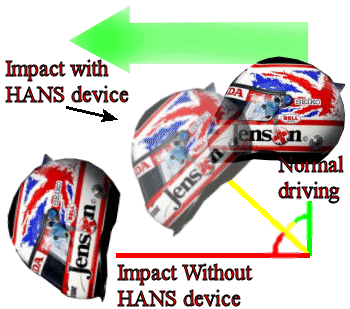
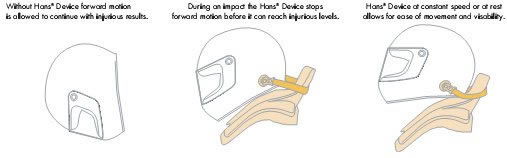
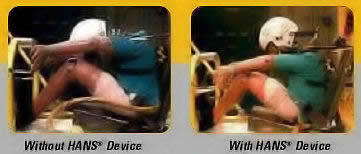
SCHROTH (one of two certified FIA suppliers) data, simulating a 50 km/h 90-degree head-on collision with a 75 kg dummy, suggests a maximum deceleration of 30 g. In a crash without HANS, the shoulder harness and seat belt restrain the driver’s torso, but only the neck restrains the head and helmet. HANS reduces the whipping action of the head and keeps the driver’s head from being pulled away from the upper body. With HANS, the forces stretching the neck in a frontal collision are typically reduced by 80%. In a frontal impact, the tethers restrain the head’s forward movement while the torso and HANS device are restrained by the shoulder harnesses. By restraining the head to move forward with the torso in a crash, excessive head motion, neck forces, and injuries are dramatically reduced.
The HANS device must be built to exact standards imposed by the FIA and SFI, and must bear one or both certification stickers from these organisations. The fact that the FIA has approved only two manufacturers underlines the complexity of a frontal-head restraint, and for a long time purchasing a HANS device was an expensive proposition.
Main Components
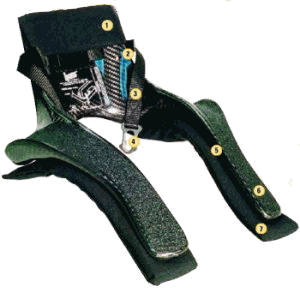
Main parts of HANS device:
1 – Head pad
2 – Collar 3 – Tether 4 – Post Catch 5 – Yoke 6 – Rubber 7 – Yoke padding
FIA Regulations
What the FIA Sporting Code (Appendix) says:
CHAPTER III - DRIVERS’ EQUIPMENT
3. Head restraint
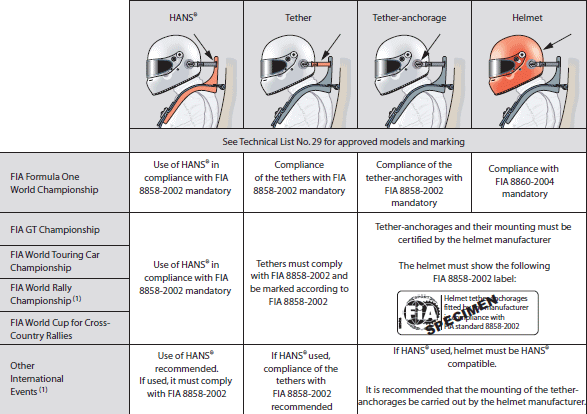
**3.1 **The wearing in an international event of any device intended to protect the head or neck and attached to the helmet is prohibited, unless the device has been homologated by the FIA and listed in
FIA Technical List n° 36.
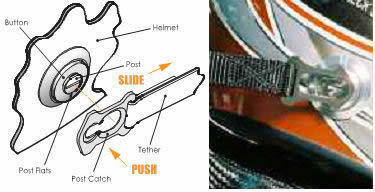
When the device used is the HANS®, it must be worn only with a compatible helmet appearing in Technical List n° 29. Drivers are strongly recommended to use helmets with tether-anchorages fitted by the manufacturer as original equipment. These helmets are identified by a glossy silver holographic FIA label as illustrated in FIA Technical List n° 29 - Figure 1.
It is also strongly recommended to use homologated tethers which are identified by an FIA 8858-2002 label sewn on them.
For more details, “Guide for the Use of HANS® in International Motor Sport”, published by the FIA Institute for Motor Sport Safety, can be found on www.fia.com, under the heading FIA Sport - Regulations - Drivers’ Equipment.
3.2 Mandatory wearing of an FIA-approved head restraint - by
championships
3.3. Future requirements concerning the obligatory use of head restraints
Wearing a head restraint approved by the FIA will be mandatory for all drivers and co-drivers in international events as follows:
all FIA championships, trophies, cups and challenges: from 1 January 2008*;
in all events entered on the FIA International Sporting Calendar: from 1 January 2009*.
- Exceptionally, the wearing of an FIA-approved head restraint system is:
a) mandatory for Thoroughbred Grand Prix and Formula 1 cars of period G and onwards where the construction of the vehicule makes it practical to do so; recommended for other historic cars;
b) mandatory, in off-road, for FIA European Championship events as follows:
Division 1 (Rallycross): from 01.01.2009
Division 1 (Autocross): from 01.01.2009
Rallycross Cup: from 01.01.2009
Division 1A (Rallycross): from 01.01.2010
Division 2 (Rallycross): from 01.01.2010
Division 3 (Autocross): from 01.01.2010;
c) not mandatory for the following categories of alternative energy vehicles: I, III, IIIA, IV, V Electric Karts, VII and VIII;
d) recommended for alternative energy vehicles in categories II, V Cars and VI with a technical passport issued before 01.01.2006;
e) not mandatory before 01.01.2009 for drivers and co-drivers competing in events of the FIA Regional Rally Championships but not registered to score points in them, although strongly
recommended;
f) not mandatory before 01.01.2009 for non-priority drivers and their co-drivers in events of the FIA World Rally Championship, but strongly recommended;
g) not mandatory before 01.01.2009 for drivers competing in events of the FIA Hill-Climb Championship, the FIA Hill- Climb Challenge or the FIA Hill-Climb Cup although strongly
recommended.
For other cars in which for technical reasons it is impracticable to fit the FIA approved head restraint, it will be possible to apply for a waiver to the FIA Safety Commission.