Gurney Flap
Definition
A flap, from an aerodynamic point of view, is a hinged or fixed device at the trailing edge of the wing, which can, in the majority of cases, be lowered to increase the lift of the wing.
|
|
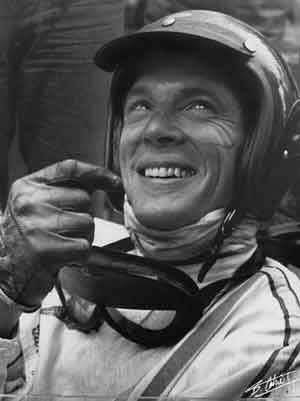
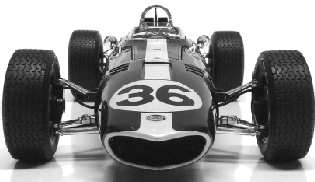
The Gurney Flap was named after Dan Gurney, who invented it. He was the driver and constructor of the Eagle F1 cars (the one in the banner of my site) and Eagle Indy cars. If you adopt this device on a single-element wing, its effect is phenomenal.This device has retained its value in a way that Chapman’s minimalist rear suspension never did. |
What Is a Gurney Flap?
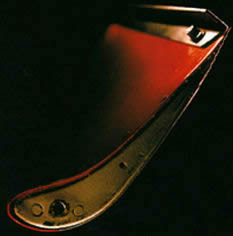
A Gurney Flap – often called simply a Gurney or a wickerbill in the United States – is not a particularly sophisticated piece of equipment. It is a simple length of aluminium or carbon fibre right-angle, rigidly bolted, riveted, or glued to a wing’s trailing edge. Its use on a racing car wing is intended to keep the car on the road by improving wing efficiency, although the Gurney Flap also sees some aircraft use.
The Apache AH-64 helicopter tail planes feature Gurney flaps, for example. The Apache actually has a couple of G-flaps (upward on the starboard wing, downward on the port wing). The G-flaps improve performance during high-powered climbs. The device is also applied to other helicopters for stabilisation purposes.
The McDonnell Douglas MD-11, a 300-seat large airliner, has this device on the full span of its main wing. The shape is not L-shaped as on racing cars, but the reason for the modification is purely structural and it works in the same way. Since its invention, the Gurney flap has been used to enhance the aerodynamic performance of subsonic and supercritical airfoils, high-lift devices, and delta wings.
Aerodynamic Effect
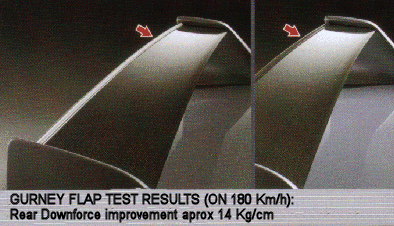
Crude as it looks, the Gurney flap serves essentially the same purpose as the complex flaps on an aircraft wing. It increases lift on aircraft or, in the case of racing cars, downforce. Wind tunnel tests showed a 30 percent downforce increase with a very small drag penalty in some extreme cases. These results could not be reproduced in all conditions, and in fact, in some situations the G-flap does give rise to a drag penalty.
Origin of the Gurney Flap
The birth of the Gurney flap, in Dan Gurney’s own words, was a classic example of necessity being the mother of invention. It happened in 1971 while Dan Gurney’s AAR (All American Racing) team was testing its new USAC car at Phoenix prior to the season’s first race. The car was too slow and everyone knew it. Towards the end of the third and last day of testing, driver Bobby Unser challenged Gurney to come up with a solution, and Gurney suggested the flap. Dr. Bob Liebeck of McDonnell Douglas was participating in this test. You may have seen his name in many aerodynamic textbooks, since he is a leading, renowned figure in the aerodynamic field. He told Gurney that he thought the flap would not work. Gurney had seen the success Richie Ginther had had experimenting with spoilers on Ferrari sports cars and wondered what would happen if a small spoiler were fitted along a wing’s trailing edge.
In about 45 minutes, the first Gurney Flap was fabricated and attached to the car’s rear wing, and Unser went out again. Within a couple of laps it was clear he was circulating no faster than before, and everyone in the pit assumed the flap was a failure. But when Unser came in, he called Gurney over and quietly asked whether anyone was around to spy on what they were doing. Once Gurney confirmed they were alone, Unser told him the rear was now so well planted that the car was understeering badly, and that was the reason for the poor lap times. All they needed to do was restore the aerodynamic balance by adding more front-end downforce and the car would be transformed.
For most of that first season, none of the other teams understood what Gurney had achieved. Anyone who asked was told that the flap was a purely structural feature to strengthen the wing’s trailing edge and prevent hand injuries when pit crew pushed the car. Taken in by this, some teams tried fitting Gurneys on the underside of the wing with predictable results: they lost lap time or worse. Eventually word got around that the Flap was an Eagle secret weapon and everybody started using it, whether they understood its function or not. And surprisingly, nobody – Gurney included – properly understood its operation at the time. As Carroll Smith observed in his book “Tune To Win”, “It was a case of monkey see, monkey do.”
Gurney, meanwhile, gained access to an old McDonnell Douglas wind tunnel to test it. Measurements on the test wing showed that fitting the Gurney Flap affected pressure across the wing’s entire upper and lower surface, increasing lift (or downforce) and reducing flow separation on the wing’s suction side. Gurney placed the patenting of the device in the hands of McDonnell Douglas, and for some years after, AAR cars carried “Pat Pend” scripts on their wings.
How It Works
This shape is very counterintuitive because it runs in the opposite direction to most aerodynamic devices, which are smoothly shaped and sharply ended. For wing profiles especially, it seems to destroy all carefully calculated sensitive shapes.
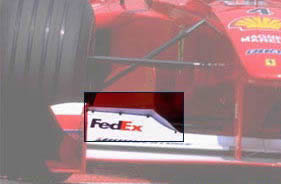
The device basically operates by increasing pressure on the pressure side of the wing, decreasing pressure on the suction side, and helping the boundary layer flow stay attached all the way to the trailing edge on the suction side of the airfoil. At the same time, a long wake downstream of the flap containing a pair of counter-rotating vortices can delay or eliminate the flow separation near the trailing edge on the upper surface (aircraft wing) or lower surface (racing car wing). Correspondingly, the total suction on the airfoil is increased.
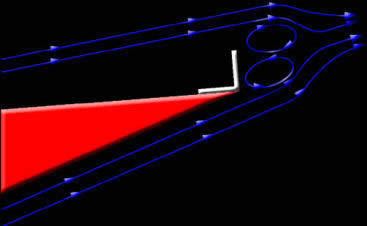
For the Gurney flap to be effective, it should be mounted at the trailing edge perpendicular to the chord line of the airfoil or wing. The flap height must be of the order of the local boundary layer thickness, typically 1% to 4% of the wing chord length.
Wing Behaviour With and Without the Flap
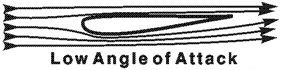
The first illustration shows a racing car wing generating downforce or negative lift as it moves through the air. The air has to accelerate to go around the lower side of the wing and loses pressure when it speeds up. Recall Bernoulli: the slower air on top is at a higher pressure and presses down on the wing surface. The force a wing produces depends on the airfoil shape, the area of the wing, and the square of its speed through the air.
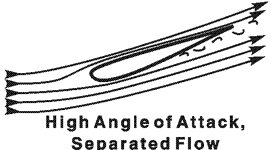
The second illustration shows a racing car wing at a high angle of attack. At high angles of attack, air is unable to follow the contour of the lower wing surface and can detach (stall), lowering the efficiency (downforce) of the wing and adding drag.
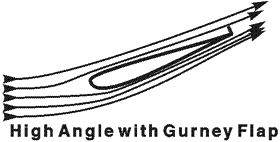
A small lip on the trailing edge, shown in the third illustration, causes a lower pressure just behind it which sucks the lower flow back up to the wing surface. The Gurney flap causes some extra drag, but the wing can be run at a higher angle of attack and produces more downforce.
Practical Use in Racing
Designers can only use a limited amount of wing on a racing car because of rules limiting the number and dimensions of wings. Sidepods and tyres get in the way and cannot simply be removed. A designer has to extract all the downforce possible from the available wing surfaces. With Gurney flaps, more downforce can be generated from the allowable wings because they can be run at higher angles of attack.
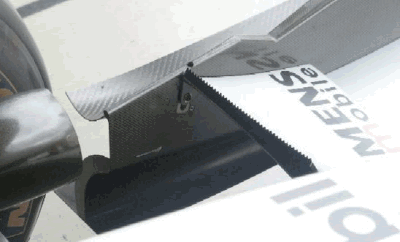
Although common in US single-seat racing, rear wing adjustments during the race are not common in F1. However, rear downforce can also be tuned via the Gurney flap. By switching the Gurney for a taller or wider strip, downforce can be increased. These strips are attached simply by adhesive tape, so are quickly removed. Fitting one is impractical during a race because it takes time. Therefore, in race conditions, teams are largely limited to removing a Gurney rather than adding one. Typically, teams will add a more powerful Gurney for a wet race; if the race dries, they will remove it. Removing a Gurney is a relatively simple process, as the strip is taped to the wing only via its leading edge. The mechanic standing behind the wing pushes the Gurney forwards and then rips it off at an angle, taking the tape with it.
Who Was Dan Gurney?
The best American road racer of his generation and the only competitor that Jim Clark truly feared, Daniel Sexton Gurney was most at home in the 1.5-litre era of the early 1960s, where his sympathy with highly fragile machinery counted for much.
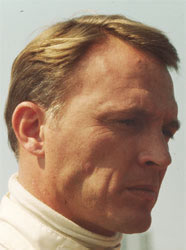
Despite winning races for Porsche and Brabham, his greatest triumph was victory in the 1967 Belgian Grand Prix in his own car, the Anglo-American Racers-run Eagle-Weslake, making him the only man to take maiden World Championship race wins for three different constructors.
Early Life
Daniel Sexton Gurney was born April 13, 1931, in Port Jefferson, Long Island, to John Gurney, a Metropolitan Opera star, and his wife Roma Sexton. Following high school, his family moved to Riverside, California. He graduated from Menlo Junior College and served two years with the United States Army, most of that time overseas in the Korean War. Young Dan quickly became immersed in the California hot rod culture. At age 19, he built and raced a car that reached 222 km/h at the Bonneville Salt Flats. He then became an amateur drag racer and sports car racer.
Career Achievements
Dan Gurney had three remarkably successful careers as a racing driver, racing car
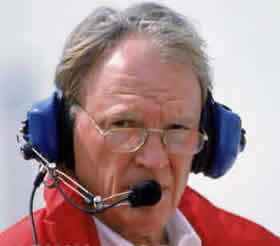
manufacturer and inventor, and long-term team owner at racing’s highest levels since 1958.
Gurney also won races in Indy Car, NASCAR, Can-Am, and Trans-Am Series. He is the first driver to win races in Formula One (1962), NASCAR (1963), and Indy Car (1967). The other two drivers to achieve this feat are Mario Andretti and Juan Pablo Montoya.
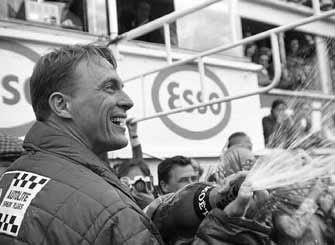
In 1967, after winning the 24 Hours of Le Mans together with A.J. Foyt, he spontaneously sprayed champagne while celebrating on the podium. Apart from starting this now-universal tradition, he also was the first to put a simple extension on the upper end of the rear wing.
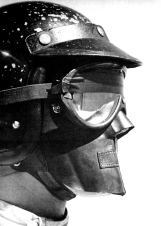 At the 1968 German Grand Prix he became the first driver ever to use a full face helmet in open-wheel Grand Prix racing.
Driving Style
Gurney was particularly noted for an exceptionally fluid driving style. On rare occasions, as when his car fell behind with minor mechanical troubles and he felt he had nothing to lose, he would abandon his classic technique and adopt a more aggressive (and riskier) style. This circumstance produced what many observers consider the finest driving performance of his career, when a punctured tyre put him nearly two laps down halfway through the 1967 Rex Mays 300 Indycar race at Riverside, California. He produced an inspired effort, made up the deficit, and won the race (with a dramatic last-lap pass of runner-up Bobby Unser).
|
Dan Gurney win Belgian GP 1968. Poster signed by him and by: JOSEPH SIFFERT, LUCIEN BIANCHI, BRUCE McLAREN, PEDRO RODRIGUEZ, JEAN-PIERRE BELTOISE and artist MICHAEL TURNER |
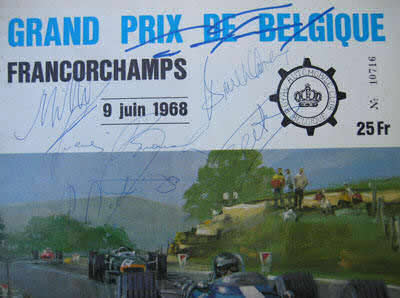
Racing Career
His racing career, which started with a Triumph TR2 in 1955, spanned 15 years. During that time he became the top road racing star in America, as well as one of the most popular F1 Grand Prix drivers. Gurney etched himself a place in racing lore with exciting battles against drivers like Stirling Moss, Jim Clark, John Surtees, Jack Brabham, Graham Hill, Phil Hill, and many others on the classic road courses of the Nurburgring, the Targa Florio, and Monte Carlo. He remains the only American to win a Formula 1 Grand Prix with a car of his own construction.
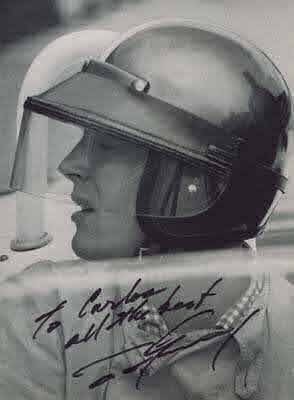
Gurney began racing in West Coast sports car events before competing at Le Mans for the first time in 1958. By 1960 he had gained a place in the works Ferrari F1 team, but it was not until 1962 that he won his first F1 race for Porsche in the French Grand Prix. Between 1963 and 1965, Gurney drove for Jack Brabham’s F1 team, consistently proving himself a match for Clark and his Lotus whilst repeatedly let down by trifling mechanical failures. With the advent of the 3-litre F1 regulations in 1966, he started his own team, Anglo American Racers, and won the 1967 Belgian Grand Prix at the wheel of the Eagle-Weslake. Underlining his versatility, Gurney also won Le Mans in 1967, sharing his 7-litre Ford with Indy 500 winner A.J. Foyt.
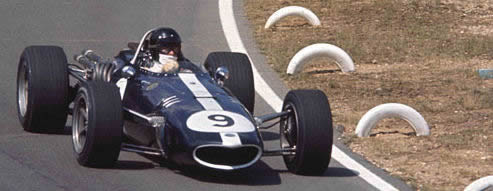
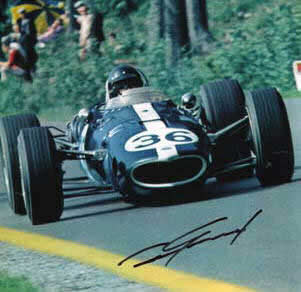
At June 18, 1967, Gurney took a historic victory in the Belgian Grand Prix. Starting in the middle of the first row, Gurney initially followed Jim Clark’s Lotus and the BRM of Jackie Stewart. A muffed start left Gurney deep in the field at the end of the first lap. Clark encountered problems on Lap 12 that dropped him down to ninth position. Having moved up to second spot, Gurney set the fastest lap of the race on Lap 19. Two laps later, he and his Eagle took the lead and came home over a minute ahead of Stewart.
The Champagne Tradition
This win came just a week after his surprise victory with A.J. Foyt at the 24 Hours of Le Mans, where Gurney spontaneously began the now-familiar winner’s tradition of spraying champagne from the podium to celebrate the unexpected win against the Ferraris and the other Ford GT40 teams. Gurney said later that he took great satisfaction in proving wrong the critics (including some members of the Ford team) who predicted the two great drivers, normally rivals, would break their car in an effort to show each other up.
|  |
From “All American Racers” web site |
Legacy and Innovations
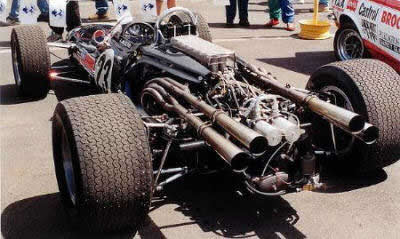
A member of various Motorsports Halls of Fame, Gurney was a pioneer of racing innovations. In 1971 he developed the Gurney Flap (wickerbill), an invention adopted by the automobile racing and aviation industries throughout the world. He was the first race car driver to introduce a full-face helmet to Indy Car racing as well as Grand Prix racing. He was instrumental in launching the rear-engine revolution in Indianapolis in 1963.
One of the original founders of Championship Auto Racing Teams (CART), Gurney came up with the name and acronym. He was instrumental in bringing Monte Carlo-type street car racing to the United States and became a co-founder of the Long Beach Grand Prix in 1974, where he continued to serve on its Board of Directors for 24 years.
Gurney was also no stranger to Hollywood. A member of the Screen Actors Guild since 1965, he appeared in such motor racing films as ‘Winning’, ‘A Man and a Woman’, and ‘Grand Prix’. His win of the ‘Cannonball Run’ across the United States in 1971 inspired his friend and co-pilot Brock Yates to write the screenplay for the ‘Cannonball Run’ movie. His long-term relationship with Toyota started in 1982 when Dan was hired by the company to do TV commercials for the introduction of the Supra. This relationship resulted in three Drivers and three Manufacturers championships for the auto maker.
Death
Dan Gurney died at noon on January 14, 2018. He passed away due to complications from pneumonia. He is survived by his second wife, Evi Butz, a former Porsche public relations executive, whom he married in 1969, and by their two sons, Justin and Alex; by three sons, Daniel Jr, John and James, and a daughter, Lyndee, from his first marriage, to Arleo Bodie; and by eight grandchildren. (Obituary from Autoweek)