Gears
|
|
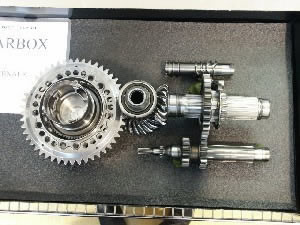
Parts of a transmission cluster | |
To know more about “shifter”, and to get the complete picture, check my article about gearbox and transmission.
Why Cars Need Gears
From the other articles on this site, the pistons drive the main crank in the engine so that it spins. The need for gear ratios in the gearbox of a car is a consequence of the characteristics of the internal combustion engine. Engines typically operate over a range of 600 to about 7000 revolutions per minute (though this varies, and is typically less for diesel engines), while the car’s wheels rotate between 0 rpm and around 1800 rpm. The crankshaft cannot simply be connected directly to the wheels because the speed is too high and too variable, and the engine would need to be stalled every time the car stops. Instead, the revolutions of the crank must be reduced to a usable value, or the engine must be disengaged from the driveshafts. This is known as gearing down – the mechanical process of using interlocking gears to reduce the number of revolutions of a spinning component.
This article first explains the basics of the gearbox and how it works in standard road cars. Racing cars have more sophisticated gearboxes, especially in Formula 1, where they are optimised for faster operation and higher forces.
|
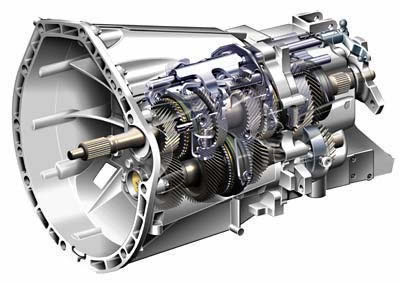
A graphic illustration of a Mercedes-Benz C-class sport coupe’s six-speed manual gearbox |
The Role of Transmission
A car’s propulsion system consists of an engine and a power transmission system, which provides controlled application of the power to the road. The most common use is in motor vehicles, where the gearbox adapts the output of the internal combustion engine to the drive wheels. Such engines need to operate at a relatively high rotational speed, which is inappropriate for starting, stopping, and slower travel. The gearbox reduces the higher engine speed to the slower wheel speed, increasing torque in the process. Gearboxes are also used on pedal bicycles, fixed machines, and anywhere else rotational speed and torque need to be adapted.
Often, a gearbox will have multiple gear ratios, or simply “gears,” with the ability to switch between them as speed varies. This switching may be done manually by the driver or automatically. In car applications, the gearbox is generally connected to the crankshaft of the engine via a clutch. The output of the gearbox is transmitted via a driveshaft to one or more differentials, which in turn drive the wheels.
Gear Ratios and Torque
Neglecting mechanical losses, gearboxes and differentials simply reduce speed according to the gearing ratio and multiply torque by the same factor. If P = w x T (where P is power in Watts, w is rotational speed in radians/sec, and T is rotational torque in Nm), and this is passed through a gearbox with a reduction ratio of 2:1, the result is P = (w/2) x (T x 2). The output moves at half the speed but can push more inertia and accelerate quicker.
It can also be appreciated that with a fixed amount of power, the lower the revs of the motor, the greater the torque.
Most modern gearboxes are used to increase torque while reducing the speed of a prime mover output shaft (such as a motor crankshaft). This means that the output shaft of a gearbox rotates at a slower rate than the input shaft, and this reduction in speed produces a mechanical advantage, causing an increase in torque.
Gearbox Layout
| [Typical 5 speed gearbox] |
Internals of a 5 speed gearbox. You can see the helical gears meshing with each other. The lower shaft in this image is called the layshaft and it’s the one connected to the engine via clutch. The output shaft is the upper shaft in this image. |
The gearbox has an input and an output. The mainshaft extends outside the case in both directions: the input shaft towards the engine, and the output shaft towards the rear axle on rear-wheel-drive cars. Front-wheel-drive cars generally have the engine and transmission mounted transversely, with the differential being part of the transmission assembly. Both shafts are suspended by the main bearings, and the mainshaft is split towards the input end. At the point of the split, a pilot bearing holds the shafts together.
Types of Transmission
Types of automobile transmissions include manual, automatic, and semi-automatic. There is always some number of gear ratios – in modern cars, from 4 to 7 – and one reverse gear ratio. The forward gears are all constant-mesh, meaning that the gear teeth for all ratios are always engaged with each other at all times. Instead of sliding a gear out of engagement with another gear, the gear is disengaged by disconnecting it from the shaft it is on. Only one gear ratio pair can be connected to the shaft at one time. The reverse gear is an actual non-constant-mesh sliding gear whose teeth actually slide out of engagement when it is not being used.
| [Reverse gear] |
Reverse gear has one extra gear involved. Typically, there will be three gears that mesh together at one point in the gearbox instead of the customary two. There will be a gear each on the layshaft and output shaft, but there will be a small gear in between called the idler gear. The inclusion of this extra gear causes the last gear on the output shaft to spin in the opposite direction to all the others. |
Synchromesh and Dog Rings
Each forward gear can be coupled to its shaft by a sliding locking coupler. This coupler connects splines on the shaft to splines on the gear. The coupler needs to be at the same speed as the gear splines to avoid grinding. When people refer to “grinding the gears,” it is actually the splines that are grinding, not the gear teeth. To synchronise the coupler with the gear splines, there is an intermediate device called a synchromesh or “dog ring.”
One of Webster’s definitions for “dog” is “Any of various devices for holding, gripping or fastening something, as one consisting of a spike or bar of metal with a ring, hook, claw or lug at the end.”
The concept of dog ring engagement can be visualised by holding both hands out with fingers spread and fingertips pointed toward each other, then moving the hands together so that the fingers slip between the fingers of the other hand. Trying to rotate one hand within the other demonstrates the principle: the fingers, or dogs, of one hand are engaged with those of the other hand – they are hooked together.
| [Dog rings] |
| [synchromesh]Synchros, synchro gears or synchromesh - all basically the same thing. A synchro is a device that allows the dog gear to come to a speed matching the helical gear before the dog teeth attempt to engage. In this way, you don't need to 'blip' the throttle and double-clutch to change gears. Synchro does this job for you. |
The synchromesh is a lightweight ring with spline teeth on one side and a conical friction surface on the other side. It is positioned between the sliding coupler and the gear splines. The gear also has a conical friction surface that mates with the surface of the synchromesh.
When a gear is to be engaged, the shift linkage selects a sliding coupler to connect to a gear. At this point, the coupler and the gear to be engaged are usually spinning at different speeds. As the coupler starts to slide, it first engages the spline teeth of the synchromesh ring. Because the synchromesh is lightweight, it can virtually instantly change speed to match the sliding coupler. It then becomes part of the coupler. As the coupler continues to slide towards the gear splines, the friction surface of the synchromesh ring is pressed into contact with the friction surface of the gear assembly. This friction causes the transmission’s input shaft (which at this point is hopefully disconnected from the engine by the clutch) to be accelerated or decelerated so that the coupler and the gear are spinning at the same speed when their spline teeth finally engage.
A synchromesh is limited in how much mass it can accelerate and how fast it can do it.
Racing Gearboxes
| [dog box] |
A true racing transmission may not have synchronizers at all. The transmission may be equipped with very strong dog rings that are simply jammed together. These are also known as crash boxes (because gears are not synchronized but crashed together), or dog boxes, and use straight-cut gears instead of helical gears. Straight-cut gears have less surface area where the gears contact each other, which means less friction, which means less loss of power. That’s why people who make racing boxes like to use them. And on many early transmissions there were no dogs to help with gear alignment, the gears themselves were simply put together - with various degrees of success and grinding depending on the expertise of the driver. racing gearboxes. |
Gear Ratios in Formula 1
Cars’ speeds are limited by the gear ratios chosen for different circumstances. A car cannot go faster than the gear ratio allows. A short gear results in higher torque but a lower top speed. A long gear results in lower torque but a higher top speed.
With that in mind, F1 engineers tune gears for each track separately. Finding the right gear ratio for an F1 car on a new track requires testing, simulation, and experience. On well-known tracks, F1 engineers use data from previous events.
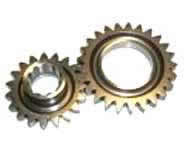
If revs are not reaching the redline at the end of the straight, the gears can be shortened until the revs just reach the redline. If the revs rise too quickly on a faster part of the track, that normally means that on the slower curvy sections there is not enough power (torque) on the wheels. Adjusting a gear ratio is always a compromise between speed and torque.
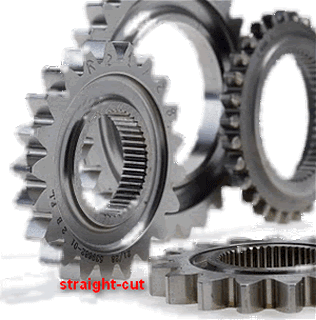
The number of teeth on mating gears determines the gear ratio. Ordinarily, the ratio is found by dividing the number of teeth on the larger gear by the number of teeth on the smaller gear or pinion. For example, if the ratio is 2 or “2 to 1,” the smaller gear or pinion makes two revolutions to one revolution of the larger mating gear.
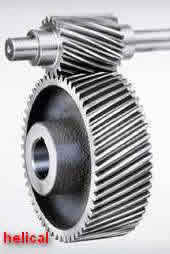
All the gears in high-performance racing cars (for track use only) are straight-cut to minimise power losses and to provide the maximum possible strength and durability; the gears of most road car gearboxes are helical, to reduce noise.
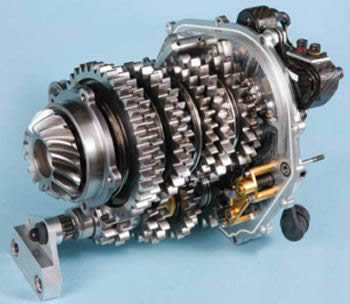
For many years it was the convention on F1 cars to locate the gear clusters behind the differential, for ease of access in order to change gear ratios, although this compromised weight distribution and aerodynamic performance. The current trend, with the gear clusters at the front end of the gearbox, means that the gearbox must be removed to change the gear ratios. The gear cluster (input shaft and output shaft) is mounted in a removable cassette, which can be removed once the gearbox/rear suspension/wing assembly has been removed from the rear of the car.
|
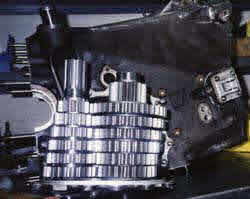
The gear clusters in Formula 1 car are mounted in a removable cassette. Much easier to work with gears, but can be removed only when the gearbox/rear suspension/wing assembly are removed from the rear of the car . |
FIA Regulations
The input shaft and output shaft each carry seven gears (the maximum allowed by FIA regulations), and each pair of gears (one on the input shaft and one on the output shaft) is carefully selected to give the required gear ratio. The FIA regulations from 2011 stipulate that each car is allowed 30 pairs of gear ratios from which to choose during the entire season, and these 30 ratios must be declared to the FIA before the first race of the season. The 2010 FIA regulations stipulated that all gears must be manufactured from steel, with a minimum weight (0.6 kg) for gear pairs, and a minimum thickness (12 mm) for each gear.
|
When reverse is selected, a solenoid operated intermediate gear (red arrow) is engaged between the input and output shafts. |
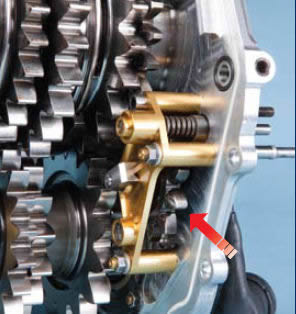
All cars must be fitted with a reverse gear to comply with the FIA regulations, and reverse is operated using a button on the steering wheel which engages an intermediate gear between the gearbox input and output shafts to reverse the direction of rotation of the output shaft.
|
|
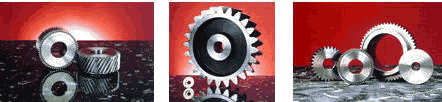
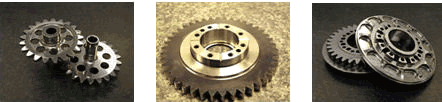
Master gears |
The Pinion
The smallest gear of a gear drivetrain is called the pinion. The pinion can be either the driving or the driven gear and is often used in cars as a differential pinion or in a rack-and-pinion steering mechanism.
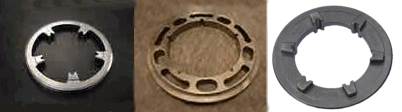 |
Different versions of dog rings |
|
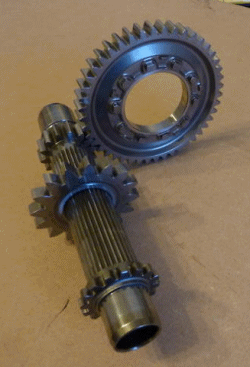
Honda F1 2007 Gear Ratio & Layshaft Assembly |
![[Typical 5 speed gearbox]](/Images/gearbox_typical.jpg)
![[Reverse gear]](/Images/gearbox_reverse_gear.jpg)
![[Dog rings]](/Images/gearbox_dog_gear_explanation.jpg)
![[synchromesh]](/Images/gearbox_synchromesh.jpg)
![[dog box]](/Images/gearbox_dogbox.jpg)
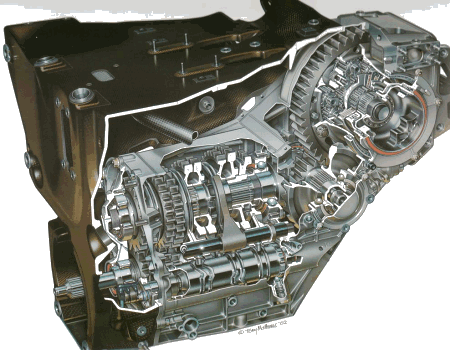
F1 gearbox used by Ferrari during season 2000
See also the Shifting Technique article.