Fuel Cell (Fuel Tank)
History and Safety
Fuel cell is simply another term for fuel tank. Historically, fuel tanks were metal containers formed to fit in any convenient space, prone to rupturing during accidents and impacts. Spilled fuel could easily cause a massive fire. Major fires in F1 cars are now thankfully rare. It’s fair to say the biggest leap in F1 safety has probably been the advent of the flexible fuel cell, which the FIA introduced as a mandatory safety bladder tank in 1970. There has been no major fuel tank fire at an F1 race since Gerhard Berger’s Imola crash in 1989 and no fire-related death since Ricardo Paletti in Canada in 1982, or in testing with Elio de Angelis in 1986.
Construction
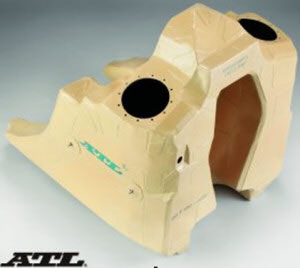
Formula 1 cars (and all other racing cars) are fitted with specially developed, flexible tanks that are practically indestructible even in an accident. From 1970, this type of aircraft-style bag tank was made mandatory to prevent ruptures, fuel spillage, and fire in case of accidents.
The fuel tanks on Formula 1 cars comprise a single puncture-proof bladder made of military-grade ballistic material Kevlar, reinforced with rubber. These must be made of materials approved by the FIA (FT5 fuel tank standard) and must be manufactured by certain FIA-approved companies.
From FIA technical regulations:
Minimum FIA Requirements for fuel cell FT5-1999 From 1/1/99:
Tensile Strength 2000 lb (8.90 KN)
Tear Strength 350 lb (1.56 KN)
Puncture Strength 400 lb (1.78 KN)
Seam Strength 2000 lb (8.90 KN)
Size and Packaging
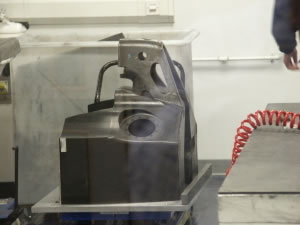
The size of a fuel tank is an important consideration during chassis design. The tank must be calculated against fuel consumption, expected average stint or race length, and aerodynamics. Since the tank is located behind the driver’s seat, it largely determines the space between the driver and the engine. The further back the sidepods and driver can be positioned, the cleaner the air onto the sidepods. It is therefore clear that for aerodynamic purposes, a tank should be as small as possible. The same logic underscores the importance of fuel economy beyond simply shortening pit stops. From 2010, Formula 1 regulations prohibit refuelling. Cars must start the race with a full fuel load of approximately 160 litres.
Location and Safety Requirements
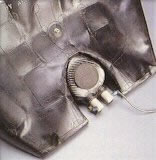
The tank must be situated directly behind the driver and directly ahead of the engine. All fuel lines must be equipped with self-sealing breakaway (dry-break) fuel couplings (introduced in the FIA rule book in 1970) in case the engine and chassis become separated in an accident, so fuel cannot leak from a broken hose. No fuel lines may pass through the cockpit. The fuel cell cannot extend more than 400 mm from the car’s centreline, so tanks are limited to 800 mm wide. Teams also want the fuel as close to the ground as possible, so the monocoque shape is modified to achieve the design capacity within the length and width constraints. Teams must consider packaging for the engine oil tank at the rear of the monocoque, the Accident Data Recorder mounted toward the front of the tank area, and the KERS batteries commonly mounted under the fuel tank area.
Fuel temperature is also a major concern. Fuel is heated by conduction and radiation from the rest of the car – the exhausts, the engine, hot lubricant oil lines, and so on. Higher fuel temperature reduces engine performance and makes the fuel more difficult for the lift pumps to handle. Developments to overcome these challenges include changes in car design to reduce heat transfer to the fuel.
The fuel tank must be encased within a crushable structure that forms part of the car’s safety cell. This structure must withstand very high impact loads as specified in the regulations. A specific crash test is performed on the bottom side of the fuel cell.
Before 2010, for refuelling during a race, teams used identical rigs supplied by one FIA-approved manufacturer. During the refuelling era, the refuelling rate was limited to 12.1 litres per second for safety reasons. Today, without refuelling, tank capacity exceeds 160 litres.
Internal Systems
The outer skin is relatively simple. The critical systems are hidden inside. There are two primary systems that need to be packaged: the baffles and the fuel pump system.
As well as controlling fuel slosh and housing the fuel pumps, there is also the matter of internal venting, so that the fuel fills and drains the tank without causing pressure variations.
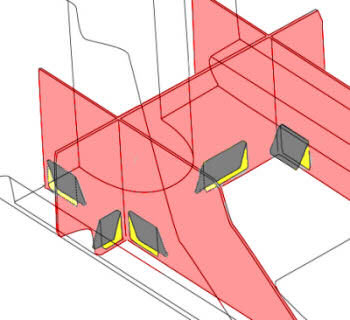
|
One way trap-doors allow the fuel to move from one compartment to the next but not back. You can see simplified arangement of the trap doors inside the bladder on picture above. |

Fuel Slosh and Baffles
During the race, fuel tends to move around in all directions due to the forces created by the moving car and high g-forces. This “fuel slosh” creates two problems. First, the weight of the fuel alters the balance of the car. Second, the fuel needs to be directed toward the fuel pump area to ensure constant delivery to the engine. Teams therefore design baffle systems within the tank to damp out fuel movement and direct it toward the final compartment where the fuel pumps are located.
Baffles are fitted in vertical, lateral, and horizontal planes. Vertical baffles control fuel slosh during turns, lateral baffles control movement under acceleration or braking, and horizontal baffles prevent fuel rising upwards during vertical g-forces. Baffles also direct fuel into one compartment to be collected by the fuel pump system. They feature precision-engineered one-way trap-doors that allow fuel to flow from one compartment to the next but not back. Fuel flows down the horizontal and vertical baffles toward the rear of the tank.
Fuel Delivery System
In the final collecting compartment, the fuel system picks up almost all of the fuel remaining at the end of the race. Inside this last compartment, three or four lifter fuel pumps pick up the fuel and send it to a carbon fibre fuel collector tank at a pressure of about 1 bar. This collector tank is fitted inside the cell itself, holds around 2.5 kg or 3 litres of fuel, and contains enough fuel to feed the main pump continuously even if supply from the lift pumps becomes intermittent at low fuel levels – particularly important given that an engine running at full revs will need up to 3.5 litres per minute. That represents enough fuel to feed the engine for 30 to 40 seconds or more.
From the collector tank, fuel is picked up by a precision high-pressure main fuel pump and delivered to the car’s engine fuel system at a maximum pressure of 100 bar. This entirely mechanically driven fuel pump delivers fuel to the injectors and must be protected by a fine filter at the entry. The pump delivers fuel flow fundamentally proportional to engine RPM. Fuel consumed by the engine is also approximately proportional to RPM at full throttle, but at closed throttle the engine uses no fuel. To match fuel supply to demand, the main pump has a variable displacement mechanism actuated by a sophisticated pressure-regulating device.
| Courtesy of Sauber F1 team, published on their own Google+ stream:CFD simulation of 40kg of fuel fuel slosh trough Ascari chicane, Monza |

Fuel Injection
After passing through the pump and a final filter in the fuel rail, the fuel is delivered to the injectors at high pressure. Technical regulations forbid a pressure higher than 100 bar.
The injectors are precision electro-mechanical solenoid valves controlled by the SECU (Standard Electronic Control Unit). Fuel is delivered when the solenoid is energised, injecting it at high pressure into the intake air at precisely the right instant in the engine cycle to achieve optimum cylinder filling and mixture preparation. At 18,000 RPM – before the limiter engages – the fuel injector fires once every 6.6 ms for a duration of 2.7 ms at full throttle. The fuel delivered per injection event is 0.049 cc. However, total fuel consumption at full throttle under these conditions is between 3.5 and 4 litres per minute depending on ambient conditions.
ATL (Aero Tec Laboratories)

ATL (Aero Tec Laboratories) is the sole FIA-approved Kevlar-reinforced fuel cell manufacturer, and all F1 teams use products from this company. ATL’s Racing Fuel Cell Division was founded over 30 years ago. Today, ATL’s advanced coated fabrics are considered state-of-the-art equipment and are used by every Formula 1 team and most other top racing teams worldwide.