
Fuel
The Role of Fuel in F1’s Future
The future of Formula 1, and motorsport generally, depends on how the sport adapts to environmental needs. Fossil fuels will not last forever, and the sport’s public image must be one of leading the way in environmental initiatives – which it is certainly doing, in my opinion. Racing does not have to be detrimental to the environment – it is all about how the cars are fuelled. This encompasses more efficient use of fossil fuels, the transition to alternative fuels, and hybrid KERS and ERS electric systems.
Fuel and Performance
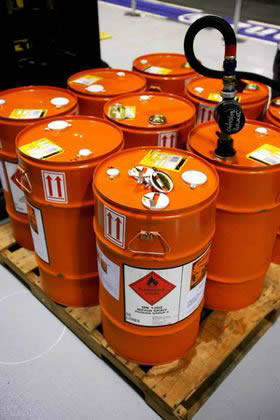
A common misconception about Formula 1 is that on-track performance is solely a function of power. In fact, performance comes from a number of different sources, and one of those is fuel consumption. If fuel consumption can be lowered while maintaining the same performance, the car’s efficiency improves. Achieving this in Formula 1 means less fuel needs to be carried, reducing overall weight and improving performance. For this reason, teams have a close working relationship with fuel suppliers, especially since the ban on refuelling in 2010, which means cars must carry enough fuel to last the entire race distance. Suppliers therefore focus all their efforts on producing fuels that achieve high efficiency per unit of mass. The benefits learned in Formula 1 are transferred directly to commercial products.
One way to achieve maximum performance from the least fuel is to blend the fuel with certain additives that help reduce friction on the pistons. Additives also help clean the engine, avoid deposits in the combustion chamber, and minimise friction, all of which lead to reduced fuel consumption. The same additives developed for Formula 1 fuel are used in commercial fuel for road cars.
Regulations History
Formula 1 fuel has been strictly regulated since 1996, when the FIA imposed unleaded fuel that had to meet the Euro 95 standard applied to pump fuel for normal road cars. Prior to this, Formula 1 had used leaded fuel and chemical additives with very high octane ratings for maximum power. Since specifying the use of pump fuel, the FIA’s focus for evolving fuel regulations has been environmental. Formula 1 has consistently operated ahead of standards in force for production cars: in 1999, fuel already conformed to production standards for 2000; in 2001, fuel met 2005 standards; and since 2004, fuel has met production standards that became applicable in 2009.
Recent regulations have introduced a percentage of biofuel, such as ethanol, which is highly relevant to the car industry because European law now requires that commercial fuel also includes a percentage of biofuel.
Composition and Blending
The fuel used in F1 cars is fairly similar to ordinary petrol, albeit with a far more tightly controlled blend. Formula 1 fuel cannot contain compounds not found in commercial petrol, in contrast to the alcohol-based fuels used in American open-wheel racing. Blends are tuned for maximum performance in given weather conditions or for different circuits. One key difference between regular petrol and the racing fuel provided to teams is that although both are blended using the same base fuel chemistries, the racing fuel is highly optimised and fine-tuned for use in a specific Formula 1 car. The best fuel for the Ferrari F1 engine might not necessarily be the best for the Cosworth engine, and vice versa. Each blend is tailored to provide optimum performance for a specific race engine.
Historical Fuel Strategies
During the first no-refuelling period from 1984 to 1994, when teams were limited to a specific volume of fuel during a race (250 litres), exotic high-density fuel blends were used that were actually heavier than water, since the energy content of a fuel depends on its mass density.
FIA Testing and Compliance
To ensure that teams and fuel suppliers are not violating fuel regulations, the FIA requires Elf, Shell, Mobil, Total, and other fuel suppliers to submit a sample of the fuel they are providing for a race. At any time, FIA inspectors can request a sample from the fuelling rig or car fuel cell to compare the “fingerprint” of the race fuel with what was submitted. For this test the FIA uses a Gas Chromatograph instrument. This is a type of instrument used in forensic and drug testing. A 5-microlitre sample is injected into the instrument, producing a fuel fingerprint. The instrument is so precise it can detect one part per million, though only one part per thousand is required for legality testing.
Teams usually abide by this rule, but in 1997, Mika Hakkinen was stripped of his third-place finish at Spa-Francorchamps after the FIA determined that his fuel did not match the correct formula. Similarly, in 1976, both McLaren and Penske cars were forced to the rear of the Italian Grand Prix grid after the octane mixture was found to be too high.
Fuel Efficiency Strategies
F1 fuel blenders can adjust the fuel to give better consumption, so any help that lightens the fuel load at the start provides an advantage. The challenge in fuel formulation is finding the optimised balance of a range of performance parameters. Optimising for power is a priority, but doing so at the cost of fuel efficiency would be counterproductive. There are two types of fuel efficiency: volumetric fuel efficiency (where the fuel is designed for best performance based on volume) and gravimetric fuel efficiency (where the fuel is designed for best performance based on mass).
At certain circuits where tank capacity is marginal, maximising power and volumetric fuel efficiency is key. At other circuits where the fuel tank is not a constraint, gravimetric fuel efficiency (reducing the weight of the system) along with power becomes most important. Teams and fuel suppliers carry out extensive modelling and engine testing with candidate racing fuels to select the best overall fuel for each circuit.
The fuel must always match the sample given by the fuel company to the FIA, but the sample can be changed at any time provided a new blend is submitted ahead of the race weekend and approved for use. However, teams must be careful – fuel can be contaminated by something as minor as grease on a glove, which is enough to fail the FIA test.
To know more about fuel and internal combustion engine thermal efficiency, check my article here, and to know more about the fuel cell and fuel system, check here.
Race Fuel Calculations
Now, with no refuelling during the race, engineers have to calculate the precise amount of fuel to carry for the full race distance. Too much fuel and you lose too much time carrying unnecessary weight around. Not enough fuel and, well…!
Fuel calculations per kilometre of the race are established dating back to pre-season testing, and the engine engineers monitor consumption closely throughout the season. The process works as follows: the race engineer informs the engine engineer how many laps will be run – for example, two single-lap runs in Q3 or 55 laps in the race. The engine engineer then calculates the required fuel, and that amount is loaded into the car.
Shell V-Power Test at Fiorano
On 5 August 2011, Ferrari and their partner Shell carried out a fascinating experiment at Fiorano, comparing Shell V-Power road car fuel with Ferrari’s race fuel in an F1 car.
The FIA regulations stipulate that Formula 1 race fuels must be composed of compounds normally found in commercial fuels, but there are some tightly controlled areas where innovation with additives is permitted for more power or temperature control.
Fernando Alonso performed the comparison test with a 2009 Ferrari F1 car (a two-year-old car is permitted for testing under FIA rules). He drove four laps using the race fuel, setting a fastest lap of 1:03.950. He then did a similar-length run on the road car fuel and was nine-tenths slower. The race fuel was notably superior in pick-up and acceleration, but the road fuel was surprisingly faster in top speed at the end of the straight.
2022 Sustainable Fuel Regulations
For the 2022 engine rules, Formula 1 made the move to more sustainable fuel as part of the sport’s environmental strategy. The new E10 fuel is a mix of fossil fuel and ethanol at a 90/10 ratio. The ethanol must be a second-generation biofuel made sustainably, meaning it has a near-zero carbon footprint. Previous regulations saw cars running on fuel containing 5.75% bio-components.
With E10 fuel, the available power and energy per unit of weight are reduced – a characteristic of alcohol fuels. Engine power output decreases accordingly. On the other hand, abnormal combustion (knocking) associated with the previous fuel is easier to control with E10.
Some manufacturers have played down this effect, suggesting they have found ways to compensate for the lost power.