FRIC
Front to Rear Interlinked Suspension
Introduction
Every year in Formula One there is a new development that one team introduces and is touted as a game changer. All teams complain about the legality of such a device, but eventually end up copying it. Formula One is always ripe with innovation. In 2008 Ferrari brought a nose cone with a hole, in 2009 Brawn GP had the double diffuser, in 2010 McLaren had the F-Duct, 2011 saw Red Bull pioneer and perfect exhaust blown diffusers, and 2012 brought the Coanda exhaust. In 2012 Mercedes introduced the Double DRS.
One area that piqued particular curiosity during 2013 was the complex interlinked suspension, named “FRIC” by the media, which helped the Lotus E21 and Mercedes W04 reach competitiveness. The system was first introduced by Mercedes in 2011, and for two years they worked to perfect the mechanism. Lotus caught up soon after, and other teams began trying similar solutions. During the 2013 Chinese GP, the Marussia F1 Team also introduced this system.
The Problem FRIC Solves
When a car drives on track, it goes through a number of movements. It pitches under braking, it rolls on turn-in to the corner and on corner exit. There are significant changes in terms of stability and ride height, and a considerable amount of downforce is lost as a result. If the car could be made more stable through those changing dynamics and the ride height could be fixed through those manoeuvres, aerodynamic performance would improve dramatically. Many innovations like FRIC are designed to produce a stable ride height through a manoeuvre, optimise aerodynamics, and maintain downforce.
The FRIC, or “Front and Rear Inter-Connected” suspension, is a system that links the front and rear suspension of the car using hydraulics. It aims to provide better stability and drivability for the driver – a so-called stable and consistent aerodynamic platform.
How the System Works
There are various theories as to how the Lotus and Mercedes systems looked and worked, because unlike an F-Duct wing or a Coanda exhaust, the FRIC system is hard to see as it is completely internal. The basic principle behind FRIC suspension is to keep all four corners of the car at a constant ride height under braking, acceleration, and during cornering.
The only difference between the FRIC system and the Williams FW14 and FW14B electronically controlled active suspension of the early 1990s is that the FRIC system is totally passive and not controlled by any electronics. The Mercedes concept is inertia-based and does not use electrical or mechanical input from the driver to work, making it perfectly legal and within the FIA technical regulations.
Teams had been using interlinked suspension for a number of years to control either roll or heave, or in the case of Mercedes both simultaneously, which allowed them to control pitch. Ferrari were one of several teams to run a cable-based system in the 1970s.
Advantages of the System
The advantages of running such systems lie in helping with mechanical grip and aiding a consistent and stable aerodynamic platform. Ideally, engineers want a softly sprung car, but this cannot be achieved because it compromises the aerodynamics too much. Aerodynamicists argue that given a stiff car (a rigid aero platform), they can create enough downforce that the suspension becomes irrelevant, with the forces acting on it regulating the driver’s ability to corner as the car is effectively sucked to the ground. But the platform must maintain a constant ride height within millimetres.
Active suspension created this bridge in the late 1980s and early 1990s, with the driver given a more consistent platform as the computers fought the car’s tendency to pitch or roll. The interlinked suspensions of today achieve a similar result passively through the use of hydraulics. The system helps generate more underbody downforce by providing a degree of control over how the car changes attitude at speed when downforce is increasing. It also allows some degree of ride height/rake control when the car is braking.
Historical Precedents
| 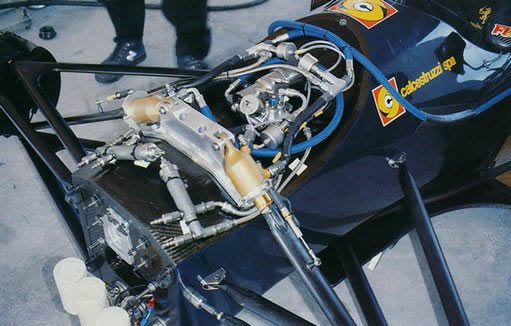 |
The Minardi FRIC system introduced on Minardi M193 |
Nothing is truly new in F1. Twenty years before (1993), when active suspension rapidly gained popularity, Gabriele Tredozi (former Minardi and Scuderia Toro Rosso engineer) and Aldo Costa (former Minardi, Ferrari, and later Mercedes AMG engineer) at the Minardi Formula 1 team created their own passive suspension system for Luigi Martini’s and Fittipaldi’s M193. It was equipped with a passive hydraulic system. An external pump pressurised the system, but the car also retained traditional suspension. The system worked on the dampers controlled by hydraulic lines with a strut that sent the circuit under pressure. They then made the system fully active by adding electronic control, ready for use the following year. Unfortunately, the FIA banned the system, leaving them with very advanced but unusable suspension. However, the next year they continued to use it without the active element.
The goal was to minimise variations in height between the front and rear during braking and acceleration. To passively manage pitching of the car, they used cross-connected links of the front axle with the rear. When the vehicle was under braking, the front actuator created a vacuum at the back, occupied by oil from the rear, so the rear also compressed to the ground. This kept the height difference unchanged. The cross-connection also helped in corners. When the load was greater on the outside rear wheel, it intervened on the inside front wheel, limiting body roll.
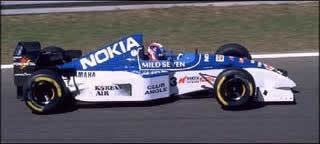
Tyrrell introduced its unique “Hydrolink” Suspension System as a key feature of the Tyrrell Yamaha 023 Grand Prix car. The Tyrrell Yamaha 023, created by the design team headed by Dr Harvey Postlethwaite, was packed with innovations seeking to revive the team’s fortunes after its highly promising 1994 season. The new Hydrolink System was developed with the assistance of Fondmetal Technologies to enhance mechanical grip and restore some of the performance benefits enjoyed by Formula 1 cars fitted with the sophisticated computer-controlled active suspension systems in 1992-93.
The chief advantage of the system was the way it allowed independent control of the suspension’s bump and roll characteristics, enabling the car’s handling to be adapted to individual tracks with great precision. The system offered substantial theoretical benefits, but these were not realised on track, where the cars proved very nervous and difficult to drive. The team started the season in strong form with new signing Mika Salo driving as high as third place in Brazil. When the teams reached the first European Grand Prix at Imola, it became evident that the new chassis suffered from handling problems. Ultimately, the system could not make a great car out of an average one, and the team returned to conventional suspension for the second half of the season.
Technical Detail
So, let’s take a deeper look into the working of the FRIC suspension.
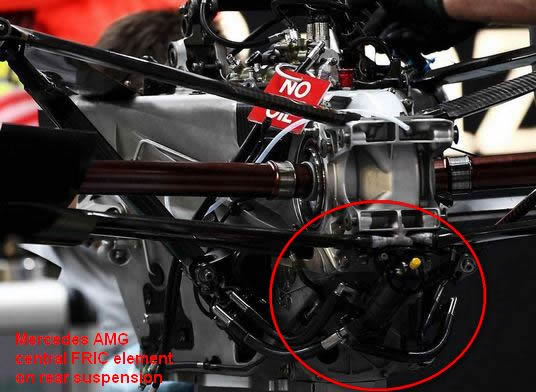
Well, it’s an area that is difficult to explain in its entirety with images because the teams hide it, with most of the system being enclosed under bodywork. But in a rare shot of the rear end of the Mercedes W02, we can see how the team is hydraulically linking both sides of the suspension.
When a car goes through a corner it undergoes a number of movements: it pitches under braking, it rolls on turn-in and on corner exit. There are significant changes in terms of stability and ride height, and a substantial amount of downforce is lost as a result of constantly changing ride height.
With rake being increasingly important to the aerodynamic setup, this generation of F1 cars is very sensitive to roll and pitch, so anything that can minimise the roll angle is a significant advantage. The challenge for the aerodynamicist is to assess the trade-offs between downforce and smoothing out the ride. Much of the work that goes on at F1 tracks in the build-up to a race focuses on getting a good compromise. Essentially, the engineers are trying to maintain a static ride height as the car pitches and rolls through corners.
Controlling Heave, Pitch, and Roll
The FRIC suspension controls the heave, pitch, and roll of the car. Heave is when the car moves up and down vertically, typically caused by aerodynamics compressing the suspension at speed. When this occurs at just one end of the car, it is known as pitch. Pitch occurs when the car’s nose dives under braking as weight transfers forward, or when the nose lifts under acceleration as weight shifts rearward. Roll is when the car corners and weight transfers in the opposite direction of the turn.
All of these effects take grip away from the unloaded tyres. More crucially, all of these effects move the car’s aerodynamic undertray away from its ideal attitude to the track. The front wing, floor, and diffuser become less efficient when the car pitches and rolls.
On a conventionally suspended car, the parts controlling these movements are purely mechanical. Each end of the car may have springs and a damper for each wheel, then elements linking each side left-to-right, such as heave elements with a third spring, an anti-roll bar, a roll damper, and sometimes an inerter.
The FRIC system links the front and rear suspension hydraulically and can be adjusted in a similar way to the brake balance. It also connects the left and right suspensions, acting like an anti-roll bar to help maintain a constant ride height and aerodynamic balance. The system has been dubbed “FRIC” by the German press, though it is not clear if this is the team’s own term. It is something of a misnomer, as the simpler Renault-style systems are front-to-rear connected only. The Mercedes system links all four corners of the car, controlling roll and pitch not just individually but combining the effect when the car is in both roll and pitch simultaneously.
Hydraulic Operation
Conventional individual wheel dampers displace hydraulic fluid as the suspension moves, creating higher pressure in one end of the damper and lower pressure in the other. To act as a damper, valves in the damper piston control the rate at which the fluid moves between the two chambers to create the damping effect.
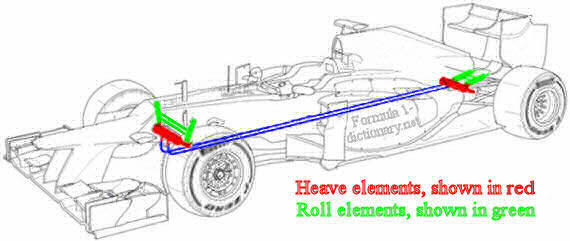
In concept and layout the FRIC system is straightforward. At each end of the car there are three hydraulic elements: a pair of elements attached to each pull/pushrod rocker to control roll, and a centre element linked to both rockers to control pitch. The heave elements, shown in red, link front-to-rear to control dive under braking. The roll elements, shown in green, link side-to-side for anti-roll. Each of these elements is linked left to right and front to rear.
In the FRIC, the fluid is displaced not from one chamber to another, but via pipes through a valve block and into the opposite hydraulic unit. How the upper and lower chambers are interconnected left to right makes the system react differently to inputs from the suspension – either resistance to roll or heave.
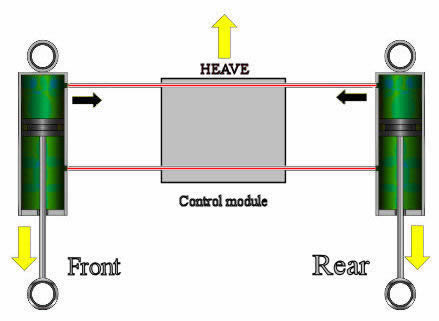
When the car brakes (in heave), weight shifts forwards, the front suspension compresses, and the rear rises. Pressure builds up in one side of the centre element on the front suspension, and this pressure in the hydraulic fluid is transferred to the rear centre element.
This increases the spring effect at the front and reduces it at the rear, which means the car will not dive nose-down under braking.
When the car is in heave, both upper chambers create high pressure. This creates resistance between the two systems wanting to displace their fluid, with the effect of increasing the car’s heave stiffness. The car’s ride height remains more consistent for better control of the front wing and diffuser aerodynamics.
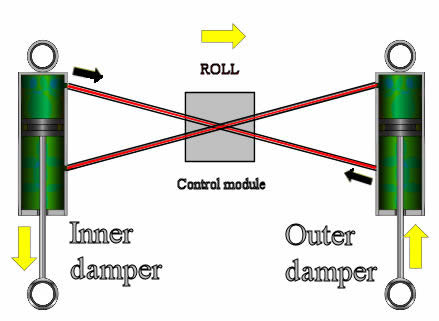
When the car rolls in a corner, the outer hydraulic elements compress and the inner elements rise. With the same effect as when the centre element is in pitch, the hydraulic fluid is transferred from one side to the other to increase the spring effect, preventing the car from rolling. The upper chamber on one side and the lower chamber on the other side create high pressure. As these chambers are cross-connected to the high-pressure chambers on their opposite side, this creates resistance between the two systems wanting to displace their fluid, with the effect of increasing the car’s roll stiffness.
Additional Benefits and Complexity
Another benefit of the FRIC is that teams can run the cars very low and with very high downforce levels. As the pitch and roll movements of the car are minimised, the tyres face lesser loads, and thus the system also aids tyre management. With the FRIC suspension, the cars can be run with stiffer suspension without compromising overall driving comfort. It indirectly aids the overall aerodynamics and gives the driver more comfort and drivability.
Although outwardly simple, the system has far more complexity in its details. As described, it would not work well, since the suspension would be very stiff at low speeds. For that reason, a gas spring is incorporated in the system, and this spring can be locked out at certain speeds. This gives the driver the benefit of soft suspension at low speed while retaining the jacking effect at higher speed.
It is not a foolproof system by any means, even with Mercedes having utilised their version for around three years. The system needs to incorporate flow control valves to provide the spring and damper effect of conventional suspension. Accumulators are needed to account for the change in volume of fluid in the system when the temperature varies.
Perhaps the biggest complexity arises when the team starts to link the roll and pitch circuits together. The system could be used simply to control pitch and roll separately, but the car is rarely in just one of these modes. Under heavy braking into a slow corner, the car will pitch from the braking and then roll as the steering is turned – this mode is known as warp. In this condition, pitch control should be strong to prevent dive, but a little roll is desirable to induce some mechanical grip.
If the pipework linking the centre elements could switch a valve to reduce the fluid transfer in the roll hydraulics, warp stiffness could be tuned for slow corners. Conversely, the roll control in fast turns when braking is lighter can be set to a stiffer setting for more aerodynamic control, which is critical in high-speed corners. With this sort of interconnectivity, many different modes could be designed into the system’s valving. As long as the valve switching is created by pressure differentials in the system, it is legal.
The hydraulic system takes considerable time to set up for each track. Mercedes appeared to have spent some difficult years setting up its FRIC system, and its pace in 2013 was probably as much to do with improved aerodynamics as getting the FRIC system properly tuned. Reports indicated that it took days at the Barcelona test to get the system right, and it would be difficult at a normal weekend of three one-hour practice sessions to tune it perfectly. But with increasing experience during the season, things improved steadily.
Ross Brawn has been quoted as saying that since Formula One cars were invented and aerodynamics understood, the relationship between suspension and aerodynamics has always been a compromise. Essentially, the FRIC allows this compromise to be reduced, allowing for chassis compliance while also ensuring a predictable aerodynamic platform.
The Ban
An FIA technical directive was issued to the teams following the 2014 British Grand Prix warning that cars running FRIC systems could be reported to the stewards, though it stated FRIC would remain on the cars until the end of 2014 if teams agreed unanimously. One can presume that Mercedes had a bigger advantage than others from this system, and so the other teams wished to stop it.
FIA’s Charlie Whiting concluded that FRIC systems help control the pitch and roll of the car under braking and cornering, maintaining ride height for aerodynamic advantage and thereby controlling the aerodynamic platform. The FIA rules (Article 3.15 of the FIA Technical Regulations) on the matter are deliberately vague, stating that any specific part of the car influencing its aerodynamic performance must remain immobile in relation to the sprung part of the car. The FIA concluded, after analysing the current systems, that they had evolved so much that the hydraulic system was now helping to control aerodynamic performance. FRIC enabled cars to run softer suspension settings and lower ride heights, which ultimately meant they produced more downforce.
It was regrettable that the sport found a way to change rules mid-way through the season, as it did with the ban on exhaust blowing a few years earlier, or Michelin’s wide contact patch tyres, or mass dampers. Teams again had to invest significant sums to develop a suspension without FRIC.
As most teams had some version of the FRIC suspension, the relative difference in performance between them when it was removed was negligible. These teams are made up of very intelligent people: given time to find solutions, they will. The real impact was on tyre wear.
Formal Outlawing for 2015
While not on the scale of the 2014 shake-up, a number of new regulations came into effect for the 2015 season. Of relevance here is the new suspension rule: for 2015, Front-and-Rear Interconnected Suspension (FRIC) was formally outlawed.
The relevant rule change banning the FRIC system is as follows:
**10.1 Sprung suspension :
**10.1.1 Cars must be fitted with sprung suspension.
10.1.2 Any suspension system fitted to the front wheels must be so arranged that its response results only from changes in load applied to the front wheels.
10.1.3 Any suspension system fitted to the rear wheels must be so arranged that its response results only from changes in load applied to the rear wheels.