FIA
Origins and Purpose
La Federation Internationale de l’Automobile, commonly referred to as the FIA, is a non-profit association established as the Association Internationale des Automobile Clubs Reconnus (AIACR) on 20 June 1904 – 46 years before the first championship F1 race was held, and around the time that the world’s first motor races were taking place. Given that road cars had only gone into production at the end of the 1800s, there was a need for an organisation to govern not only motorsport but also the emerging motoring industry. The FIA was born to represent the interests of motoring organisations and motor car users.
To the general public, the FIA is mostly known as the governing body for motor racing events.
Structure and Membership
Headquartered at 8, Place de la Concorde, Paris, the FIA consists of 213 national member organisations in 125 countries worldwide.
As is the case with football’s FIFA, the FIA is generally known by its French name and acronym, even in English-speaking countries, but is occasionally rendered as International Automobile Federation.
In 1922, the FIA delegated the organisation of automobile racing to the Commission Sportive Internationale (CSI), an autonomous committee that later became the Federation Internationale du Sport Automobile (FISA). A restructuring of the FIA in 1993 led to the disappearance of FISA, placing motor racing under the direct management of the FIA. Today, the federation represents 227 national motorsport and motoring organisations from 132 countries, including the world’s biggest group, the American Automobile Association (AAA). The AAA alone has over 50 million members, and in total, FIA clubs represent well over 100 million motorists and their families.
Influence and Activities
Through the years, the federation has used its position and power to wield considerable influence on consumers and car manufacturers alike by developing initiatives such as the Euro NCAP rating system, which has become the de facto standard for judging the safety of road cars.
In a sporting sense, the FIA operates like other governing bodies. In every country where it operates, it has a member that holds the national sporting power necessary to sanction motor races. It also works with marshals and stewards at events to ensure standards are maintained.
Governance
Any general problems of FIA policy are dealt with by its senate, which comprises a team of 10 members drawn from the federation’s clubs and management. Sporting matters are resolved by the World Motor Sport Council, a 26-member board whose members all come from within the sport and are presided over by the President. The external experts who handle disputes at the FIA work for its International Court of Appeal (ICA), which hears challenges to World Council decisions.
All FIA members normally meet once a year at a General Assembly, and the cost for entertaining hundreds of members comes to around $150,000. Decisions are made there on overarching matters for motorsport or the federation, such as approving the F1 calendar. Since the FIA is a non-profit making organisation, it needs to show a revenue for every cost but does not need to file accounts.
Finances
F1’s industry monitor, Formula Money, estimates that for a sport which has billions of dollars poured into it, the FIA gets by on relatively modest revenues.
The FIA has two branches – FIA France and FIA Switzerland – with the former receiving revenues from sporting activities and the latter carrying the majority of the federation’s personnel costs. According to Formula Money, the FIA’s total operating income comes to around $65 million, with expenses matching this. One of its biggest costs is the combined total of approximately $25 million spent on personnel, travel, and entertainment. The President’s position is unpaid.
The FIA’s revenue generally comes from member club subscriptions, registration and entry fees for racing series, and annual fees from motorsport commercial rights holders. F1 provides a relatively small amount of this.
The commercial rights to F1 bring the FIA around $10 million annually due to a deal struck with F1’s boss Bernie Ecclestone in 1995. The rights are ultimately owned by the FIA, but prior to 1995, the federation handed them to the teams and received a 30% share. Ecclestone negotiated the sale of the rights on behalf of the teams, but the deal with the FIA saw the rights handed directly to his company Formula One Management (FOM) until 2010. F1 also brings around $5.5 million to the FIA from registration and entry fees as well as the cost of drivers’ super licences. This put the FIA’s total take from the sport at around $15.5 million. In contrast, the commercial rights fees and registration income from World Rally as well as all other series, such as GT3 and World Touring Car, came to around $22.5 million.
The FIA’s decisions are not always liked by F1’s participants and the media, but that is inevitable given its position of power over many competing interests. The irony is that while the FIA’s ultimate power is perhaps its biggest strength, it also makes it an easy target for criticism.
Organisational Structure
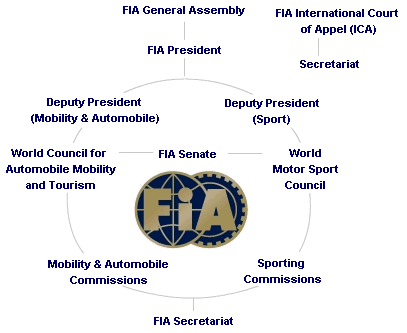
The FIA General Assembly is the federation’s supreme governing body, consisting of the presidents of the FIA’s numerous member clubs.
The head of the FIA and chairman of the General Assembly is the President. The President is elected to a four-year term by the FIA General Assembly and, from October 2005 onward, is not permitted to serve more than two terms. The current President, Jean Todt, took office in 2009.
To learn more about Formula 1 authorities and rule-makers, see the article on administrative forces.
FIA Technical and Sporting Regulations
2.1 Role of the FIA:
The following technical regulations for Formula One cars are issued by the FIA.
The FIA will organise the FIA Formula One World Championship (the Championship) which is the property of the FIA and comprises two titles of World Champion, one for drivers and one for constructors. It consists of the Formula One Grand Prix races which are included in the Formula One calendar and in respect of which the ASNs
and organizers have signed the organization agreement set out in Appendix 4.
All the participating parties (FIA, ASNs, organizers, competitors and circuits) undertake to apply as well as observe the rules governing the Championship and must hold FIA Super Licences which are issued to drivers, competitors, officials, organisers and circuits.
2.2 The Championship and each of its Events is governed by the FIA in accordance with the Regulations.
Event means any event entered into the FIA Formula One Championship Calendar for any year commencing at the scheduled time for scrutineering and sporting checks and including all practice and the race itself and ending at the later of the time for the lodging of a protest under the terms of the Code and the time when a technical or sporting certification has been carried out under the terms of the Code.
4) LICENCES
4.1 All drivers, competitors and officials participating in the Championship must hold a FIA Super Licence.
Applications for Super Licences must be made annually to the FIA through the applicant’s ASN.