Ferrari Nose Hole
Introduction
In 2008, after so much speculation, Ferrari have once again introduced a completely new concept in Formula One, now by cutting open the nose cone and creating a duct through the nose itself. Although the idea is not new, it is the first real implementation in this area of aerodynamic use.
Historical Precedent
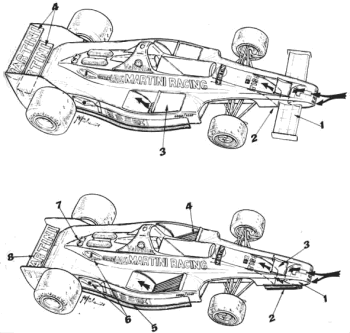
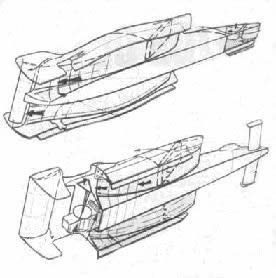
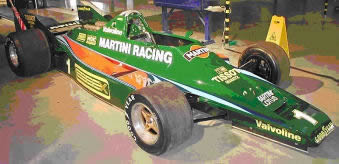
As I said, the idea with this kind of nose cone is not new. It was first used almost 30 years earlier. Great Colin Chapman used it first time on the Lotus 80 to maximise ground effect. He used a design similar to the pictures shown, but employed skirts to channel air below the nose cone, isolating this area and creating low pressure beneath it. After an initial trial with front wings and without skirts, he removed the wings and used only skirts. Reutemann, who drove this car, was totally disappointed because the car was undrivable over uneven surfaces – the skirts were not movable, and the front end lost downforce very easily when the skirts did not touch the ground.
|
|
Ground effect - wing car Lotus 80 | |
Ferrari’s Implementation
Ferrari used the same fundamental idea but in an entirely different concept.
The fact is that the nose cone obstructs the front wing’s upward air stream.
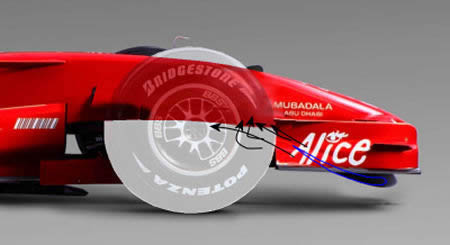
In the way Ferrari implemented this idea, the problem of turbulent air and a high-pressure area below the nose cone was resolved.
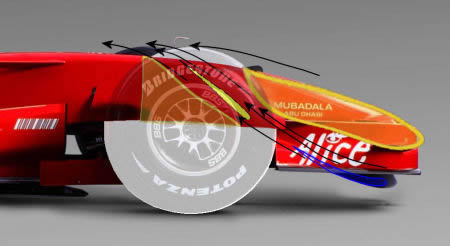
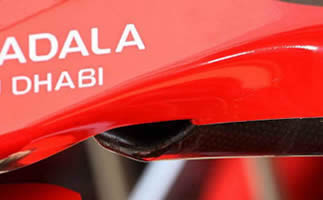
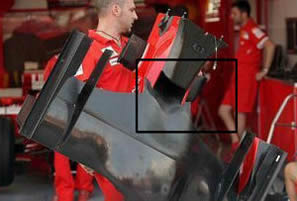
In the centre of the wing (“spoon area”) below the nose cone, the airflow previously hit the underside of the cone, creating extra drag, a high-pressure area, and in doing so reduced the efficiency of the front wing itself. This “hole in the nose” was designed to make use of the high-pressure air that builds up between the front wing and the underside of the nose and expel it on the upper side of the nose cone.
This improved the car’s downforce by sending more air and better airflow to the rear wing.
What Ferrari did was create a channel inside the nose cone that takes this high-pressure region and vents it over the top of the chassis.
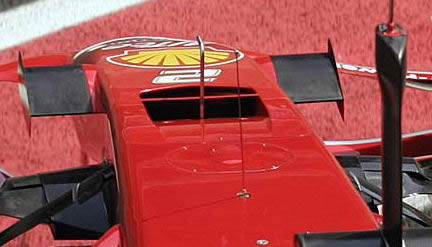
From overhead shots, the hole’s outlet can be seen, with one large exit split into two. This helps the exit airflow merge better with the flow already passing over the car. It exits above the nose, just ahead of the front suspension components.
Despite its negative drag effect on top of the nose, the improvements underneath are substantial. Not only is the upward airflow smoother, it also creates a lower-pressure area under the nose. As a result, molecules of air tend to fill that void and flow faster along the front wing, further improving its efficiency.
Setup Sensitivities
This concept has several downsides from a setup perspective. The nose hole must be at the exact position in relation to the front wing and the angle of the front flaps. In other words, the air exiting the front wing must find a direct path through the hole. If the angle of the front wing is too shallow, the air will overshoot the hole, and if the angle is too steep, the air will undershoot it. In both situations, the resulting gain from this concept is not positive: drag over the nose increases, and pressure under the nose is almost the same as without the hole.
That is why Ferrari decided to use this design only on certain circuits, mainly slow circuits where even a small gain in downforce is important.
|
|
Air intake hole under the nose | |
Interview with John Iley, Ferrari Aerodynamicist
Q: How was the hole in the nose born?
Iley: ‘‘It’s the result of continuous work on the car, something that never stops, not even in a period in which the regulations remain unchanged for a long period. We have lots of memories, preceding experiences and ideas that have been put aside. It occurs that we find something interesting but that we cannot use instantaneously because it wouldn’t be working on the car we have at that very moment. But something that isn’t useful today could become useful tomorrow.’’
Q: How many of the solutions you experiment with are effectively used in the end? One out of nine?
Iley: ‘‘Maybe, but it’s important to underline that there’s always a good reason why an idea is discarded, or momentarily discarded. The difficulty of passing the crash test for example. It’s up to technicians like me to decide when certain solutions are to be introduced. Saying: ‘right, this is the moment for it’.’’
Q: But then do you never invent something new?
Iley: ‘‘We usually apply concepts that have been known for years. When you go and ’explore’ the history of Formula 1 then you’ll find many ideas that could be made to work today. But it depends on how your car works. Not every solution works on every car.’’
Q: How much time goes past between coming up with an idea and introducing it on track?
Iley: ‘‘That’s not the right way the question should be put. Let’s take the nose with the hole in it: we’ve been thinking about it for a while, we wanted to introduce it earlier but we weren’t able to simply put it on the car. Together with the hole, which is the main thing people talk about, a whole range of other, less evident solutions were necessary to be introduced as well. On top of that we’ve encountered some problems with the production. It is obviously essential to have a very efficient organization to try out everything, not wasting your time. When you test a component too early, then the entire car is different compared to what you have in mind (as to when the component is to be introduced) and the interaction between the various parts doesn’t work.’’
Q: Is there room for the fantasy of the designers in the age of the computer?
Iley: ‘‘Of course. The computers are programmed. We decide which and how much data we insert. The contribution from the drivers is fundamental also. The programs that are used for the simulation of the aerodynamics and other technologies are useful to understand if the things we’ve thought up will give good results. Or bad results, which is just as interesting: it could be a little alarm bell that tells you not to ‘peeve’ the car too much because it’s very sensible to modifications.’’
Q: Will other teams copy your famous nose within two or three races?
Iley: ‘‘It’s not easy. I don’t think it will happen. Each car has its own geometry. The hole works well with ours. When you notice a team has copied a solution of yours, then you can conclude that the car of the team has a similar geometry which could give you useful indications.’’
Q: How many people work in Ferrari’s aerodynamic department?
Iley: ‘‘I’m afraid I cannot say that. That’s sensitive information. We’re a big group, but elsewhere, in other departments there are groups that are bigger still.’’
Q: If your ideas come from the past, then where have you gone ‘fishing’ for the hole in the nose solution?
Iley: ‘‘I’ve been in Formula 1 for eleven years. The idea was going around. It was only necessary to find the right moment to exploit the idea. And this was the right moment, with the new regulations that are to come. It’s important to begin with exploiting areas that are not considered by many, such as the geometry of the design. Because everything could give you an advantage. When I started working in Formula 1 it wasn’t necessary to be at the limit of each aspect of the car. Now it is necessary, and will be even more so in the future.’’
Q: Are you not afraid of the reduced role of the aerodynamics in 2009?
Iley: ‘‘The implications of the new regulations are not completely clear yet. And then it’s somehow comforting to know that in my working field there’s still some freedom to work, whereas other areas, that of the engine for example, are almost completely frozen for development. Maybe we can do less compared to the past, but the little bit we can still do is more important. I’m fascinated by the challenge.’’
Q: Will the new regulations really enable more overtaking?
Iley: ‘‘The ‘mechanism’ with which the regulations for 2009 have been designed is the right one: a group of independent technicians which have been studying the problems for a long time. The geometry of the car will play a key role, something I’m very pleased about. I think this is a good base to begin with. The spectacle and the public will rejuvenate because of it. At least at the start. My worry is that you never know how the regulations will be interpreted by technicians on the long term and which side effects, such as the electronics, will interact with the regulations in place.’’
Q: Apart from being an engineer you really seem to be passionate about it all…
Iley: ‘‘I am. The world of motors makes you addicted, more or less. And when you’re as passionate as I am you become a driver or a technician.’’
Later Developments
During the 2008 Turkish GP, Ferrari did not use the vented nose. The vented nose was present again at Monaco GP the same year. The reasons for this are explained above: the nose was used by Ferrari at tracks where more forward downforce was needed, as this design is not favourable for circuits where the front wing is set at low angles of attack.
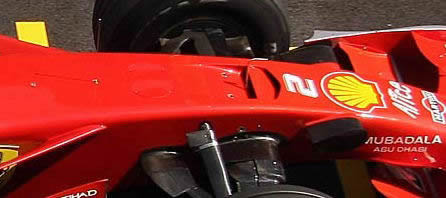
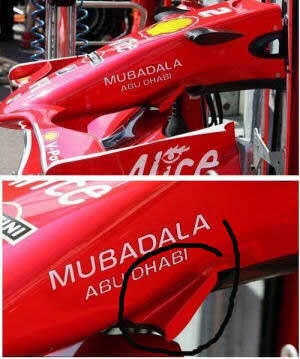
The team made a small improvement to the design by adding two triangular, inclined winglets at each side of the nose cone to increase the effect of the air channelling. The aerofoils help push air upwards – similar to what happens inside the nose cone – and divert away turbulence generated by the front-wing pillars, enhancing the efficiency of the bottom hole.
As a result, downforce improved further, despite the drag penalty.
From 2009 onward, rule changes banned all aerodynamic appendages on the car body, including chimneys, flip-ups, Ferrari nose-hole-style additions, and turning vanes.