F1 Drivers Deceased Behind the Racing Car Wheel
Decade-by-Decade Statistics
The fifties
Accidents
GP races: 84
Estimated racing kms: unknown
Accidents in races: unknown
Injuries, drivers: unknown
Fatalities, drivers: 25
Fatalities, officials: unknown
Fatalities, spectators: unknown
Technical innovations:
Disc Brakes (1951)
First non-turbo producing 100 hp/1000 cc (1953)
Direct Injection (1945)
Desmodromic valves (1954)
Cars with the engine in the back
The sixties
Accidents
GP races: 100
Estimated racing kms: 483,000
Accidents in races: 47
Injuries, drivers: 4
Fatalities, drivers: 3
Fatalities, officials: 0
Fatalities, spectators: 0
Technical innovations:
Four wheel traction (1960)
Six speed gearbox (1961)
Monocoque (1962)
Spoilers and small wings (1967)
Wings on supports (1968)
The eighties
Accidents
GP races: 156
Estimated racing kms: 863,000
Accidents in races: 540
Injuries, drivers: 4
Fatalities, drivers: 8
Fatalities, officials: 1
Fatalities, spectators: 0
Technical innovations:
Double Chassis (1981)
Carbon Fibre chassis (1981)
The survival cell (1982)
Pneumatic Valve handling (1986)
Active Suspension (1987)
Semi-automatic gearbox (1989)
Seven-speed gearbox
The nineties
Accidents
GP races: 162
Estimated racing kms: 854,000
Accidents in races: unknown
Injuries, drivers: unknown
Fatalities, drivers: 2
Fatalities, officials: 0
Fatalities, spectators: 0
Technical innovations:
High nose (1993)
The 2000s
Accidents
GP races: in progress
Estimated racing kms: unknown
Accidents in races: unknown
Injuries, drivers: unknown
Fatalities, drivers: 4
Fatalities, officials: 1
Fatalities, spectators: 0
Technical innovations:
CART-alike flip-ups (2001, Williams)
Carbon-cased gearbox (2004, BAR 006)
V-keel front suspension (2005, Renault R25)
Complete List of Driver Fatalities
Below is the list of drivers who died during a racing event. All drivers on this list raced at least once in an unofficial Formula One race or in an official Formula One World Championship race. Drivers with their names marked in red died at an official Formula One Championship race.
The Indianapolis 500 was part of the FIA World Championship from 1950 through 1960. Drivers competing at Indy during those years were credited with World Championship points and participation. This list includes only drivers who competed in the Indianapolis 500 plus at least one FIA World Championship race.
The modern era of safety in Formula One began with the deaths of Roland Ratzenberger and Ayrton Senna at the San Marino GP in 1994. The tragic loss of one of F1’s greatest drivers was a wake-up call for the entire Formula One community.
Sorted by year:
1950 - 1955, 10 drivers died
1956 - 1960, 20 drivers died
1961 - 1965, 6 drivers died
1966 - 1970, 18 drivers died
1971 - 1975, 10 drivers died
1976 - 1980, 3 drivers died
1981 - 1985, 5 drivers died
1986 - 1990, 2 drivers died
1991 - 1995, 3 drivers died
1996 - Today, 4 drivers died
Visualising the Data
As an addition to my list, there is a list made by London-based data visualisation agency infogr8. They researched and visualised the trends in driver fatalities and subsequent safety features in Formula One since the championship began in 1950.
There are some interesting details hidden in the list. Despite being a round on the F1 calendar for only a decade, it is the Indy 500 that has claimed the most F1 lives, with seven fatalities since 1950. The legendary “Green Hell” of the Nurburgring, in contrast, has claimed five, while three F1 drivers lost their lives at Monza and two died at Spa-Francorchamps.
But there are limits on the infogr8 data set. The data set includes only those F1 drivers who died in practice, qualifying, or while racing in a Formula One event. As a result, some big names are excluded from the list. For example, Jim Clark is one of the notable omissions from the analysis.
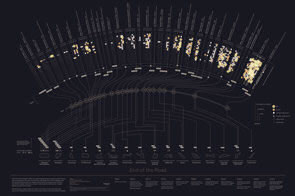
Click here for the full image as a PDF
All together, 81 drivers died in 65 years of Formula 1 World Championship racing.
Safety Resources
To know more about safety in Formula 1, development in safety after incidents and tragedies, check my article about general safety.
Check my article about improvement in racing car safety year by year
Check my article about improvement in track safety year by year
Check my article about improvement in driver safety year by year
A Milestone in Safety
Formula 1 is now in its seventh decade and it was only when reflecting on Webber’s accident at the European GP at Valencia 2010 that I realised that the 2000s was the first decade in which no one died in an F1 car – a massive achievement in Formula 1 safety.
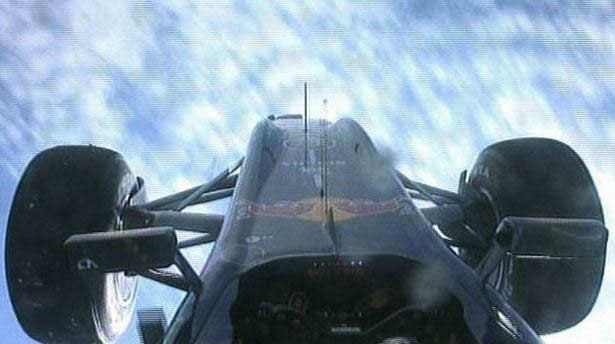
The Red Bull driver somersaulted and landed upside down after running into the back of Heikki Kovalainen’s Lotus.
Webber said: “I’m happy. After the accident I was just having a shower and thinking, ‘Mate, you’re lucky to be in one piece.’ It was a nasty incident. I was surprised by what happened. I’m a little bit tender here and there but the car did a great job.”
Video Archive
Sadness in Formula 1 Part 1
Sadness in Formula 1 Part 2
FATAL CRASHES IN F1 PART 1
FATAL CRASHES IN F1 PART 2