Differential
What a Differential Does
On one end of the gearbox lives the engine with clutch, and on the other end the differential – an essential part of the drive train where drivability is concerned. As a car travels around a corner, it maps out a curved path the width of the car itself.
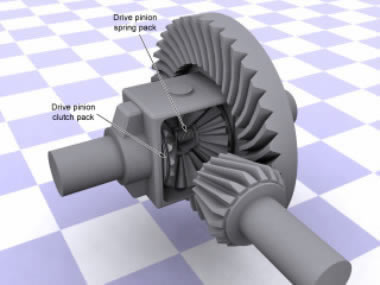
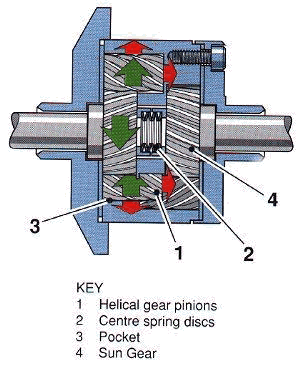
The inside arc of the path has a tighter radius than the outside arc, so the wheel on the outside must travel further and therefore rotate at a higher speed than the wheel on the inside. If the two wheels were directly connected, the loaded outer wheel would force the inner wheel to rotate at the same speed, causing the tyre to spin and scrub along the ground. To solve this, sports cars and F1 cars use a limited-slip differential, while most family cars use open differentials.
| Internals of an Limited slip differential in sport cars |
| Internals of an Limited slip differential in sport cars |
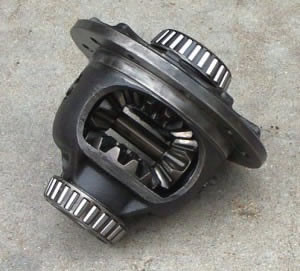
| Open slip differential in road car |
| Open slip differential in road car |
Formula 1 differential with ring gear visible | |
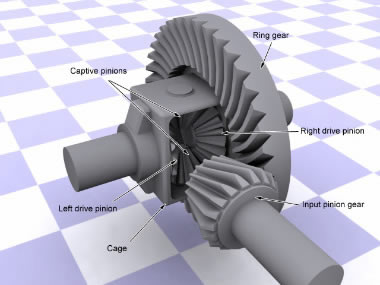
Open vs. Limited-Slip Differentials
The open differential theoretically delivers equal torque to both drive wheels at all times, whereas a limited-slip device uses friction to alter the torque relationship between the driven wheels.
This allows the sport car wheels to roll at separate speeds to each other when the car is entering the corner, then as the driver comes back on the power, the differential will slowly lock up to avoid the inside, unloaded wheel spinning. Of course, like most things on a Formula One car, this is all electronically controlled, and can be programmed into the car – in fact, until it was banned, there was a button on the steering wheel which drivers could press to manually lock or release the diff as they pleased, enabling them to get better traction out of the corners.
Electronic Control in F1
Electro-hydraulic devices are used in F1 to constantly vary the torque acting on both drive wheels at different stages through a corner. This torque relationship can be adjusted to “steer” the car through corners or prevent the inside rear wheel from spinning under harsh acceleration out of a bend. The FIA allows the use of these devices provided that their characteristics are fixed once the car is out on track.
A Moog electrohydraulic valve (from RaceCar-Engineering, Charles Armstrong Wilson, 2008) constantly adjusts the friction between the two shafts around the track to maximise the car’s performance, dependent on the characteristics that have been entered into the on-board computer.
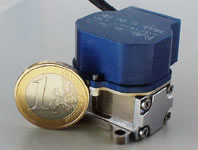
The Moog valve opens and closes depending on what the software instructs it to do, but the valve must work to the same set of conditions that are pre-programmed while the car is in the pits. This means the driver cannot alter the characteristics of the differential in response to changing track conditions, which was permitted in the era of extensive driver aids around 1993.
Moog Valve Technology
A Moog valve is based on technology developed during World War Two to meet the need to convert an analogue electrical signal into a proportional hydraulic oil pressure differential, which in turn drives a spool valve. This valve controls the flow, pressure, and flow velocity of a hydraulic actuator or cylinder. Moog valves are popular in Formula 1 because they control equipment with precision and with very high response, facilitating the operation of all servo-hydraulic control systems currently in use.
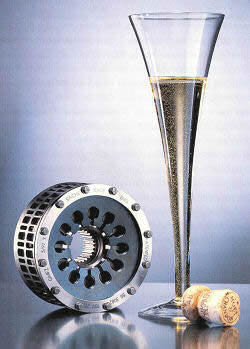
The wineglass and champagne bottle cork provide a remarkable
prospective for this ZF Sachs Formula 1 clutch. Though tiny, only 111 mm in diameter, it can transmit more than 900 horse power.