Desmodromic Valve System
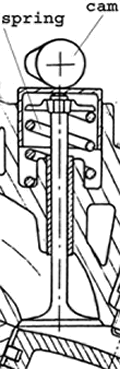
Conventional Valve Actuation
The characteristic and universally used mushroom or “poppet” valves (found in every four-stroke engine) open during their down-stroke and close during their up-stroke, until they make contact with their seats in the cylinder head.
Normally, the valve is operated by a cam system, which controls valve opening (down-stroke), while the valve closing movement (up-stroke) relies on the action of a spring in most cases.
Valve Float and Valve Bounce
Valve float is an adverse condition that occurs when the poppet valves on an internal combustion engine valve train do not remain in contact with the camshaft lobe during the valve closure phase of the cam lobe profile. This reduces engine efficiency and performance and can increase engine emissions.
Valve bounce is a related condition where the valve does not stay seated, due to the combined effects of the valve’s inertia and resonance effects of metallic valve springs that effectively reduce the closing force and allow the valve to reopen partially.
Understanding the Problem
Desmodromic valve drive was often justified by claims that springs could not close valves reliably at high speed and that the forces caused by suitably strong springs exceeded what cams could withstand. Subsequent analysis revealed that valve float was caused largely by resonance in valve springs that generated oscillating compression waves among spring coils.
High-speed photography showed that at specific resonant speeds, valve springs were no longer making contact at one or both ends, leaving the valve floating before crashing into the cam on closure.
For this reason, as many as three concentric valve springs, press-fit into each other, were often used – not for additional force (the inner ones having no significant spring constant) but to act as snubbers to reduce oscillations in the outer spring.
Stiffer valve springs can help prevent valve float and valve bounce, but only at the expense of increased friction losses. Various techniques have been used to offset the effect of stiffer springs, such as dual-spring and progressive-sprung valves, roller-tipped tappets, and pneumatic valves in Formula One.
A less obvious secondary effect is that valve springs typically weigh as much as the valves they actuate, meaning the total mass that the actuation mechanisms (belt, bearings, shafts) must move also needs to be larger to avoid fatigue failures. The combined weight of the mechanism and the energy needed to overcome the spring forces and added friction means that a larger fraction of the engine’s available power output is consumed by valve actuation.
If a racing engine with conventional valve springs has an upper RPM limit of about 10,000 rpm, that same engine design equipped with a desmodromic valve system would be capable of 15,000 rpm and considerably more power.
How the Desmodromic System Works
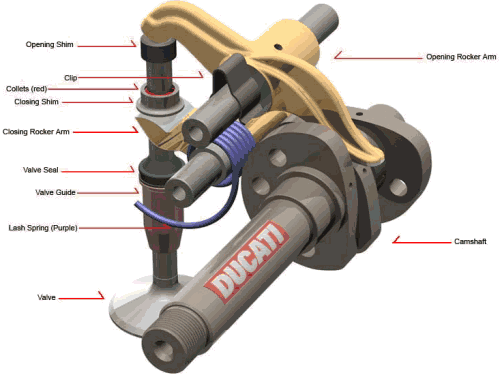
While the desmodromic system is not the most practical in a production context, it has survived and performed without problems to this day. While it can be more expensive to maintain than traditional spring-actuated valve systems, there are many aftermarket precision-machined components that can extend the maintenance interval to match that of comparable spring-actuated engines.
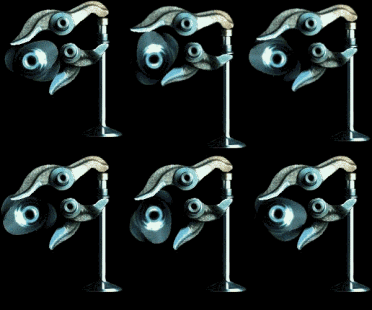
In traditional spring valve actuation, as engine speed increases, the inertia of the valve train overcomes the spring’s ability to close the valve completely before the piston reaches Top Dead Centre. This can lead to several problems. Most catastrophically, the piston can collide with the valve and damage it permanently. Additionally, the valve may not fully return to its seat before combustion begins, allowing cylinder gases and pressure to escape prematurely. This causes a major decrease in engine performance and can cause the valve to overheat, potentially resulting in warping or catastrophic valve failure.
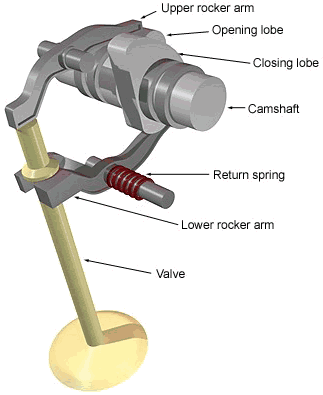
The desmodromic system avoids this problem because, although it has to work against the directional energy of the valve opening and closing, it does not have to overcome the static energy of a spring. A small spring is still present in the desmodromic system, but only to take up the slack in the closure mechanism.
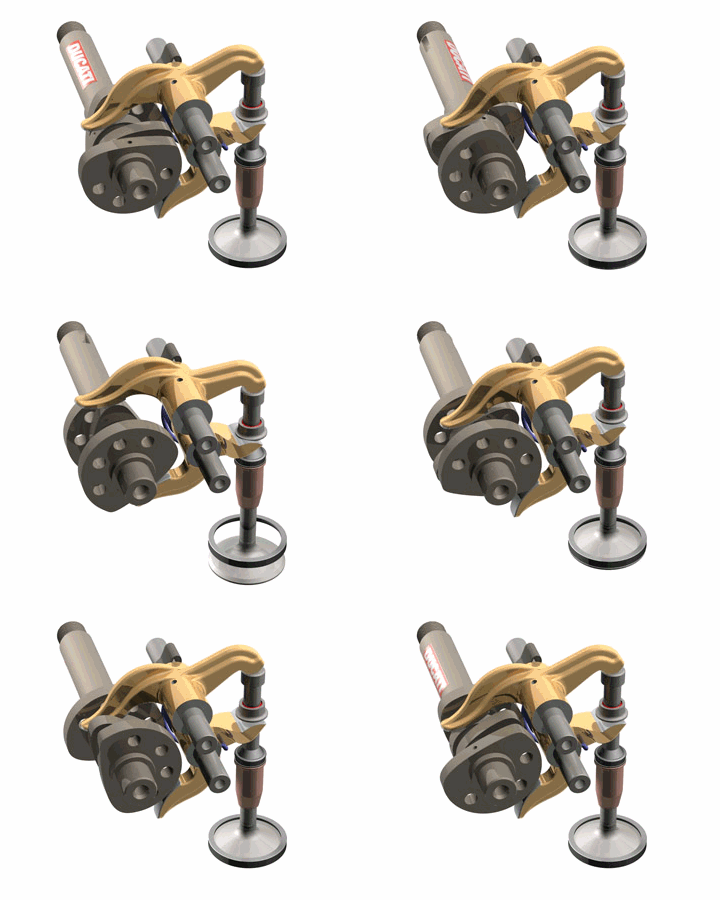
Italian motorcycle manufacturer Ducati uses the desmodromic (springless) valve system to counter this problem and allow for higher engine speeds. The system consists of a mechanical lifter mechanism that uses a second rocker arm to push the valve closed. Formula 1 engine manufacturers use a pneumatic system to close the valves, allowing for very high RPM without valve float.
Advantages and Disadvantages
The main benefit of the desmodromic system is the prevention of valve float. There are no heavy, power-robbing springs to close the valves, the engine has better protection if over-revved, and overall efficiency and performance are improved.
The disadvantage of the desmodromic valve system is its complexity and cost. While the overall efficiency possible in a desmodromic design cannot be matched by current alternatives, its main advantage – greater power output – can be achieved at less expense by using four or more valves per cylinder.
|
|
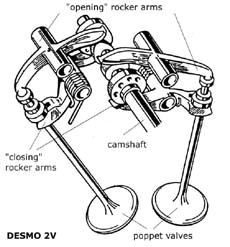
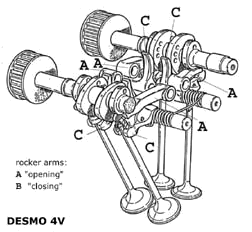
Desmodromic, 2 valve per cylinder | Desmodromic, 4 valve per cylinder |
Etymology
The word “desmodromic” is derived from two Greek roots: desmos (controlled, linked, captive) and dromos (course, track). It refers to the exclusive valve control system used in Ducati engines, where both valve movements (opening and closing) are mechanically operated. Both strokes are positively controlled.
In mechanical terms, the word desmodromic refers to mechanisms that have different controls for their actuation in different directions.
While the design can be noisy, this is typically overridden by road noise from tyres and other engine components such as intake and exhaust noise. Ducati’s four-cylinder MotoGP and MotoGP Race Replica bikes, which are the only current production desmodromic motors with four cylinders, are intended for race use and can exceed 110 dB on full race trim.
Ducati has consistently used its desmodromic system since 1956. It is the only manufacturer in the world to have applied it to everything from standard production bikes to Superbike and MotoGP machinery.
Dr. Fabio Taglioni
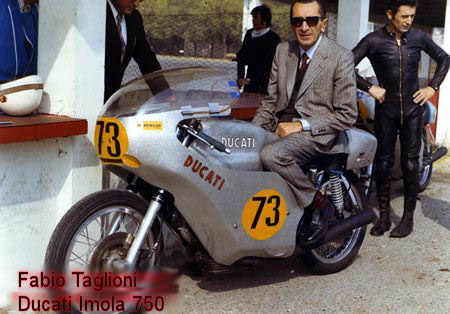
Dr. Fabio Taglioni
The desmodromic valve system was designed and developed by Dr. Fabio Taglioni, the father of the modern desmodromic valve actuation system, who worked for Ducati for most of his career.
Born in 1920 in Lugo di Romagna, Taglioni graduated as an engineer in 1948. He worked at Mondial in the early 1950s, and when he had a falling out with management, offers soon arrived from Ford and Ducati. Ford’s was the more lucrative offer, but Ducati offered something Ford could not: autonomy and the chance to form a race team. Taglioni went to work for Ducati as chief designer and technical director in 1954, where he remained until 1989.
He began in the 1950s by designing Ducati singles, and in 1963 designed the prototype V4 Ducati Apollo. This led to the 1972 Ducati 750 Imola Desmo and the 1970s and 1980s production Ducati V-twin motorcycles.
His desmodromic V-twin design is still used in all current Ducati motorcycle engines. Among the many race victories of his early desmo twin, the 1978 legendary return of Mike Hailwood at the Isle of Man is perhaps the most memorable.
Fabio Taglioni died in Bologna in late July 2001 at the age of 80.