Cornering Technique
Alfonso de Portago, who raced for Ferrari in 1956 and 1957 before dying in a crash at the Mille Miglia, explained the difference between a driver like himself and five-time champion Juan Manuel Fangio to Robert Daley for his book, “The Cruel Sport”:
*“Every curve has a theoretical limit. Let’s say a certain curve can be taken at a 100 miles an hour. A great driver like Fangio will take that curve at 99.9 every single time.
I’m not as good as Fangio. I’ll take that curve one time at 97, another time at 98, and a third time at maybe 101. If I take it at 101 I go off the road.”*
Introduction
In this article about cornering we will not talk about cornering with a normal road car. This is simple, and you should be careful only during preparation for corner entry. There are a few simple rules you have to take care of. Most of that you can read in the braking article. There is no racing line and stuff like that – just adjust your speed, don’t brake during cornering, and bear in mind weight transfer.
In this article we will talk only about racing, and the racing line through the corner.
Key Physical Laws
There are three very important physical laws we have to remember:
Kinetic Energy:
Kinetic energy is the energy of motion. An object that has motion – whether vertical or horizontal – has kinetic energy. The amount of kinetic energy an object possesses depends upon two variables: the mass (m) of the object and the speed (v) of the object. The following equation represents the kinetic energy (KE) of an object:
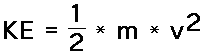
m = mass of object
v = speed of object
This equation reveals that the kinetic energy of an object is directly proportional to the square of its speed. That means that for a twofold increase in speed, the kinetic energy will increase by a factor of four. Kinetic energy is a scalar quantity; it does not have a direction. Unlike velocity, the kinetic energy of an object is completely described by magnitude alone.
First Law of Motion:
Isaac Newton (a 17th-century scientist) put forth a variety of laws explaining why objects move (or do not move) as they do. These three laws have become known as Newton’s three laws of motion. The focus here is Newton’s first law of motion, sometimes referred to as the law of inertia.
Newton’s first law of motion is often stated as:
An object at rest tends to stay at rest, and an object in motion tends to stay in motion with the same speed and in the same direction, unless acted upon by an unbalanced force. The behaviour of all objects can be described by saying that objects tend to “keep on doing what they’re doing” (unless acted upon by an unbalanced force). If at rest, they will continue in this same state of rest. If in linear motion, they will continue in this same state of linear motion. The state of motion of an object is maintained as long as the object is not acted upon by an unbalanced force. All objects resist changes in their state of motion – they tend to “keep on doing what they’re doing.”
Inertia
Inertia is the tendency of an object to resist changes in its state of motion. The state of motion of an object is defined by its velocity – speed with a direction. Thus, inertia can be redefined as follows:
Inertia: the tendency of an object to resist changes in its velocity and direction.
The Role of Suspension
But before we can start with the discussion about cornering, it is important to acknowledge the importance of suspensions. If they are not set properly, or there is some malfunction or lack of maintenance, all this theory we will talk about is useless. In addition to keeping the chassis off the track, race car suspension springs or roll bars serve the same basic purposes as passenger car springs. The springs isolate the vehicle’s components (and occupants) from road shock. They control the pitch and roll attitudes of the car and, in concert with the shock absorbers, the rate at which these attitudes change in response to lateral, longitudinal, and vertical acceleration. Finally, again working with the shocks, they keep the tires in contact with the road surface as constantly as possible.
Actually, shock absorbers do not absorb road shocks – the springs do. The shocks control the release of the energy stored in the springs when they are compressed. Racing imposes more stringent requirements than road driving, including better accuracy of manufacture, minimum practical size and weight, and absolute consistency of performance. To realise the performance benefits offered by sophisticated shock absorbers, the springs must be absolutely consistent in load at height, rate, and linearity.
Cornering Fundamentals
HUH…, Now we can start with the discussion about cornering.
When taking corners, the aim is to keep the car balanced throughout the bend. We are talking balance between the front and rear of the car. When you are driving near the limit of grip, you really want to spread the weight evenly, otherwise overloading the front or rear tires can cause you to lose grip. When you lift off the throttle or brake, the weight is thrown forward; when you accelerate, the weight is thrown to the rear. Using a trailing (semi-open) throttle you can keep the corner grip and take the corner at the fastest speed possible. These techniques should only be applied on the track – it is foolish to push your car to the limits on the roads without the safety of run-off areas. Good techniques learnt for the track will one day come in handy when you hit a slippery road or if road conditions change suddenly.
Braking during cornering is a big NO. If you remember one thing from the Braking and advanced braking articles, make sure to never brake on a bend. Braking really upsets the cornering balance and will nearly always cause problems, especially if hard braking is required.
Cornering plays an important role in deciding the outcome of races. The engine and brakes play a crucial role on the straights, but on the corners, the driver’s skill is a major factor. Factors like dirt, wetness, and overall car balance also affect cornering.
There are some important concepts to understand:
Traction Circle
The concept of the traction circle is the fundamental principle of efficient cornering. A car’s tires have longitudinal grip for braking and acceleration. Expert drivers overlap the different phases of braking, turning, and applying power on the tires, trying to exploit the overlap to the fullest. They make an effort to best utilise the traction circle, meaning they try to keep the tire working as long as possible when applying pressure. Learn more about traction.
Oversteer and Understeer
Other basic principles of cornering are oversteer and understeer. These deal with which end of the car runs out of grip first. In oversteer, the back end of the car loses adhesion and tries to overtake the front. In understeer, the front end breaks free first and centrifugal force makes the car run wide.
Now let us understand one thing. Road cars are naturally made to understeer, and race cars are naturally made to oversteer. That’s because understeer is stable – it slows down a car. On the contrast, oversteer is unstable. If the driver is a novice, it could result in a spin. With skilful use of steering, brake, and throttle (heel and toe), the driver can avoid a spin. But the racing car is designed to oversteer. This enables a skilled driver to carry far more speed through a corner than understeer would allow. And with use of the heel-and-toe technique, a skilled driver can turn oversteer to understeer and vice versa.
Racing Line
The racing line is the imaginary line a driver should follow to travel around corners quickly. The basic assumption is that a straight line between two points is usually the quickest route. The tighter the corner, the slower the driver must go to get around without losing grip. By using all the space on the track, a straighter route can usually be created, thus keeping the speed up. However, there are various additional factors that determine the perfect racing line, as discussed below.
When cornering on a track, several factors influence the choice of line:
- Braking point
- Turn-in point
- Apex
- The position and direction of the next corner
- Overall situation around the driver
It is important to remember that there is rarely a perfect line through any corner for all conditions. It depends on the characteristics of the car, the cornering strategy, and the conditions. Experimentation with different lines and learning from those who know the track well are essential.
Corner Zones
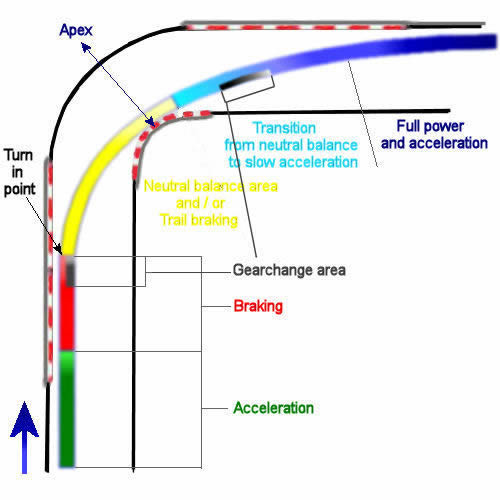
Every corner is made of three parts: the entry, the apex, and the exit.
The entry is where turning begins. The entry portion of the corner can be divided into:
Acceleration zone (prior to cornering)
Braking and gear change zone
Turn-in point
Neutral throttle zone before the apex.
The apex is the point where the car reaches the furthest point on the inside of the turn.
The exit is where the car is driving straight again, and this zone can be divided into the acceleration and full-throttle zones.
Each of these parts is explained below.
Acceleration Zone:
To get the best times on the track, the driver must be either accelerating or braking at all times while on the straights – any coasting means precious seconds are being lost. Maximum throttle should be applied all the way up to the braking zone.
Braking Point:
How effective are the brakes? How quickly can speed be reduced from 200 km/h to 50 km/h? How does the car behave when weight transfer occurs? How does the car behave when the front wheels lock? How confident is the driver? All these factors determine the braking point. A sensible strategy is to brake earlier while learning the track and the car, and progressively shorten the braking area as experience grows. The rule of thumb is to get most of the braking done before turning into a corner, although light brake pressure on entry can help reduce understeer and give a better turn-in (this is known as trail braking). The driver should try not to turn in if any of the wheels have lost traction. Check the advanced braking article for more detail.
Gear Change:
Before turning into the corner, a downshift is usually necessary. The golden rule is to select a gear that allows efficient acceleration out of the bend. Heel-and-toe shifting is an essential technique to master, as it allows simultaneous braking and downshifting while avoiding transmission shock loads that can unbalance the car and cause unwanted weight transfers. Check the advanced Shifting Technique article for more detail.
Turn-in Point:
When turning in, the steering motion must be smooth and progressive. The perfect corner involves tightening the steering until the apex and then gradually unwinding the steering lock. If the driver finds it necessary to increase or correct the steering lock while travelling through the corner after the initial turn-in, the wrong line has probably been taken. To get the line right, it is vital to turn in at the correct point. Too late and the apex will be missed; too soon and the line will need to be tightened mid-corner. Getting this right sets up a good corner. The apex may be further around the corner than is visible, so learning the track and its apex points before driving in anger is essential.
Neutral Throttle Zone:
The largest demand on the grip reserves of the tires occurs from the point of turn-in up to the apex. It is vitally important not to place additional demands on the tires by accelerating or braking. This does not mean constant speed cannot be maintained, but the important factor is that the car is in a neutral state until after the apex. Understeer or oversteer are most likely to occur at this point. Trail braking or a trailing (semi-open) throttle can be used to carry more speed into the corner, or heel-and-toe technique can be used to aid balance.
The Apex
Apex
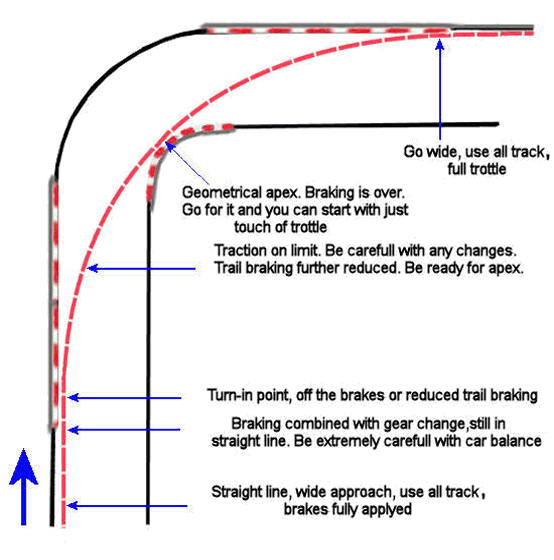
The apex is often, but not always, the geometric centre of the turn. Hitting the apex allows the car to take the straightest line and maintain the highest speed through that specific corner. It is also the tightest part of a corner and the point at which the car is closest to the inside of the corner. It is also called the clipping point. Once the apex has been hit, the driver should be able to reduce the steering lock and increase the throttle.
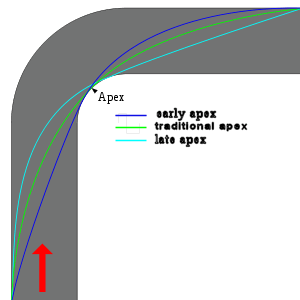
Determining the apex can be tricky, but the guidelines below explain how to do it. There are two different types of apex: the geometrical apex (fixed or traditional) and the racing apex (fluid – early or late). The geometric apex of a constant-radius corner is the central point of the corner, which may also be the racing apex, depending on the context.
Cornering Strategies
There are two generic strategies for cornering:
Carrying Speed in the Corner
For a majority of drivers, front-end grip and front-end feel mean precision of corner entry and the ability to carry a lot of speed into a corner and maintain it through the apex, while receiving good feedback from the front tires. In this way, drivers can feel – without guessing – exactly what the front tires are doing, carry the speed into the corners, and keep it up in the mid-corner. This is generally the fastest way around a corner, and when the car is working as desired, the fastest maximum speed can be found this way.
Without the response from the front end, some drivers cannot make the fine adjustments that allow them to carry speed in the most efficient way through the corner. If the car cannot be placed precisely and braking applied where desired because of front locking or sliding, it becomes a guessing game about where the car will end up. Missing a corner by even a small margin means losing a lot of speed on the next straight. It sounds like a small thing, but around one lap, guessing every corner creates quite a large deficit.
Carrying Speed in the Corner - Use the Traditional Apex
To carry maximum speed through a corner, the route that minimises the corner radius is needed, thus minimising cornering force and freeing up precious grip for keeping the speed up. This route places the apex near the geometric apex of the corner and is usually known as the classic racing line. In the picture above, the green line is a constant-radius 90-degree right-hander and the geometric apex is exactly halfway around the corner. An early apex maximises the use of speed from the incoming straight; this is used when approaching a corner where the following straight is much shorter than the straight before the corner, or when trying to outbrake an opponent during an overtake.
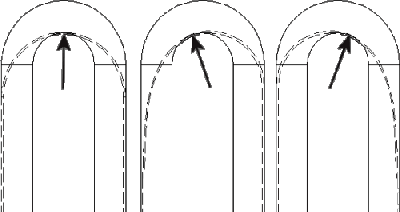
Getting the Power on Early - Use a Late Apex
Carrying the highest average speed around corners may not actually be the quickest way around a track. The objective in any corner is to have the highest exit speed. In addition to increasing the corner radius, this involves taking a line that allows the earliest possible point of getting back into the throttle. To do this, the car must be straightening out on the corner exit path as early as possible. The blue line in the picture above is the late apex, and this is generally regarded as the best strategy for racing, with a slightly lower entry speed but a faster exit speed. The entry and exit affect the speed into and out of the corner onto the following straight. A late apex is used to maximise the acceleration onto the following straight. The amount of grip available is the factor that determines how late the driver can brake and apex.
Entering the Corner Outside the Racing Line
If the braking point is missed, or the driver is trying to outbrake an opponent from the inside line and carries too much speed into the corner, it is important to try to make the corner entry as much of a straight line as possible. In this case, an early apex (marked in blue in the picture) can be used. It allows the brakes to be applied without strong steering input, reducing the risk of unsettling the car’s stability. With an early apex, entry speed is highest but exit speed is the slowest.
Hairpins
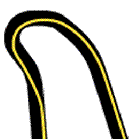
A hairpin is a corner that turns 180 degrees. In this case, the apex for the late-apex racing line is about three-quarters of the way around the bend. The early apex is about one-quarter into the bend.
Post-Apex Acceleration
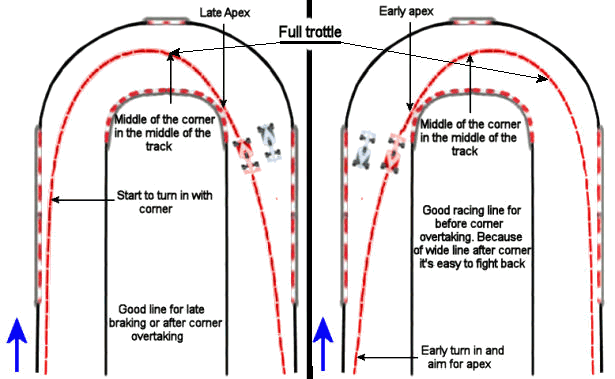
On a race track, exit speed is paramount. A car that has a greater distance to accelerate will be going faster than a car that has only been accelerating for a shorter distance. When approaching a tight apex, the driver should slow down and aim to take the late apex of the bend, leaving a long, gentle arc from that apex point. This effectively turns a long, sweeping bend into a tight bend with a long straight, meaning there is more opportunity to accelerate.
Once the apex has been hit, the driver should be able to start reducing the amount of steering lock. As this is done, the throttle should be progressively increased up to the point of full power. The principles of the traction circle should always be kept in mind. The point at which full power can be applied depends on the car and the racing line being used. Some cars will be able to apply full power straight after the apex, depending on the severity of the corner. By this point, the driver should already be thinking about the next corner and positioning the car appropriately to use the racing line.
The Influence of the Next Corner
The Position of the Next Corner
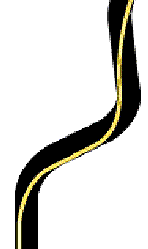
The position and direction of the next corner also affect the apex. For example, if the next bend is a left-hander, the driver will need to move over to the right-hand side of the track and will therefore need to apex later. If the next corner is another right-hander, an early apex would be more appropriate. This approach works for corners that require hard accelerating out of them, which will be most of them. However, there are many types of combinations of corners that require analysis and preparation before the race to understand the best approach.
Drifting
Drifting
In drifting, the driver should aim the front of the car towards the apex to initiate a high-angle drift. High-angle drifting keeps the front of the car facing the apex, blocking the opponent from overtaking.
Depending upon cornering situations, techniques like trail braking can be used to maintain more speed upon entry of a corner and to attain more grip while turning in. In this technique, brake pressure is applied slightly later than usual upon deceleration and is maintained during steering input, sometimes all the way to the apex. The action of braking causes a weight transfer in the vehicle, shifting more weight from the rear of the car forward to the front tires, increasing the normal force on them and in turn increasing the amount of traction the front wheels have. Because of the characteristics of weight transfer, this technique causes weight to be shifted away from the rear of the car, resulting in lower rear traction, and can be used to induce oversteer in some cases. The heel-and-toe technique can also be used in this situation.
Practical Considerations
All of the above guidance depends on the individual driving style and the car being used. It is not possible to use all the power of a Bugatti Veyron or F1 car until the car is completely in a straight line; with this kind of car, the acceleration and full-throttle areas will be very distinct. However, in a lighter, less powerful car, the throttle can be applied much closer to the apex point.
It is very rare to achieve the perfect corner. It takes knowledge of the track, knowledge of the car, and a great deal of practice.
The Battle for the First Corner
There are many corners with famous names, such as the Parabolica at Monza, Spoon at Suzuka, or Becketts at Silverstone. But those are not the corners that can decide a race: on every track, the corner the drivers pay most attention to, and which commands the most interest from the fans, is the first corner after the race begins. The battle for the first corner is very brief. When the start lights go out, the drivers have just a few seconds to get into position among the mass of 20-30 cars or motorbikes charging towards the eye of the needle at the end of the start/finish line. For them, the stakes are extremely high.
The battle for the first corner is one of the most exciting moments in any race, and especially in Formula 1, where overtaking during the race is very difficult. It is no wonder that the drivers prepare for it specifically. Because every track is different, it is important to analyse the racing lines through the first corner using video recordings from recent years.
It is much easier to catch up or lose places at the start than during the rest of the race. So only one motto applies for the drivers up to the first corner: keep your eyes straight ahead and put your foot down. Every driver tries to approach the first corner on precisely the ideal line, which as a rule is an extremely narrow corridor with space for only one car. The drivers must concentrate fully on the perfect position and the right braking point while also watching very carefully what is happening in front, behind, and next to them. In these few seconds at the absolute limit, one thing is clear: anyone who makes even the tiniest mistake can ruin not only their own chances but also those of their team-mates or rivals. In no other phase of the race is the pressure so great, or must so much information be absorbed and processed simultaneously.
Because jostling is inevitable in the battle for the first corner, the FIA has done a great deal to make sure it does not have serious consequences for the drivers or spectators. The implementation of generous run-off zones in the first corner area has guaranteed greater safety at the start, as has the restriction of frequent sudden lane changes on the start/finish straight. As a result, the car in front can now only change position once to prevent the car behind from overtaking.
A great deal has been done to improve safety during circuit conversions. There are now generous tarmac run-off zones, but the drivers like to integrate them into their driving line to make the corner wider and go faster.