Coanda Effect
Henri Coanda and the First Jet Aircraft
Although generally unrecognised, Romanian aerodynamics pioneer Henri Coanda was actually the first person to build and fly a jet-powered aircraft. It is commonly believed that the first jet engines were developed during World War II. Dr. Hans Von Ohain designed the first German jet aircraft, which made its first flight on 27 August 1939. Unaware of Dr. Von Ohain’s work, British engineer Sir Frank Whittle also independently designed a jet aircraft, which first flew on 15 May 1941.
The Coanda-1910, the world’s first jet aircraft
Although these two men are generally thought of as the fathers of jet aircraft, Henri Coanda built and flew the first recorded jet aircraft about 30 years earlier.
In 1934, he obtained a patent in France for an effect now named after him, described as:
“Deviation of a plane jet of a fluid that penetrates another fluid in the vicinity of a convex wall.”
Unfortunately, Coanda could not obtain funding to continue his research after he wrecked his aeroplane, and so his contribution to jet propulsion never became widespread. If he had been able to continue his work, France could have had a jet-powered air force before WWII began. Even though he didn’t build another jet aircraft, he did make a very important contribution to how aircraft wings produce lift when he discovered what is now called the Coanda Effect.
What Is the Coanda Effect?
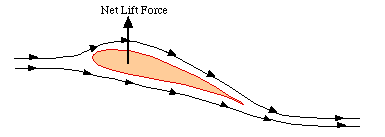
A natural question is “how the hell does the wing divert the air down?” When a moving fluid, such as air or water, comes into contact with a curved surface, it tends to follow that surface.
Coanda Effect: A moving stream of fluid in contact with a curved surface will tend to follow the curvature of the surface rather than continue travelling in a straight line.
Demonstrating the Coanda Effect
|
|
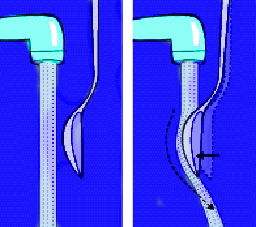
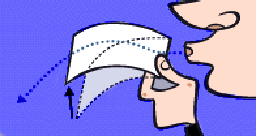
To perform a simple demonstration of this effect, grab a spoon and find a sink. You can easily demonstrate the Coanda effect for yourself. Conveniently, these are often found together in the kitchen – no need for a highly technical lab. Get a small stream of water coming down from the sink, and then place the bottom of the spoon next to the stream. I say dangle because you want to hold it loosely enough so it can swing back and forth a bit (attaching a piece of tape at the handle end to act as a hinge helps). Move the spoon up to the edge of the stream so it barely touches. The water will flow around the bowl of the spoon and off the bottom, deflected to the side, and the spoon will move into the stream. The spoon is actually being pulled toward the stream of water. Gases behave much like liquids, so when water behaves in this way with the spoon, air does the same with curved surfaces. Just as water flowing around the spoon’s curved surface draws it into the stream, air blown over curved paper is what causes the lift in the common paper lift demonstration.
What is unusual about the Coanda effect is the fact that the fluid or gas flow is pulled so strongly by a curved surface. With a tap, the water will be projected out at a remarkable distance. The degree to which the water and the curved surface remain attached goes beyond the expected. A concave curve will naturally push the flow, but the fact that a convex one would react so strongly to fluid or gas is unusual.
Coanda Effect and Wing Lift
Wings rely on the same principle. Since air behaves exactly like any fluid, Bernoulli’s principle applies. Whenever wind blows or a fan pushes air, the pressure of the moving air becomes less than it would be if the air were still. If air can be made to move faster on one side of a surface than the other, the pressure on that side will be lower than on the opposite side.
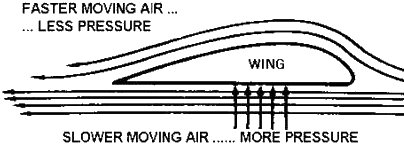
One of the most widely used applications of Bernoulli’s principle is in the aeroplane wing. Wings are shaped so that the top side is curved while the bottom side is relatively flat. In motion, the front edge of the wing strikes the air, and some of the air moves downward below the wing while some moves upward over the top. Since the top of the wing is curved, the air above the wing must move up and down to follow the curve and stay attached to it (Coanda effect), while the air below the wing moves very little. The air on top of the curved wing must travel farther before reaching the trailing edge, so it must travel faster than the air below the wing. The air pressure on top of the wing is therefore lower than that on the bottom, according to Bernoulli’s principle. The higher-pressure air on the bottom pushes up on the wing with more force than the lower-pressure air above pushes down. This results in a net upward force called lift.
Angle of Attack
Though Bernoulli’s principle is a major source of lift in an aircraft wing, the Coanda effect plays an even larger role in producing lift.
If the wing is curved, the airflow will follow the curvature of the wing. To use this to produce lift, the concept of angle of attack must be understood. This gives the angle between the wing and the direction of the airflow.
The angle of attack indicates how tilted the wing is with respect to the oncoming air. To produce lift or downforce acting on the wing, Newton’s third law requires an equal force acting in the opposite direction. If a force is exerted on the air directing it downward, the air will exert an upward force back on the wing.
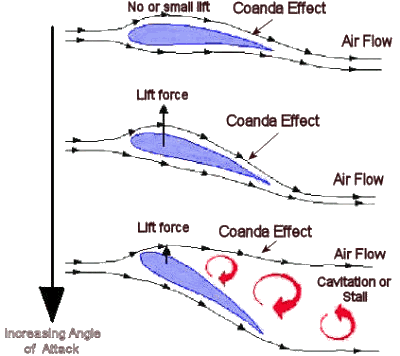
This diagram shows that increasing the angle of attack increases how much the air is deflected downward. If the angle of attack is too high, the airflow will no longer follow the curve of the wing (the Coanda effect loses its power). As shown at the bottom of the diagram, this creates a small vacuum just behind the wing. The wing is said to have stalled. As air rushes in to fill this space (called cavitation), it causes heavy vibrations on the wing and greatly decreases efficiency. For this reason, aircraft wings are generally angled like the middle wing in the diagram. This configuration efficiently directs the airflow downward, which in turn pushes up on the wing, producing lift. If you turn this wing upside down, you get a Formula 1 wing or any wing used in motorsport. This configuration of the wing, with a longer lower part, will produce the opposite force – downforce. But we can apply the same rules.
Multi-Element Wings
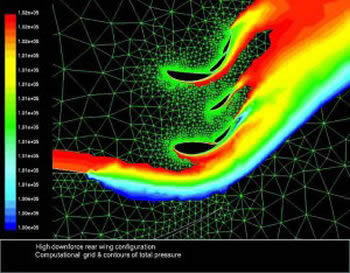
To get around the air stream separation problem in airplane wing construction and in Formula 1, and increase the Coanda effect on wings, dual or multi-element (slot-gap) wings are used. These allow some of the high-pressure flow from (in the Formula 1 case) the upper surface of the wing to bleed to the lower surface of the next flap, energising the flow. This increases the speed of the flow under the wing, increasing downforce and reducing boundary flow separation.
The Coanda effect has important applications in various high-lift or high-downforce devices on aircraft and, in the context of racing, on car wings, where air moving over the wing can be bent using flaps over the curved surface. The bending of the flow results in its acceleration and, as a result of Bernoulli’s principle, pressure decreases; aerodynamic lift or downforce increases.
Clarifying the Coanda Effect’s Role
It is unlikely for a wing in flight to have airflow on only one side. The Coanda effect works under specific conditions where an isolated jet of fluid (or air) flows across a surface – a situation that is usually man-made and rarely found in nature. Just so you know, there is no Coanda lift on an airfoil. The Coanda effect helps the airstream stay attached to the wing surface, but Bernoulli’s principle and pressure differences are the actual reasons for lift or downforce.
The Coanda effect is a balancing act between many factors, including stream speed, pressure, molecular attraction, and centrifugal effects if the surface is curved.
The main limitation of the Coanda effect is that the airstream can become turbulent and detach from the surface – that is how a wing stalls. The pull of surrounding air causes turbulence, and drag from both the surface and the ambient air reduces the stream’s energy. If the airstream becomes turbulent and stops following the curved surface, there is no more low air pressure and no more thrust.
Applications in Formula 1
Since all applications of the Coanda effect involve a fluid flowing over a solid surface, the underlying science is known as fluid dynamics.
The Coanda effect is used throughout a modern Formula 1 car – sometimes to generate downforce directly, but often to guide and condition airflow in one area as a means of maximising downforce elsewhere. For example, the rear of a modern Formula 1 car is tightly tapered between the rear wheels, like the neck and shoulders of a Coke bottle. By means of the Coanda effect, the air flowing along the flanks of the sidepods adheres to the contours at the rear, and the airflow is accelerated, creating lower pressure. In itself, this transverse pressure differential on either side of the car cancels out and creates no net force. However, the accelerated airflow between the rear wheels and over the top of the diffuser raises the velocity of the air exiting the diffuser. In addition, bending air away from the rear tyres contributes to reducing drag.
The Coanda effect is also used by the bargeboards, aerodynamic appendages typically sited between the trailing edge of the front wheels and the leading edge of the sidepods. Bargeboards guide turbulent air from the front wing wake away from the vital airflow underneath the car. In addition, the lower trailing edge of a bargeboard creates a vortex that travels down the outer lower edge of the sidepod, acting as a skirt and helping to seal the lower-pressure area under the car.
Exhaust-Blown Diffusers and the Coanda Effect
At the end of 2011, exhaust-blown diffusers were prohibited by the FIA. Stringent requirements were placed on the location of the exhaust exit, and engine mapping restrictions were imposed to eliminate off-throttle pumping of the exhaust jet.
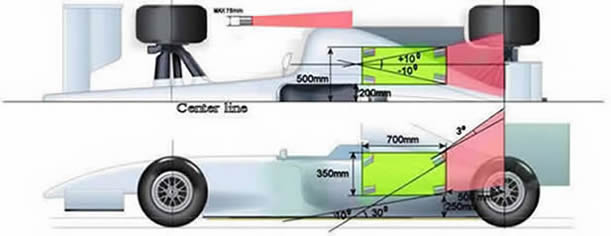
In short, these rules moved the exhaust exit to at least 500 mm in front of the rear axle line and 250 mm above the reference plane underneath the car. The exhaust exit also had to be angled upward by at least 10 degrees. Hence, it was no longer possible to blow the exhaust directly between the outer edge of the diffuser and the inner face of the rotating rear wheel. Moreover, it became illegal to place any sprung bodywork in a cone-shaped region aligned with the exhaust exit, diverging at 3 degrees and terminating at the rear axle line.
The new positioning of the exhaust pipe exits and limitations are shown in the picture below. Exits of the pipe can be positioned inside the green box with the exhaust tailpipe pointed upward.
How Teams Worked Around the Ban
These regulations were not sufficient to eliminate exhaust-blown diffusers entirely. While it was not possible to point the exhaust exit directly down at the diffuser as before, this did not necessarily prevent the exhaust jet itself from blowing in that direction. When an exhaust jet exits into a cross-stream of fresh air, the exhaust jet bends with the air stream, an effect called “downwash.”
|
Picture from paper published by F. L. Parra and K.Kontis in their 2006 , Aerodynamic effectiveness of the flow of exhaust gases in a generic formula one car configuration |
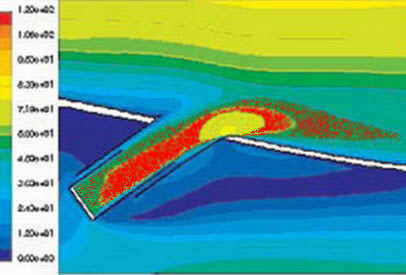
If the exhaust exit is placed flush in the rearward face of the sidepods, sweeping downward at a fairly steep angle, the free-stream airflow can deflect the exhaust jet downward toward the diffuser. The degree to which the jet is deflected is determined by the ratio between the velocity of the jet and the velocity of the cross-stream flow. The smaller the ratio, the more the jet is deflected. This effect is well documented and often termed “jet in cross-flow.”
After that, the Coanda effect takes over and “glues” the now-energised airstream (mixed with the exhaust jet) to the bodywork. Of course, the secret is to design this part of the bodywork and the bodywork in front of the exhaust exit in a way that optimises this effect and gives a proper and exact route for the gases to flow downward toward the diffuser. The effect of diffuser blowing is not as strong as before, but with clever design and optimisation, you can get a few per cent more of downforce. With this setup, the exhaust plume is curved downward by both the shape of the bodywork aft of the tailpipe (Coanda effect) and by the airflow passing over the sidepod (downwash). To learn more about exhaust-blown diffusers, check my article here.