Clutch
Basic Function
A clutch is a mechanism for transmitting rotation that can be engaged and disengaged. Clutches are essential in cars and other devices that have two rotating shafts. In these devices, one shaft is typically driven by a motor, and the other shaft drives another device, such as a gearbox in the case of cars.
The gasoline or diesel engine has a limited output bandwidth of approximately 1,000 to 6,000 or more RPM. An internal combustion engine cannot operate from 0 RPM (unlike an electric motor), so it needs a device – the clutch – to disconnect it from the drive train so that it can idle while the car, or any other equipment driven by an ICE, is at a standstill.
How a Road Car Clutch Works
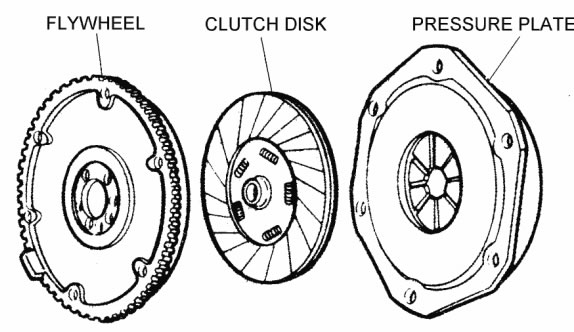
The clutch is integrated with the engine’s flywheel. A disc with friction material, similar to a brake pad, is connected to the transmission input shaft on a sliding
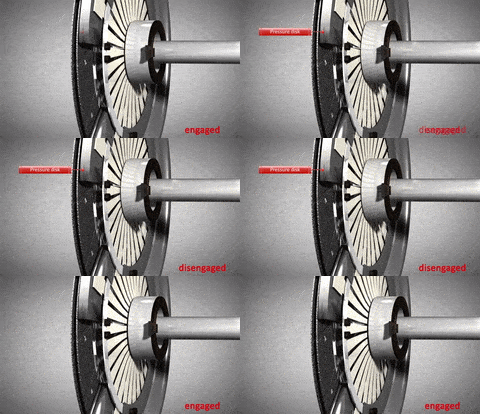
spline. This disc is sandwiched between the flywheel surface on one side and the pressure plate surface on the other. The pressure plate is spring-loaded to squeeze the clutch disc against the flywheel, effectively creating a solid connection. The pressure plate can be moved by pressing down on the clutch pedal, which releases the coupling pressure between the flywheel and the clutch disc so that they can rotate independently.
Three States of the Clutch
CLUTCH DISENGAGED (pedal pressed down): The engine flywheel and the clutch disc can rotate independently. No power is being transferred.
CLUTCH SLIPPING (pedal brought up to the point where the clutch starts to grab): The engine flywheel and the clutch disc are still rotating at different speeds, but some power is being transferred. If the clutch pedal is continued to be brought up properly, the speed of the engine and the clutch disc will equalise. This is the state in which clutch wear occurs.
CLUTCH ENGAGED (pedal up): The engine flywheel and the clutch disc are locked together. Full power is being transferred, and no clutch wear is occurring.
Clutch Materials
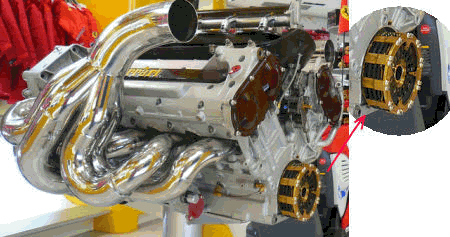
There are many different vehicle clutch designs, but most (at least those of interest here) are based on one or, in the case of Formula 1, multiple friction discs pressed tightly together or against a flywheel using springs. The friction material varies in composition depending on whether the clutch is dry or wet, and on other considerations. Clutches found in heavy-duty applications such as trucks and competition cars use ceramic or carbon plates that have a greatly increased friction coefficient. However, these have a “grabby” action and are unsuitable for road cars.
The spring pressure is released when the clutch pedal is depressed, either pushing or pulling the diaphragm of the pressure plate depending on the type, and the friction plate is released and allowed to rotate freely.
The F1 Clutch
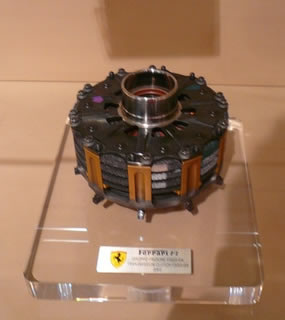
The F1 clutch consists of three (or more) plates which, when held together with a strong compressive force, provide a solid connection between the driveshaft and engine. When the driver pulls the clutch paddle (in F1, the clutch is a paddle on the steering wheel), the on-board computer sends a signal to a hydraulic actuator, and the compressive force on the clutch plates is released. The plate connected to the engine can then spin freely, while the one attached to the driveshaft and gear wheels in the gearbox remains still. This allows a new gear to be selected before the clutch paddle is released, and the pressure on the clutch plates holds them together once again. The same process occurs when the on-board computer commands the clutch to open during a gear change.
The Semi-Automatic Gearbox Era
In the world of the F1 semi-automatic and seamless gearbox, there is no need for the driver to think about the clutch during gear changes – everything is electronically controlled. All the driver must do is pull the gearshift paddle on the back of the steering wheel when changing up or down a gear, and the electronics controlling the gearbox and clutch do the rest. The advantages, beyond allowing the driver to keep both hands on the wheel at all times, are that the entire process takes a split second (much quicker than a manual clutch could be operated) and that clutch pad wear is reduced because the clutch is never held half-engaged, increasing reliability.
Size of an F1 Clutch
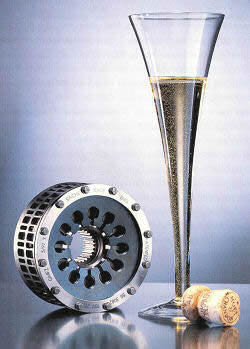
The wineglass and champagne bottle cork provide a remarkable
prospective for this ZF Sachs Formula 1 clutch. Though tiny, only 111 mm in diameter, it can transmit more than 900 horse power.
External Clutch Disengagement
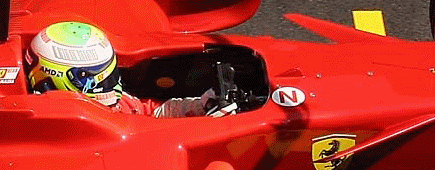
For safety reasons, all cars must have a means of disengaging the clutch that is operable from outside the cockpit by marshals. This control is usually situated just ahead of the cockpit opening and is marked on the car’s body by a red letter “N” within a white circle.
Manufacturers
For more about road car clutches, see the road car clutch article.
Two manufacturers, AP Racing and ZF Sachs, produce carbon/carbon F1 clutches.