Chimney or Funnel
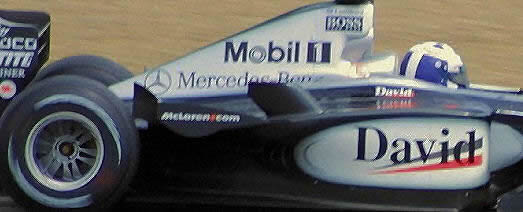
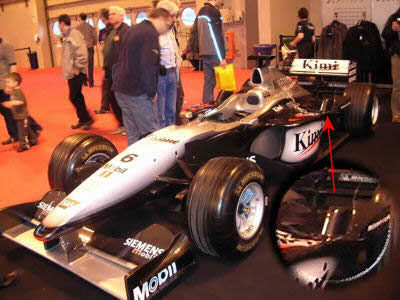
Chimney at McLaren MP4-14
Origin of the Chimney Design
The “chimneys” or “funnels” in front of the rear wheels were a notable innovation by McLaren. These outlets do not vent engine exhaust gases but rather hot air from the radiators. Several other teams copied this design in 2001. The principle behind it is straightforward: the aim is to direct airflow either side of the rear wing. Because the outlets sit above the main flow passing close to the sidepod surface, they do not significantly alter the car’s aerodynamics. Additionally, positioning the outlet further forward allowed the sidepods to be narrower between the rear wheels.
This solution became known as a chimney and was adopted by almost all teams at some point, either as a permanent fixture or as an aid to improve cooling requirements in certain situations and circuits.
How Chimneys Affect Airflow
The air passing through the radiators is not governed by throttle position but depends on car speed. Increasing the throttle makes the engine draw more air and thus generate more exhaust gases. Radiators, however, are supplied with air flowing in through the sidepods solely due to the movement of the car. The effect of engine exhausts on downforce during acceleration is therefore slightly faster than that of radiator air. On the other hand, it is very beneficial to vent hot radiator air as quickly as possible, because retaining it under the bodywork increases the engine temperature.
|
|
| |
Ferrari f2002 chimney with exhaust |
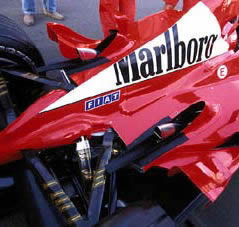
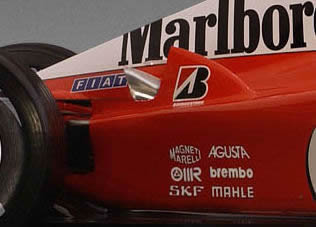
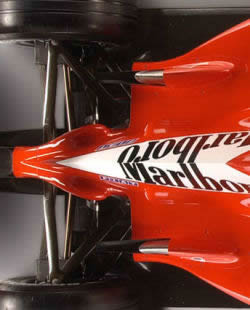
Ferrari’s F2002 Chimney-Exhaust System
In 2002, Ferrari’s F2002 made use of an aerodynamic effect that employed the very fast flow from the exhaust pipe to accelerate cooling flow through a chimney duct, effectively acting as a pump to scavenge hot air from the sidepods. This was accomplished by creating a pressure gradient and venturi effect, a phenomenon sometimes referred to as “aspiration.” The increase in speed of the air over the chimney creates a low-pressure region that draws out air from the sidepods, aiding the radiators in cooling the engine. The distinctive tall arched outlets around the sidepods were subsequently adopted by other teams, both as permanent and optional cooling solutions.
This concept was studied by Parra and Kontis in their 2006 paper, Aerodynamic effectiveness of the flow of exhaust gases in a generic formula one car configuration, published in the The Aeronautical Journal:
“Due to the characteristic configuration of a Formula One car, the exhaust pipes pass through the chamber located directly behind the radiators. This chamber is normally shaped so that it enhances the outflow of gases. However, an extra outflow could be generated by inserting the exhaust pipe into a bigger diameter duct to create a mixing stream. Such mixing is believed to generate an aspiration along the outer duct, based on the same principles of operation as an ejector pump. Because this enveloping duct connects the chamber behind the radiator with the atmosphere, an outflow of gases through this passage would increase the efficiency of the radiator,” (p574).
Drawbacks
The downside of this solution was that both the exhaust and cooling flows went directly into the rear wing, hindering its efficiency. Hot air is not as dense as cold air, which diminishes wing effectiveness.
A second problem was the very hot air blowing over the wing at temperatures of several hundred degrees Celsius. Special shielding was required to protect the carbon fibre material. This protection can be seen applied to the upper suspension wishbone in gold colour in the images above.
A third problem was that the air speed over the wing varied depending on throttle position.
However, the overall gains outweighed these drawbacks. The coke-bottle area could be made tighter, greatly improving airflow at the rear of the car.
Radiator Mounting Innovation
Allied to the exhaust fairing outlet, Ferrari placed the radiators at a compound angle within the sidepods. Typically, radiators are angled in one dimension, either vertically or horizontally, usually with both oil and water cores in a single panel. By angling the radiator in a compound manner, Ferrari was able to increase the radiator surface area (panel area is more important to cooling than core thickness) without enlarging the sidepods. This approach was eventually adopted by every team.
The 2009 Regulation Changes
As a result of the 2009 rule changes, cars appeared quite different from their predecessors. The removal of the vast majority of bargeboards, winglets, chimneys, and cooling gills led to much cleaner-looking designs. Gone were the fairings on the front suspension pickup points (where the suspension attaches to the monocoque), and the use of turning vanes was restricted to a small triangular section in front of the sidepods. Cooling vents, chimneys, and winglets were noticeably absent from the top of the sidepods, and there were no winglets on top of the rear axle.