CFD
Computational Fluid Dynamics
Introduction
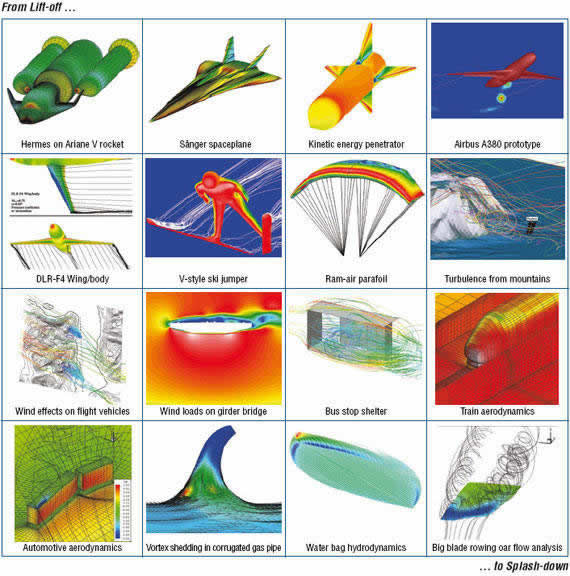
Since the introduction of supercomputers in the 1980s, the use of Computational Fluid Dynamics (CFD) for solving fluid flow problems has increased dramatically as a numerical tool across many areas of engineering.
The overview below illustrates some CFD projects through the years, focusing on space transportation systems, aeronautics, sport aerodynamics, building aerodynamics, and surface transportation. The marine aspect of CFD analysis shares many commonalities with the topics illustrated here.
CFD and Formula 1
The development of wind tunnel technology that Formula 1 has offered to the world, important though it has been, pales into insignificance alongside the rapid growth of Computational Fluid Dynamics (CFD). With a wind tunnel, experiments are conducted by blowing wind over a real object in a controlled environment and measuring the aerodynamic forces that arise. In CFD, the same experiment may be conducted in the form of a computer simulation.
Although the equations that govern these computations have been understood since the 1930s, they are very complex to solve and require the sort of computing power that has only become available in the last 10 to 15 years.
A huge range of industries benefit from the mastery of aerodynamic design that a successful CFD programme enables. It is probably no surprise that the aerospace, road car, and wind turbine industries use CFD in their design process. It might be less obvious that it also brings significant advantage in hundreds of other industries. In any application where there is any sort of fluid (gas or liquid) flow, CFD can bring benefit. Climate modelling, the force of wind on a building, the way in which medicine is distributed in an inhaler, efficient air conditioning design, and transport of gas or liquids in pipelines are just a few examples; the list of applications is truly enormous.
All of these applications benefit, to a greater or lesser extent, from the investment that Formula 1 has made in the growing technology of CFD. For a sustained period of around 20 years, the teams in Formula 1 have invested money into the development of CFD systems and programs, as it has been clear for a long time that this tool would be a useful prerequisite for success in the sport. Teams have sponsored the development of improved CFD techniques at top universities and have also put money directly with the providers of commercial CFD software to ensure that the considerable challenge of accurately simulating the aerodynamic behaviour of a Formula 1 car has turned from an aspiration to a reality. It would be wrong to pretend that the development of subsonic CFD codes has been the sole responsibility of the Formula 1 industry, but no serious observer would deny that the combined investment of the teams has been very significant.
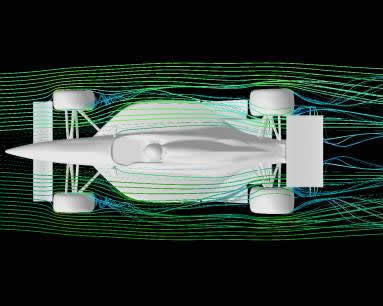
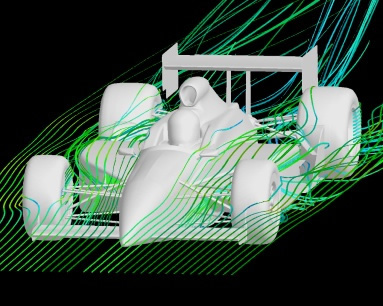
In the racing car industry, CFD is an emerging science in the aerodynamic design area. During the last decade, aerodynamicists have found a growing interest in using computers and CFD methods to simulate wind tunnel tests or track conditions. In brief, CFD codes simulate the flow over a car through mathematical modelling and solving of a discrete model.
|
|
Why Teams Use CFD
There are three compelling reasons why F1 teams and the wider industry use CFD software: insight, foresight, and efficiency.
Insight
If a device or system design is difficult or expensive to prototype or test through experimentation, CFD analysis enables engineers to virtually examine the design and see how it performs. There are many phenomena that can be observed through CFD which would not be visible through any other means. CFD provides a deeper insight into designs.
Foresight
Because CFD is a tool for predicting what will happen under a given set of circumstances, it can quickly answer many “what if?” questions. A set of boundary conditions is provided, and the software produces outcomes. In a short time, engineers can predict how a design will perform and test many variations until they arrive at an optimal result. All of this can be done before physical prototyping and testing.
Efficiency
The foresight gained from CFD helps teams design better and faster, save money, meet regulations, and ensure FIA rules compliance. CFD analysis leads to shorter design cycles, enabling teams to get their car to the track faster. In addition, equipment improvements are built and installed with minimal downtime. CFD is a tool for compressing the design and development cycle, allowing for rapid prototyping.
|
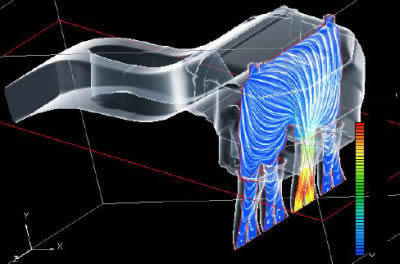
2010 Yamaha YZR M1 MotoGP engine air box air flow, speed and pressure |
CFD and Wind Tunnel Synergy
Nowadays, CFD and FEA are essential tools for the design and development of racing cars, complementing wind tunnel research. It is possible to test a car prior to any wind tunnel session, so as to pre-evaluate various configurations and submit for testing only the most promising solutions.
CFD substantially helps with understanding the phenomena involved in fluid flows, permitting accurate display and analysis of information with a level of detail that is hard to provide experimentally.
Some other examples of CFD applications:

|
|
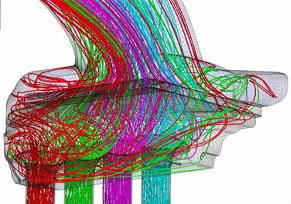
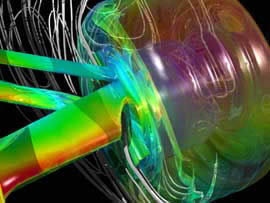
Air flow of air entering cylinders of racing car | Air flow around front F1 wheel |
BMW Sauber’s “Albert” Supercomputer
Computational fluid dynamics (CFD) offers apparently limitless options when it comes to the calculation process in the development of aerodynamic components. However, it does require extremely large computer-based capacity. To this end, the BMW Sauber F1 Team could count on one of the most powerful supercomputers not only in Formula One, but in the automotive industry as a whole. “Albert”, as the system was christened, was built using a total of 530 64-bit processors by Swiss firm DALCO. The software was supplied by Fluent.
CFD helps to calculate the design of aerodynamic components and is an important complement to wind tunnel work. Willy Rampf, former technical director, explained that aerodynamics had been gaining steadily in importance over recent years, and this meant that computational fluid dynamics had also become increasingly important.
Altogether, the Sauber supercomputer comprised 530 processors in a cluster architecture with dual nodes. The processors were installed in high-density cooling enclosures supplied by American Power Conversion (APC). These enclosures were self-contained, closed-loop water circuits providing up to 15 kW of cooling power per enclosure. The supercomputer comprised a total of ten enclosures, each one metre wide, 1.20 metres deep, and 2.30 metres high, resulting in a total width of ten metres and a weight of 18 tonnes.
The technical data was as impressive as the physical specifications: the supercomputer boasted peak performance of 2.3 Tflop/s and was equipped with 1 TB RAM and 11 TB of hard-drive storage.
To illustrate the point for non-computer experts, this means that “Albert” was capable of performing 2,332,000,000,000 computing operations per second. To achieve the same computing performance, the entire population of the city of Zurich (350,000) would have to multiply two eight-digit figures every four seconds for a whole year. BMW Sauber used all this power for calculations in CFD and FEA.
The virtually unlimited technical possibilities of the Sauber supercomputer were used for analysis in the field of aerodynamics. CFD and FEA were used in the computer-aided calculation of aerodynamic components for the Formula One race car. This involved the use of numerical grid models made up of a maximum of 100 million cells. Thanks to the supercomputer, it was possible to further refine these models, thus improving the quality of the results significantly. The extremely short calculation times possible with “Albert” allowed a large number of different variants to be evaluated. In addition, complex driving situations could be simulated. CFD played an important role in the development of front, rear, and auxiliary wings as well as in engine and brake cooling.
|
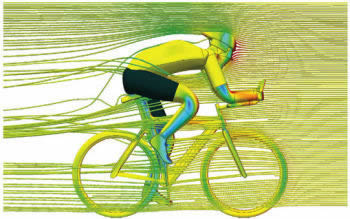
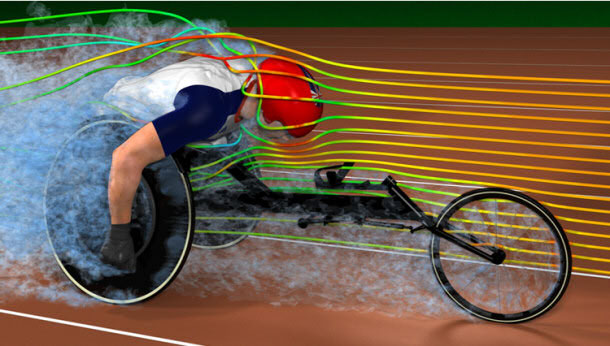
Unsteady CFD simulation and shape optimisation techniques were used to make gains for wheelchair and track cycling in 2012 (Courtesy of UKSport and TotalSim) |
CFD and Wind Tunnel: Complementary Tools
Computational fluid dynamics is intended to complement, rather than replace, the work carried out in the wind tunnel. Indeed, CFD and experimental work in the wind tunnel are closely interlinked and generate valuable synergies benefiting both disciplines.
In the development of a new front wing, up to 100 variants are evaluated in two-dimensional form before roughly half a dozen of them are analysed in 3D. The most promising versions are subsequently built for the 60-percent model and tested in the wind tunnel. CFD thus enables the wind tunnel to be used particularly efficiently.
CFD of full rear wing configuration pre 2008
The Challenge of Correlation
I have to say something about modern F1 cars. I doubt that there is any among all of them on the grid that has a complete correlation. A modern F1 car has so many difficult interactions between vortices, streams, wakes, etc. This area is extremely sensitive, and you only need a vortex stream to move by a few centimetres and it can really change the characteristics of the car quite a lot.
CFD Software Providers
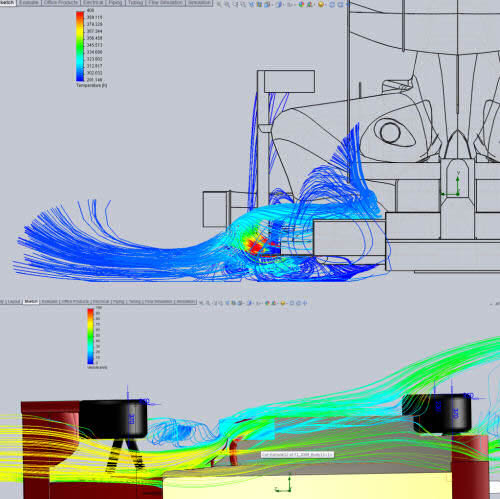
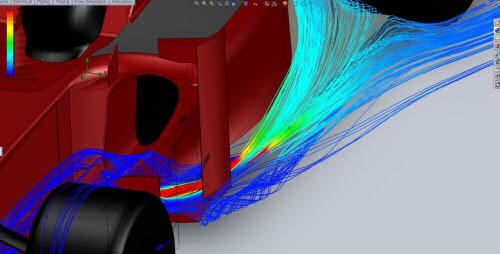
Only a few CFD software packages are capable of satisfying the demanding requirements of the Formula 1 world. Most teams use CFdesign, Flow Science, Fluent, ANSys, Metacomp Technologies, CD-adapco, and FieldView from Intelligent Light.
Aerodynamic Resource Restrictions
Aerodynamic resource restrictions in Formula One were introduced by FOTA in 2009 as a means to limit team expenditure on aerodynamics. These limitations were initially optional and open to abuse. Large investments were being made in full-scale wind tunnels, enormous computational clusters, and on-track testing, and costs were getting out of control. To prevent this, limits were placed on running full-size cars in a wind tunnel, track testing, wind tunnel usage time, and CFD usage. Limitations were introduced for the length of time the wind tunnel is switched on (with the speed above a nominal value) and harvested CFD teraflops (a measure of the computational usage of a CFD cluster).
For 2014, the testing restrictions were moved into an appendix to the sporting regulations and became enforceable by the FIA. They were no longer optional. Beyond this, the two main changes for 2014 were:
- A reduction in wind tunnel and CFD usage, limited to 30 hours and 30 teraflops
- The number of wind tunnel runs limited to 80, and occupancy time restricted to 60 hours (the length of time a model can be installed in the wind tunnel, having parts changed or ready to be tested)
Previously, a Formula 1 wind tunnel would typically run 24 hours a day, seven days a week, during which it could perform upwards of 200 runs, so the new restriction cut this down to roughly a third of the old run rate. Assuming that each wind tunnel run tests a new part, this represented a dramatic reduction in the number of components that could be tested.
The reduction in wind tunnel testing led to a greater emphasis on the use of CFD in the development process. Designing parts in CFD prior to tunnel testing allows all but the most promising directions to be filtered out without wasting tunnel runs and time.
Virgin Racing: A CFD-Only Approach
In 2010, three new teams were invited into Formula 1, and Virgin Racing F1 team technical boss Nick Wirth aimed to showcase CFD technology outside of Formula 1 by building a successful grand prix car with it.
Wirth designed Virgin’s maiden F1 car (VR-01) using only CFD instead of the traditional combined wind tunnel and CFD method used by all other Formula 1 teams. He had already used this method with Acura’s American Le Mans Series car.
Wirth highlighted the importance of CFD when reducing the costs of running a Formula 1 team, noting that the team pursued this approach because it was cheaper and faster. He argued that more accurate aerodynamic answers could be obtained for a given amount of money using this technology than any other method, and that more endplates, rear wings, and other components could be tried for the same budget than wind tunnel testing or full-scale testing would allow.
He acknowledged that the CFD approach had limitations, but insisted wind tunnel testing was no different. Both CFD and scale-model testing are approximations, and it is only when the car hits the track that the effect of factors that are tricky to model with any technology – such as the effect that the real stiffness of all bodywork components and joints has on the airflow – can truly be appreciated.
Update: Virgin CFD F1 Project After Two Years
In the middle of the 2011 season, and after two disappointing seasons in Formula One, Virgin parted ways with technical director Nick Wirth.
With Wirth Research behind their F1 cars, Virgin had entered Formula One with a car designed solely using CFD technology. However, the car proved unsuccessful in its first and second seasons, finishing at the bottom of the Constructors’ Championship in year one.
Although the team had expected better in 2011, Virgin again failed to deliver, as the car was not up to the task. Former Renault engineering director Pat Symonds was called in as a consultant, and he was believed to be behind the team’s new strategy.
Symonds was also reported to be supervising Virgin’s 2012 car. For the following year’s car, the team planned to use all available testing technologies, with both CFD and wind tunnel work in use.
Related Videos and Resources
Here you can see cool CFD video of F1 car CFD analysis demo by Advantage CFD (company now out of business). Video is showing BAR Honda F1 car (now out of business too) and must be from around year 2000 - 2003.
PETSc-FEM CFD simulation of flow around spinning projectile
Water pump design Automotive CFD
Formula One Split Wing CDG Aerodynamics
Supercomputing in F1 - Unlocking the Power of CFD (PDF) (Larsson T and Sato T. and Ullbrand B, Sauber Petronas, 2005)