Centre of Gravity Machine
The Importance of Precise Measurement
Centre of gravity in high-performance racing is no small matter. A fraction of a centimetre change in the balance point can make the difference between a solid performer and a car that the driver must fight through every competitive lap. Differences in engine placement and overall balance, along with other factors, significantly alter performance.
The centre of gravity (CoG) of any car has a profound effect on the way it drives, rolls, handles, and responds to driver inputs. A nose-heavy or tail-heavy car drives poorly – constructors and designers who overlook this will discover the consequences on track.
In the drive to extract the last tenths of a second from a car’s setup, proper steps to determine the CoG are essential. Sometimes, paperwork and blueprints alone are not sufficient.
Who Uses These Machines
All teams in Formula 1, Le Mans, and MotoGP, as well as every serious racing operation, own or use a contracted centre of gravity machine.
Engine manufacturers use smaller centre of gravity machines to test components such as gearboxes, transmissions, crankshafts, clutches, flywheels, pistons, rocker arms, connecting rods, steering wheels, and more. Reducing moment of inertia is especially important in car racing, where lower moment of inertia of moving engine and transmission components translates into a net gain in power transmitted to the wheels.
Center of gravity machine during Nike golf club testing
How They Work
|
Center of Gravity Measurement |
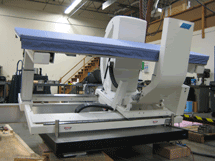
Large centre of gravity machines are used to test CoG on full-scale engines and entire cars. Lowering the centre of gravity is essential because it directly impacts stability and handling in curves.
To obtain the centre of gravity and moment of inertia in three axes, an object needs to be placed on the centre of gravity machine in three orthogonal positions.
The method involves tilting the car by 20 degrees in three axes and extrapolating the results for 90 degrees. The extraordinary precision of the instruments allows very accurate results with this method, to within approximately 0.1 mm for CoG.
|
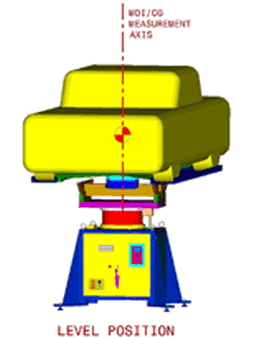
Space Electronics Equipment
Space Electronics is the best-known manufacturer of CoG machines and, to general knowledge, the only one that produces machines for full-scale car testing.
Over the past 50 years, they have sold more moment of inertia and centre of gravity instruments than any other company. They invented the spherical gas bearing spin balance machine, which uses two force transducers to determine both product of inertia and CoG offset in a single run. Their instruments are noted for extraordinary reliability, with some units in daily use for more than 20 years without malfunction. Larger instruments (KSR and MP Series) are used to measure moment of inertia and centre of gravity location of engines and entire vehicles or smaller aircraft.
|
Center of Gravity Measurement in NASA facilities. Thing on MP Series Space ElectronicsCenter of Gravity machine is a satelite |
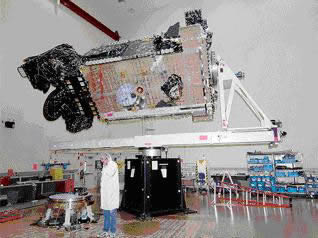
Space Electronics KSR series instruments offer the highest accuracy available for CG measurement through the use of closed-loop force rebalance technology. Since their development more than 20 years ago, KSR systems have proven superior to conventional passive technology such as load cells. These instruments have a dynamic range greater than 30,000 to 1. One instrument can cover a range of payload weight previously requiring two machines. These instruments are available in a variety of sizes and measure both centre of gravity and moment of inertia.
Key features include:
CENTRE OF GRAVITY measurement along two horizontal axes in a single setup with better than +/- 0.025mm accuracy for payloads weighing as little as 4% of machine capacity.
MOMENT OF INERTIA measurement around a vertical axis with accuracy better than +/- 0.1%.
UNBALANCE MOMENT is measured directly. Corrections can be made with the test part mounted and changes in CG observed immediately.
CORRECTION WEIGHTS and locations computed to achieve test part static balance.
The Seven-Post Rig
When an F1 team has problems with the balance of the car, is not using its tyres properly, or is trying to extract the last tenths of a second from the car’s setup, one approach is to examine the setup in detail using a centre of gravity machine called a seven-post rig.
This is a hydraulically driven device onto which the car is mounted, simulating the forces it experiences on track. A seven-post rig in motion is quite a sight – it vividly demonstrates how violently an F1 car is shaken when it is on the limit. Technicians then work with the collected data to prepare for the next race in the best possible way.