Centre of Gravity
Why It Matters
The centre of gravity is perhaps the single most critical aspect of any racing car’s weight consideration. It must be as low as possible relative to the ground, not only because the car’s weight acts through it, but also because all accelerative forces – acceleration, braking, and cornering – work through it.
Any force that acts through the CoG has no tendency to make the car rotate.
Centre of gravity location can be defined as:
The balance point of an object
The point through which a force will cause pure translation
The point about which gravity moments are balanced
The centre of gravity (CoG) is also called the centre of mass.
Measuring CoG Location
The centre of gravity location must be referenced to a three-dimensional coordinate system. CoG location is directly a function of the coordinate system in which it is referenced. It is measured relative to a reference datum using moment balance equations.
If a force is applied in a direction that does not pass through the CoG, it will make the car rotate unless balanced by another force. For a racing car, the CoG is located between the front and rear wheels and as close to the ground as physically possible.
Effects on Vehicle Dynamics
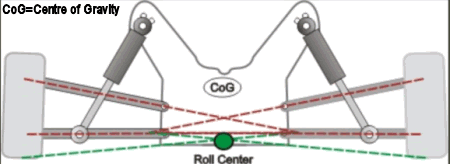
You know from travelling in a road car that when the driver brakes, the car dives down at the front. Equally, you have experienced rolling in corners, and squat – the car sitting down under acceleration if you put your foot down hard enough. These movements you feel are accelerative forces, and they are acting through the centre of gravity. Much of their control is owed to suspension design, but a high centre of gravity won’t help. Lower centre of gravity – less rolling, squatting and diving, less weight transfer.
Longitudinal and Lateral Positioning
Designers are interested not only in the vertical position of the centre of gravity but also its lateral and longitudinal placement. The CoG must be on the centreline of the car, and its position between the front and rear wheels determines how braking and accelerative forces are distributed between front/rear and left/right wheels. It is good to have the static weight distribution tuned so that the centre of gravity is positioned closer to the rear of the car, as this puts more weight on the rear wheels and provides more traction, but some F1 teams think differently (see Weight Balance).
Polar Moment of Inertia
As well as this, the vehicle should have a low polar moment of inertia. This basically means how easy it is to move the car around, and if the designer concentrates the weight close to the centre of gravity, he can achieve this, and obtain a responsive race car. These criteria are also dependent on where the wheels are positioned. F1 wheelbases are so long that with a low centre of gravity and stiff suspension, squat and dive are significantly minimised. Wheelbase changes are often made to alter static load distribution and reduce weight transfer rather than to improve stability.
Centre of Gravity Measurement
There are only a few companies in the world manufacturing centre of gravity machines. They are highly sophisticated and expensive pieces of equipment.
One of them is Space Electronics, the world’s leading manufacturer of aerospace mass properties measurement instruments.