Caster (or Castor) Angle
Definition
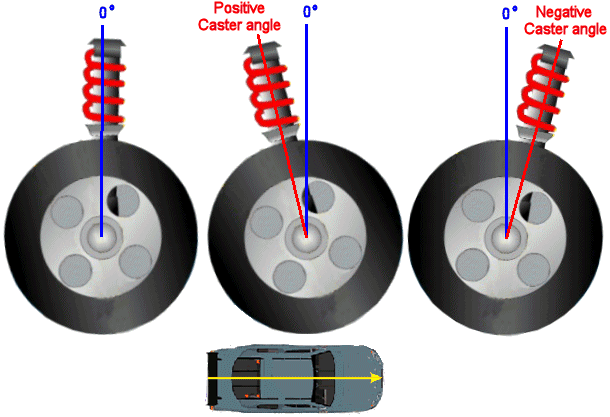
In simple terms, the caster angle is the steering axis’s angle of inclination relative to the vertical. More precisely, caster (or castor) angle is the angular displacement from the vertical axis of the suspension of a wheel, measured in the longitudinal direction (the angle of the kingpin when viewed from the side of the car). This can be relatively easy to spot on a single-seater racing car, as the push/pull rod is exposed and the angle between the upper and lower wishbone pickup points on the wheel hub is clearly visible. The angle at which the rod leans back or forward provides a rough indicator of how much caster angle the car has, as it has to pass through the gaps in the wishbones from the base of the hub to reach the chassis.
It is the angle between the pivot line (an imaginary line running through the centre of the upper ball joint to the centre of the lower ball joint) and the vertical. Caster angle can be adjusted to optimise a car’s handling characteristics for particular driving situations.
Purpose and Effect
The pivot points of the steering are angled so that a line drawn through them intersects the road surface slightly ahead of the contact point of the wheel. The purpose of this is to provide a degree of self-centring for the steering – the wheel casters around so as to trail behind the axis of steering. This makes a car easier to drive and improves its straight-line stability by reducing its tendency to wander.
Improper adjustment will result in steering inputs required both into and out of corners, producing a car that is difficult to keep on a straight line. Too much caster (positive caster) and the front of the car will understeer more; too little (negative caster) and the car will exhibit oversteer handling characteristics. A large positive caster setting (wheel facing forward of the axis) is good for high-speed stability but can make steering heavier and less responsive. Excessive amounts will increase tyre wear.
Excessive caster angle will make the steering heavier and less responsive, although in off-road racing, large caster angles are used to improve camber gain in cornering.
Caster Angle in Formula 1
All F1 cars run with at least a few degrees of positive caster angle – as far as I am aware there is no need to use a negative angle – and in some cases it can be over 10 degrees. The reason for this is, as I explained before, that it has a strong self-centring effect on the steering as torque is applied. The higher the angle, the more self-centring the steering feels.