
Carbon Fibre Reinforced Composite Materials
What Are Composites?
Composites are defined as materials in which two or more constituents have been brought together to produce a new material consisting of at least two chemically distinct components, with resultant properties significantly different from those of the individual constituents. A more complete definition also demands that the constituents must be present in reasonable proportions – 5% by weight is arbitrarily considered to be the minimum. The material must furthermore be “man-made,” meaning it must be produced deliberately by intimate mixing of components. An alloy that forms a distinct two-phase microstructure as a consequence of solidification or heat treatment would not be considered a composite. If, on the other hand, ceramic fibres or particles were mixed with metal to produce a material consisting of a dispersion of ceramic within the metal, this would be regarded as a composite.
On a microscopic scale, composites have two or more chemically distinct phases separated by a distinct interface. This interface has a major influence on the properties of the composite material. The continuous phase is known as the matrix. Generally, the properties of the matrix are greatly improved by incorporating another constituent to produce a composite. A composite may have a ceramic, metallic, or polymeric matrix. The second phase is referred to as the reinforcement, as it enhances the properties of the matrix. In most cases, the reinforcement is harder, stronger, and stiffer than the matrix.
Types of Fibre Reinforcement
Fibre reinforced composite materials can be divided into two main categories: short fibre reinforced materials and continuous fibre reinforced materials.
Continuous reinforced materials often constitute a layered or laminated structure. The woven and continuous fibre styles are typically available in a variety of forms: pre-impregnated with the given matrix (resin), dry, unidirectional tapes of various widths, plain weave, harness satins, braided, and stitched.
Short and long fibres are typically employed in compression moulding and sheet moulding operations. These come in the form of flakes, chips, and random mat (which can also be made from continuous fibre laid in random fashion until the desired thickness of the ply or laminate is achieved).
CFRP: Carbon Fibre Reinforced Plastic
Carbon fibre reinforced plastic (CFRP or CRP) is a very strong, light, and expensive composite material, also known as fibre reinforced plastic. Similar to glass-reinforced plastic (sometimes known as fibreglass), the composite material is commonly referred to by the name of its reinforcing fibres (carbon fibre, glass fibre). The plastic is most often epoxy, but other plastics such as polyester, vinyl ester, or nylon are also sometimes used.
Some composites contain both carbon fibre and other fibres such as kevlar, aluminium, and fibreglass reinforcement. They are known as hybrid composites.
F1 monocoque - hybrid composite structure
The terms graphite-reinforced plastic or graphite fibre reinforced plastic (GFRP) are also used but less commonly, since glass-fibre-reinforced plastic can also be abbreviated GFRP.
Carbon fibre composite has many applications in aerospace and automotive fields, as well as in sailboats, modern bicycles, motorcycles, and sports cars where these qualities are important. Improved manufacturing techniques are reducing costs and production time, making it increasingly common in small consumer goods as well, such as laptop computers, tripods, fishing rods, and racquet sports frames.
Thermal Characteristics
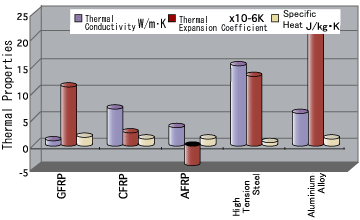
Comparison of thermal characteristics:
GFRP Glass Fiber Reinforced Plastics
CFRP Carbon Fiber Reinforced Plastics
AFRP Aramid Fiber Reinforced Plastics
CFRP in Formula 1
Carbon Fibre Reinforced Plastics (CFRP) is superior to steel or glass fibre reinforced plastics (GFRP) in its specific tensile strength and specific elastic modulus (specific rigidity). In other words, CFRP is light in weight yet strong in its mechanical performance. Composites are largely unrivalled as a material for impact absorption, with a specific energy absorption (SEA, measured in kJ per kg of material used) far higher than their metallic counterparts, provided sufficient optimisation.
The decision to use CFRP for impact absorption is straightforward. Comparing the SEA of various materials, steels achieve about 12 kJ/kg while aluminium reaches around 20 kJ/kg. However, a well-optimised carbon fibre structure (one with an optimised layup/fibre orientation and component geometry) can absorb anything from 40 kJ/kg up to 70 kJ/kg in a highly refined and tested design.
From a safety perspective, CFRP does not look likely to be superseded as Formula One’s material of choice any time soon.
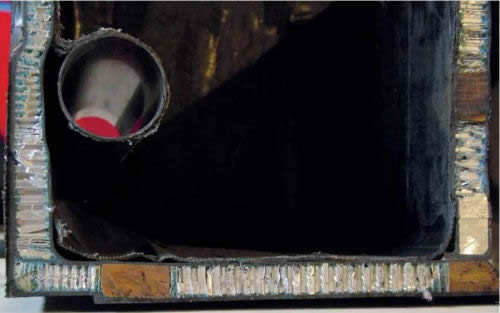
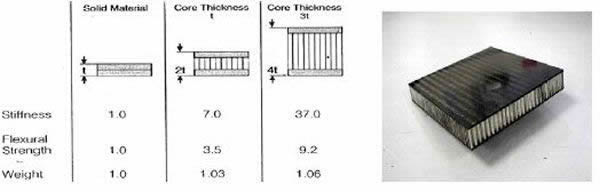
Composite honeycomb structure
Further Reading
Composite Materials Technology in Formula 1 Motor Racing (PDF) (Honda Racing F1, Gary Savage, 2008)