
Carbon/Carbon
|
Carbon/carbon is used in manufacturingof F1 clutches, brake rotors and pads |
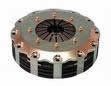
Composition and Properties
Carbon-carbon composites consist of highly ordered graphite fibres embedded in a carbon matrix. C/C composites are made by gradually building up a carbon matrix on a fibre preform through a series of impregnation and pyrolysis steps or chemical vapour deposition. C/C composites tend to be stiffer, stronger, and lighter than steel or other metals.
Manufacturing Methods
Processing carbon-carbon composites involves building up the carbon matrix around the graphite fibres. There are two common methods for creating the matrix: chemical vapour deposition and resin application.
Chemical vapour deposition (CVD) begins with a preform in the desired shape of the part, usually formed from several layers of woven carbon fabric. The preform is heated in a furnace pressurised with an organic gas, such as methane, acetylene, or benzene. Under high heat and pressure, the gas decomposes and deposits a layer of carbon onto the carbon fibres. The gas must diffuse through the entire preform to create a uniform matrix, so the process is very slow, often requiring several weeks and multiple processing steps to produce a single part.
In the resin application method, a thermosetting resin such as epoxy or phenolic is applied under pressure to the preform, which is then pyrolised into carbon at high temperature. Alternatively, a preform can be built up from resin-impregnated carbon textiles (woven or non-woven) or yarns, then cured and pyrolised. Shrinkage in the resin during carbonisation results in tiny cracks in the matrix and a reduction in density. The part must then be re-injected and pyrolised several times (up to a dozen cycles) to fill in the small cracks and achieve the desired density. Densification can also be accomplished using CVD.
A limiting factor on the use of carbon-carbon composites is the manufacturing expense associated with these slow and complex conventional methods.
Carbon Nanotubes
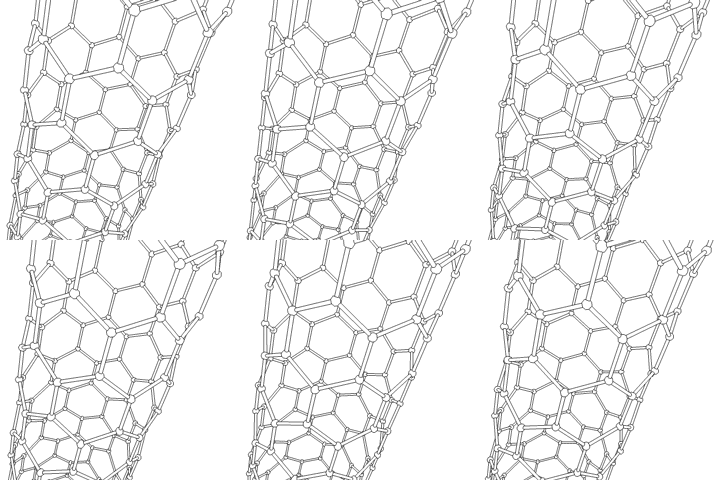
Carbon-carbon nanotube
A more recent development is the use of carbon nanotubes. The strength of the sp2 carbon-carbon bonds gives carbon nanotubes remarkable mechanical properties. The stiffness of a material is measured in terms of its Young’s modulus, the rate of change of stress with applied strain. The Young’s modulus of the best nanotubes can be as high as 1,000 GPa, which is approximately five times higher than steel. The tensile strength, or breaking strain, of nanotubes can be up to 63 GPa, around 50 times higher than steel. These properties, coupled with the lightness of carbon nanotubes, give them great potential across all applications, but the limiting factor remains manufacturing expense.
Related Articles
To learn more about carbon, see the articles on Carbon fibre and Carbon fibre composites.