Paintwork and Livery in Formula 1
Historical Background
From the beginning of organised motor sport events in the early 1900s until the late 1960s, before commercial sponsorship liveries came into common use, vehicles competing in Formula 1, sports car racing, touring car racing, and other international competitions were customarily painted in standardised racing colours that indicated the nation of origin of the car or driver. These were often quite different from the national colours used in other sports or politics.
The advent of sponsorship initially led to some chaotic approaches, but gradually teams settled on presenting the same basic livery at each race in a season. Ferrari stayed with Italian racing red, Ligier adopted French blue, Lotus claimed black and gold, and Jordan grabbed green before switching to yellow because it attracted more sponsorship money. Television viewers and fans at the track are able to instantly recognise the cars.
Livery Design
When a new car is revealed, fans see the livery and quickly become accustomed to it as an identifier of the team, rarely considering how it was designed or what it aims to achieve. Yet the livery is crucial to the team’s identity, as it is the main showcase for both the team and its sponsors, so considerable thought goes into the look and feel of every car.
A livery is a statement of intent and a statement of who the team is.
Depending on budget, teams conduct extensive screen tests in front of television cameras when developing a livery. If not on video, they do it photographically, because understanding how colours perform digitally is essential. Teams use 3D visualisation software that allows them not just to render the car but to create entire virtual environments, including racing backgrounds, all looking hyper-realistic. They use real CAD data with the actual car shape and apply different skins to it, helping to quickly identify what works and what does not.
Paint Weight Considerations
The type of paint is critically important. Paints are specially developed for carbon fibre and specifically for Formula 1. They must be light and have good covering properties to save weight. One advantage of having a black car, for example, is that fewer layers of paint are needed to cover the black carbon fibre compared to a white car, saving weight – potentially worth up to half a tenth of a second per lap. Painting a Formula 1 car white requires three or four layers and one top coat, using around 4 kg of paint. A black car needs only one base layer and one top coat, saving approximately 30% of paint. At a circuit like Barcelona, in pure performance terms, that equates to about four seconds over a 66-lap race. Although the cars must meet a minimum weight, the saving still confers an advantage.
Sponsor Visibility
|
Ferrari F2003 livery before the tobacco sponsorship ban, when Vodafone was the Ferrari title sponsor with Shell as oil and fuel supplier |
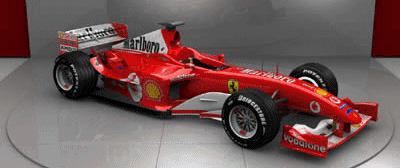
Sponsors pay significant sums to place their logos on the car, so visibility is paramount. The size and position of a sponsor’s logo depend on the financial commitment. Major sponsors such as Vodafone (in McLaren’s case after 2005) or AT&T (in Williams’s case after 2005) want their names prominently displayed on sidepods or rear wings.
Ferrari’s arrangement has historically been different. Title sponsor Marlboro (Philip Morris) paid Ferrari for the entire car surface, after which Marlboro could sell individual sections of car skin to other Ferrari sponsors, with Ferrari receiving a percentage of the earnings. There has been some suggestion that the team may face legal difficulties because the livery is based on a tobacco sponsorship now banned in most countries, but Ferrari has maintained there is no concern since no Marlboro symbol appears – only the red colour, which is (in a slightly different shade) Ferrari’s historical racing colour.
Comparison with NASCAR
By comparison, most large NASCAR teams have nothing in their liveries linking the cars together as belonging to the same team. They change liveries frequently and feature numerous small stickers on each car, creating a somewhat cluttered appearance. However, the advantage of the NASCAR approach is that major sponsors can change from one race to the next. There is no consistency aside from the car number.
Regulations
Both Formula 1 cars belonging to a team must retain their paintwork throughout the racing season. The F1 Sporting Regulations dictate that the two cars must be in the same colours, and teams must even obtain permission from the Formula 1 Commission to change the livery during a season. While this may seem restrictive, it ensures that fans always know which car they are looking at.
Every car must bear the start number of the respective driver; the number must be clearly visible from the side and front on a 25 cm TV screen.
The manufacturer’s logo must be visible on the front of the vehicle’s nose. The name of the driver must also be printed and clearly legible, either on the bodywork, the outside of the cockpit, or the helmet.
List of international auto racing colors
Regulatory Text
The FIA 2013 Formula One Sporting Regulations state:
**21) CAR LIVERY **
21.1 The provisions of the Code relating to national colors shall not apply to the Championship.
Both cars entered by a competitor must be presented in substantially the same livery at each Event, any change to this livery during a Championship season may only be made with the agreement of the Formula One Commission.
In order that the cars of each team may be easily distinguished from one another whilst they are on the track, the on board cameras located above the principle roll structure of the first car must be predominantly fluorescent red and the second car fluorescent yellow.
21.2 Each car will carry the race number of its driver (or his replacement) as published by the FIA at the beginning of the season. This number must be clearly visible from the front of the car.
**21.3 **The name or the emblem of the make of the car must appear on the front of the nose of the car and in either case be at least 25mm in its largest dimension. The name of the driver must appear on the external bodywork and be clearly legible.