Canards (Dive Plates) and Vortex Generators
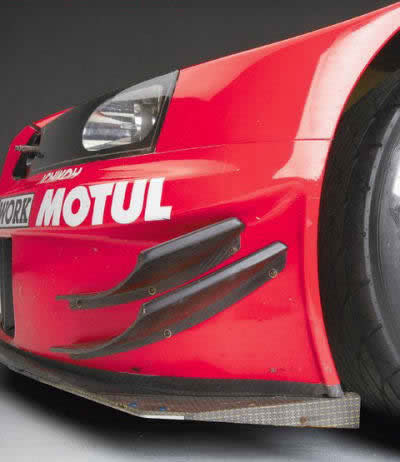
What Are Canards?
Also known as dive planes or dive plates, canards are small triangular wings attached to the front spoiler of a car for the purpose of modifying its aerodynamic characteristics in a modest way. Canards help generate downforce in two different ways. First, the canard redirects the oncoming air’s momentum upward, which causes a downward force on the canard. This effect is only moderate, since the velocity near the skin of the car is significantly slower than in the free stream because of the boundary layer effect. Dive plates are more trimming devices than anything else; they are too small to generate large amounts of downforce. Instead, they are used to fine-tune the vehicle handling before a race.
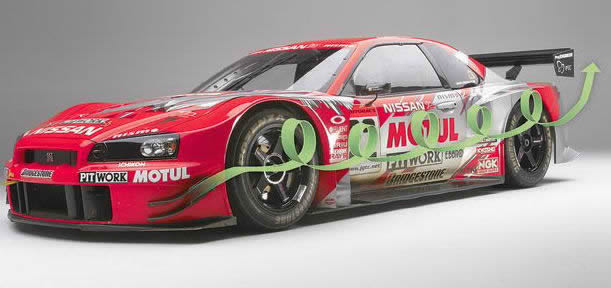
How Canards Generate Downforce
In addition, canards, together with vortex generators, produce strong vortices that travel down the sides of the car and act as a barrier. If the canards are positioned correctly, these strong vortices prevent high-pressure air around the car from entering the low-pressure underbody region, thus maintaining more downforce.
If air were allowed to enter the underside, the pressure would inevitably rise, reducing downforce. Therefore, these strong vortices act like a virtual curtain or dam, restricting higher-pressure air around the car’s sides from entering the underbody region.
Unfortunately, canards are not very efficient, since the strong vortices and the position of canards create a significant amount of drag. They are more useful for fine-tuning aerodynamic balance. Once installed, bumper canards provide a small additional amount of downforce at the front of the vehicle, adjusting the balance of traction and thus improving the handling characteristics of the car.
Vortex Generators
Very often, front bumper canards are fitted together with vortex generators. Vortex generators are smaller triangular winglets fitted a few centimetres above the larger canards. Vortex generators help to guide the airflow on cars with very steep drop-off angles between the roof and the rear window. Airflow has a tendency to become turbulent as it separates from the surface of the car in this region. This turbulent air causes drag and reduces the effectiveness of a rear wing.
Vortex generators help to reduce drag and improve the effectiveness of the rear wing by delaying airflow separation and reducing turbulence. In addition, vortex generators produce strong vortices that travel down the sides of the car and act as a barrier, as explained above, but only if positioned correctly. As a result, the low pressure under the car is maintained and downforce is maximised. However, care must be taken so that the leading-edge vortices do not affect the operation of the rear wing or other aerodynamic devices.
Vortices are created when pressure differences develop at the wing tip. High pressure exists above the wing, low pressure beneath, and near-ambient pressure to the side of the endplate. When these three flows meet, the higher-pressure flow naturally moves toward the low-pressure areas. This sets up a tumbling motion and a spiralling flow structure is created. Vortices are used to shape and alter flow over other areas of the car. They are extremely high-energy structures, but they bring considerable drag. These wing-tip vortices rise upward and outward from the rear wing tips and eventually flatten out behind the car as their energy is dissipated in the free stream flow.
The greater the pressure differential, the greater the vortex created. This is generally more visible in damp conditions, as the water in the air concentrates into the vortex to become visible as a vapour trail.
|
Canards should be installed with the large face at the front and aligned such that they do not protrude outside the existing outer line of the car body |
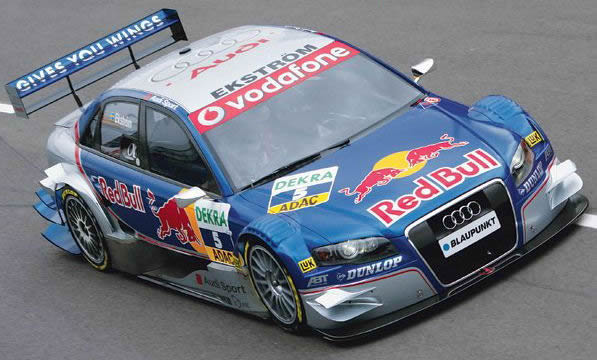
Applications in Racing
In high-performance racing, bumper canards and vortex generators are most commonly installed on racing vehicles based on conventional road cars, such as Stock Cars, Touring Cars, and GT Cars, where the essentially stock bodies (designed for road use) have not been optimised for track aerodynamics.
But they are also used in Formula 1, the Le Mans series, DTM racing, and now I am seeing them even on NASCAR cars. Basic aerodynamic principles dictate that the downforce created by air pressure on a surface increases exponentially with speed; thus, as with many aerodynamic modifications, bumper canards are best suited to the high speeds of motor racing.
Materials and Construction
Due to strength and weight considerations, bumper canards designed for race use were originally fabricated from carbon fibre reinforced plastic. The high strength-to-weight ratio and desirable appearance of this material ensures that bumper canards currently sold for road-going cars are often also made from this material.
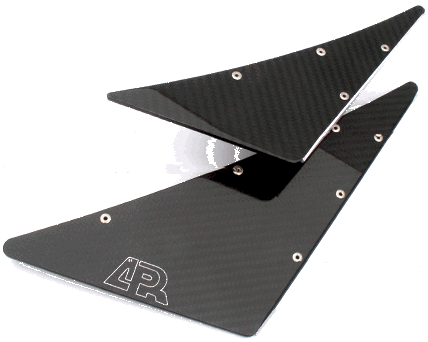
Bumper canards and vortex generators are generally made either as flat sheet triangles with additional edging strips (for mounting and directing airflow) or as a bespoke moulded component utilising the strength of the material and sophisticated match tooling to integrate the necessary upturns and curvature into a single piece of carbon fibre.
Bumper canards are relatively simple to install and are often available with slightly different curvature to match the shape of the front spoiler of the vehicle to which they will be fitted. They are most commonly installed in sets of four: a larger canard and a smaller vortex generator on each side of the bumper, with the larger canard at the bottom.
|
|
|
Canards designed for Dodge SRT4 | Canards designed for Dodge Viper | Canards designed for Mitsubishi Evo |
Installation
Commercially available bumper canards include a mounting kit with a set of high-quality bolts that fasten through holes drilled in the front bumper. Canards should be installed with the large face at the front and aligned so that they do not protrude outside the existing outer line of the car body (to avoid creating a safety hazard). This ensures that the main area of wing surface is as far forward on the vehicle as possible, in the clean air stream.
Effectiveness on Road Cars
Whether bumper canards installed on road-going cars are a genuine performance enhancement or simply a cosmetic modification is a legitimate question. How do you know if they work? How can you measure the lift they are reducing? And is there any science behind the shape and attack angles?
First of all, on street cars travelling at legal or even near-legal speeds, such devices would make only a very tiny difference, if any, and if you are travelling in such a manner that this tiny difference has any effect on your ability to control the vehicle, then you should stop this practice. The amount of downforce generated is related to the speed of air passing over and under the wing. Faster speeds mean more downforce. Racing vehicles that use this technology travel two to three times faster than any street-legal vehicle should be travelling, and they are competing for hundredths of seconds in races worth millions of dollars.
People who are attaching these wings to street-legal vehicles are either using them only for decoration, or are modifying their vehicle with the intention of using it for racing. In some rare cases, they are built into the design of a street-legal sports car that is designed from the outset to be fully capable of competing in races straight from the factory.
Many manufacturers, however, are examining the shape of the underside of their vehicles either to maximise downforce or to minimise fuel consumption. The real racer will work on this area first before attaching tiny wings to the front of his car.
If after reading this you still want to know exactly how much downforce a canard will generate, then either the packaging should say, or the manufacturer’s website should say. If they don’t say, then assume it is only for decorative purposes, and will actually increase drag without improving performance.
To learn more about vortex, check my article here.
To know more about aero devices and components, check these articles: