Brake Balance (Brake Bias)
Definition
Brake balance is adjustable by the driver in the cockpit via a dial located on the steering wheel. It establishes the ratio of braking force between the front and rear wheel brakes.
One of the most important adjustments a driver makes while running is brake balance. Also called brake bias, the front-to-rear brake balance is critical to the stability of a racing car during braking and during the turn-in phase. Too much rear braking force will tend to cause the car to spin; too much front braking force and the car will not turn in. Settings change as the fuel load lightens, the track grip changes, and particularly if it rains. This setting is so critical that it is impossible for a race engineer to determine it – the driver must set it up by feel.
The Physics of F1 Braking
When a Formula 1 driver lifts his foot off the accelerator pedal at 300 km/h, without touching the brake pedal, the car will slow at a rate of over 2 g due to aerodynamic drag alone. This contrasts with braking forces of 1.0 g to 1.5 g for the best sports cars (the Bugatti Veyron is claimed to brake at 1.3 g) during actual braking using the brake pedal. An F1 car can brake from 200 km/h to a complete stop in just 2.9 seconds, using only 65 metres.
By the time the driver has placed his foot on the brake pedal and the brakes have heated up to their working temperature, the car will have slowed by 200 km/h and the brakes will add around 4 g to the deceleration effort, instantaneously absorbing over 2,500 hp. Just over 2 seconds later, the car will be travelling at 100 km/h and the driver will be easing off the brake pedal as he approaches the apex of a second-gear corner.
During these frantic couple of seconds, apart from changing down four gears, the driver must modulate the load on the brake pedal to reduce braking as the aerodynamic downforce diminishes, and to ensure that the balance does not shift too much and destabilise the car. And the driver might, just possibly, overtake another car while all of this is going on.
These one or two seconds, as a Grand Prix driver slows the car and sets it up for a corner entry, are probably the busiest periods in a complete lap. It is these moments that distinguish the great drivers from the merely good.
Why Brake Balance Matters
The deceleration forces work against the natural stability of the vehicle, making it want to swap ends just as the driver turns in. Drivers inevitably complain most about the performance and characteristics of the car under braking, and a large proportion of incidents where control is lost occur during the braking phase.
It is therefore not surprising that designers seek to provide the most sophisticated controls and control systems they can devise, within the regulations, to assist the driver in extracting the most from the car under braking.
Load Distribution Under Braking
The percentage of vertical load on the front axle varies with speed and with the braking g-force level. The g-level must fall with speed as the aerodynamic downforce reduces with the square of speed. Provided that the aerodynamic distribution is nearly the same as the weight distribution and does not change significantly with car ride height, the main contribution to the changing front axle g-level percentage is weight transfer.
Around 10% of the retardation force is transferred from the rear axle to the front during deceleration. As speed reduces, the retardation force falls and the balance shifts towards the rear. In reality, most Formula 1 cars have aerodynamic configurations that move the aerodynamic balance towards the front as the ride height decreases and the car pitches nose-down. The shift in load distribution towards the rear becomes more pronounced as speed falls.
How the System Works
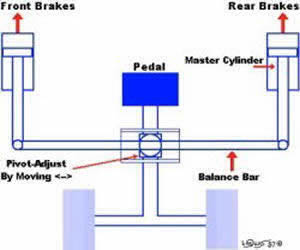
Two independent brake circuits
Formula 1 cars, and indeed all race cars, have two independent brake circuits (front and rear) which come together at the brake pedal. A pivot on the pedal apportions pedal load to the twin master cylinders, according to the position of the pivot on the crossbar that links the pedal to the master cylinder pistons.
Because the setup of brake balance between front and rear is so important to the stability of the car under braking and turn-in, it is left to the driver to adjust the balance while driving. A mechanism to move the pivot point, via a cockpit-mounted control lever or knob, permits fine adjustments to compensate for changes in track condition, fuel load, tyre conditions, and driver preference. However, it is beyond the capabilities of even the finest drivers to make such adjustments during actual braking to compensate for the changes in vertical load distribution.
Evolution of Brake Balance Controls
For years, drivers adjusted the balance by rotating a knob in the cockpit, which drove a flexible cable to move the pedal pivot to a new position on the balance bar. This system required the driver to reach down into the cockpit, usually with the left hand, to turn the knob.
Today, adjusting brake balance from the steering wheel requires an electronically controlled servo-system. The rule that must be adhered to is that adjustments cannot be made while the brakes are applied – that would constitute a form of active brake balance, which is forbidden by FIA rules. A knob with several numbered switch positions or another system is used for brake balance adjustment. All teams have their own proprietary systems for changing the brake bias from front to rear as downforce bleeds off the car during braking.
20 - brake balance adjustment
The 2014 Brake-by-Wire Change
In mid-2013, an updated version of Formula 1’s 2014 technical regulations was issued. As part of the new powertrain regulations, a large part of the cars’ power would be provided by energy recovery systems.
What was formerly termed KERS became ERS-K, with effectively double the power output for five times longer than the previous systems.
Harvesting this much energy under braking affects the braking effort at the rear wheels, so an electronic rear brake control system was allowed. This system is used to offset the ERS-K effect by aiding the braking effort at the rear, negating the need for the driver to constantly alter the brake bias.