Boundary Layer
Definition
A boundary layer is a thin layer of static to slow-moving air adjacent to the surfaces of a moving body. Friction between the body and the surrounding air holds back the flow nearest to the surfaces, while the air further from the body in the mainstream flows past at undiminished speed. This region of slow-moving air is also known as the “limit layer” or “boundary layer.”
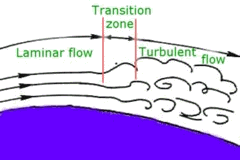
Because air is viscous, the air particles closest to the surface are effectively “glued” to the car surface. The next layer of air particles moves slowly over these, and the next layer moves slightly faster, and so on. If the speed of the air through the boundary layer is low, it maintains its laminar structure. At greater speeds, the boundary layer becomes turbulent and begins to disintegrate. The breaking of the layer consumes energy and increases the drag factor.
Additionally, the longer the surface, the thicker the boundary layer becomes towards the downstream end. As the boundary layer thickens, it slows down the airflow around it, which can lead to airflow separating from the surface and reducing performance.
Despite the best efforts in aerodynamic design, boundary layer destruction is inevitable, although it may be displaced to behind the car. Aerodynamicists attempt to reduce boundary layer effects by using golf ball dimple effects, shark skin textures, riblets, super-smooth surface finishes, and other techniques.
The details of the flow within the boundary layer are very important for many problems in aerodynamics, including wing stall, skin friction drag on an object, and heat transfer at high speed.
Laminar and Turbulent Boundary Layers
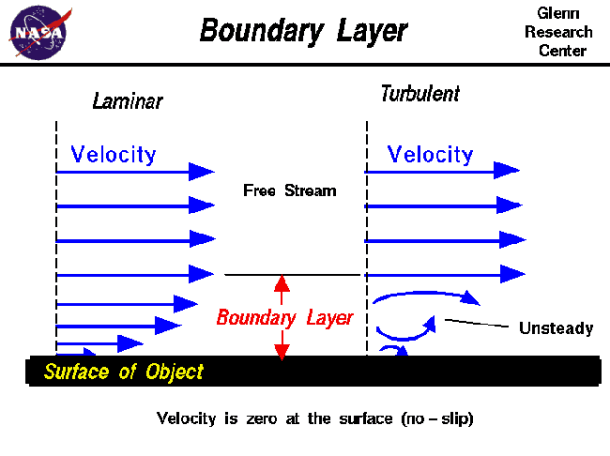
Boundary layers may be either laminar (layered) or turbulent (disordered) depending on the value of the Reynolds number. For lower Reynolds numbers, the boundary layer is laminar and the streamwise velocity changes uniformly as one moves away from the wall, as shown on the left side of the picture. For higher Reynolds numbers, the boundary layer is turbulent and the streamwise velocity is characterised by unsteady (changing with time) swirling flows inside the boundary layer.
The external flow reacts to the edge of the boundary layer just as it would to the physical surface of an object. Therefore, the boundary layer gives any object an “effective” shape which is usually slightly different from the physical shape. The boundary layer may also lift off or “separate” from the body and create an effective shape much different from the physical shape. This happens because the flow within the boundary layer has very low energy relative to the free stream and is more easily driven by changes in pressure.
Flow separation is the reason for wing stall at high angle of attack. The effects of the boundary layer on lift are contained in the lift coefficient, and the effects on drag are contained in the drag coefficient.
Pressure and Separation
The pressure across the boundary layer, normal to the surface of the solid body, is approximately equal to the pressure just outside the boundary layer.
The pressure inside the boundary layer changes along its length as the pressure outside the layer changes. Towards the trailing edge of a wing, the pressure outside the boundary layer builds and the velocity outside the layer decreases, approaching zero towards the aft stagnation point. This has the consequence that the range of fluid flow velocities inside the boundary layer also decreases.
If the pressure increase towards the stagnation point is not sufficiently gradual, the boundary layer can separate from the surface of the wing before the trailing edge. This occurs because the velocities inside the boundary layer are already smaller than those outside, and they can therefore reach zero before the aft stagnation point. After this, the velocities inside the boundary layer reverse direction, causing the flow to separate from the wing. Irrespective of where the boundary layer separates, it then breaks up into eddies and forms a turbulent wake behind the wing.
The boundary layer airflow that remains attached to the upper surface of the wing does so only because the pressure outside the boundary layer is slightly higher than the pressure inside it. There is a pressure gradient that forces the boundary layer to apparently adhere to the convex upper surface of the wing. There is no genuine force of attraction between the wing surface and the boundary layer airflow.
Historical Note
The theory describing boundary layer effects was first presented by Ludwig Prandtl in the early 1900s. The general fluids equations had been known for many years, but solutions to the equations did not properly describe observed flow effects such as wing stalls. Prandtl was the first to realise that the relative magnitude of the inertial and viscous forces changed from a layer very near the surface to a region far from the surface. He first proposed the interactively coupled, two-layer solution which properly models many flow problems.