Bernoulli’s Equation

Historical Background
Daniel Bernoulli (Groningen, January 29, 1700 – July 27, 1782) was a Swiss mathematician who spent much of his life in Basel, where he died. A member of a talented family of mathematicians, physicists, and philosophers, he is particularly remembered for his applications of mathematics to mechanics, especially fluid mechanics, and for his pioneering work in probability and statistics. (Wikipedia)
Bernoulli’s Principle and Aerodynamic Lift
The simplest and most popular explanations of aerodynamic lift invoke the Bernoulli principle, which is derived from Bernoulli’s theorem. Investigated in the early 1700s by Daniel Bernoulli, his equation defines the physical laws upon which most aerodynamic rules are based. This now famous equation is absolutely fundamental to the study of airflows. Every attempt to improve the way an F1 car pushes its way through molecules of air is governed by this natural relationship between fluid (gas or liquid) speed and pressure.
There are several forms of Bernoulli’s equation, three of which are discussed in the following sections: flow along a single streamline, flow along many streamlines, and flow along an airfoil.
All three equations were derived using several assumptions, perhaps the most significant being that air density does not change with pressure (i.e. air remains incompressible). Therefore they can only be applied to subsonic situations. Since F1 cars travel much slower than Mach 1, these equations can be used to give very accurate results.
Flow Along Streamlines
Low-speed fluid flow along single or multiple streamlines is interpreted in Figure 1. In this situation, there exists a relationship between velocity, density, and pressure. As a single streamline of fluid flows through a tube with changing cross-sectional area (for example, an F1 air inlet), its velocity decreases from station one to station two and its total pressure equals a constant.
With multiple streamlines, the total pressure equals the same constant along each streamline. However, this is only the case if height differences between the streamlines are negligible. Otherwise, each streamline has a unique total pressure.
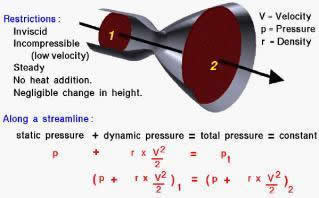
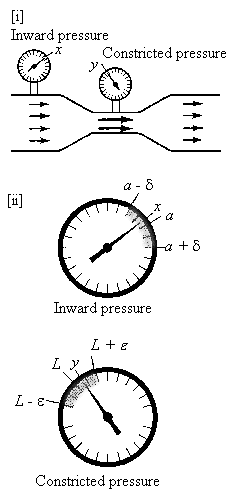
Mathematical and pictorial explanation of Bernoulli’s Equation as applied to fluid flow through a tube with changing cross-sectional area.
Application to Airfoils
As applied to flow along low-speed airfoils (i.e. F1 downforce wings), airflow is incompressible and its density remains constant. Bernoulli’s equation then reduces to a simple relation between velocity and static pressure.
(pressure) + 0.5(density)X(velocity)2 = constant
This equation implies that an increase in pressure must be accompanied by a decrease in velocity, and vice versa. Integrating the static pressure along the entire surface of an airfoil gives the total aerodynamic force on a body. Components of lift and drag can be determined by breaking this force down.
Understanding Lift and Downforce
If a fluid flows around an object at different speeds, the slower-moving fluid will exert more pressure on the object than the faster-moving fluid. The object will then be forced toward the faster-moving fluid. A product of this event is either lift or downforce, each of which depends on the positioning of the wing’s longer chord length. Lift occurs when the longer chord length faces upward, and downforce occurs when it faces downward.
Lift according to the application of Bernoulli’s Equation
Beyond Bernoulli: The Coanda Effect
Though Bernoulli’s principle is a major source of lift or downforce in an aircraft or racing car wing, the Coanda effect plays an even larger role in producing lift. To learn more about the interaction of Bernoulli’s principle and the Coanda effect, see the article here.
Whilst Bernoulli’s principle is often invoked to explain aerodynamic lift generated by the airflow around a wing profile, there are alternative explanations which employ, in some combination, the Coanda effect, the notion of circulation, and Newton’s third law. These alternative explanations are, at the very least, equally legitimate, and among aerodynamicists, are considered to be superior in some respects to the Bernoulli explanation.
Gordon McCabe published a notable paper on this subject, “Explanation and discovery in aerodynamics,” from February 2, 2008. The paper can be downloaded from here.
From the Abstract:
“The purpose of this paper is to discuss and clarify the explanations commonly cited for the aerodynamic lift generated by a wing, and to then analyse, as a case study of engineering discovery, the aerodynamic revolutions which have taken place within Formula 1 in the past 40 years. The paper begins with an introduction that provides a succinct summary of the mathematics of fluid mechanics.”