Ballast
What Is Ballast?
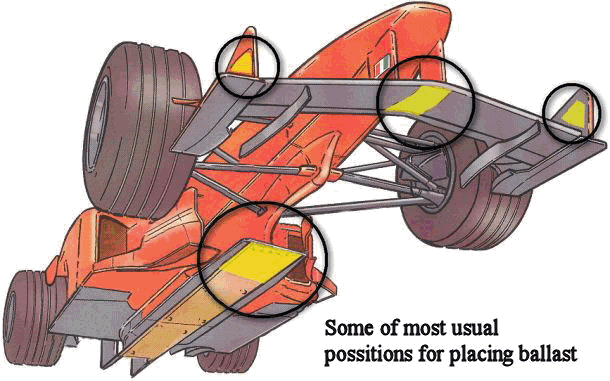
Ballast is an F1-specific tuning option. It allows teams to add weight to an already light car with the specific intention of altering the weight distribution. This works hand in hand with Weight Balance. A modern F1 car carries more than 150 kg of ballast. Very expensive, very dense metal ballast is placed in precise locations, usually (but not always) on the underside of the monocoque, as low as possible to further lower the centre of gravity.
Example: Red Bull Racing’s Front Wing Ballast
At the final race of 2008, after David Coulthard’s crash, it became apparent that Red Bull Racing was using small tungsten plates strategically placed on the endplates of the front wing. Like most cars, the RB4 had tiny blocks of tungsten inside the wing’s main profile, hidden from view within covered housings. However, in addition to this standard ballast placement, the RB4’s endplates also had detachable aerodynamically shaped covers concealing extra ballast pieces (pictured below). Although the ballast pieces appear small, the high density of the metal means they can weigh 5 to 7 kilograms. This allows the weight distribution of the car to be shifted further forward, improving overall balance.
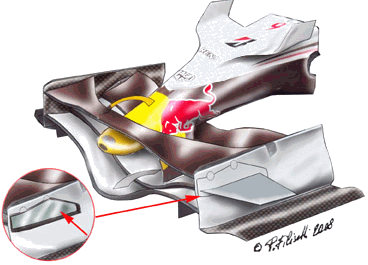
Over a complete season, a team may use ten sets of these plates at a cost of approximately half a million dollars or more. Most teams use tungsten, though some sources mention osmium, iridium, platinum, and rhenium – very expensive, rare, but extremely dense materials.
Why Tungsten?
Just to highlight how dense tungsten is:
Density Tungsten: 19.35g/cm3
Density Lead: 11.35g/cm3
Consider a chassis of an F1 car without ballast, including the driver, weighing 450 kg. To make up the required 200 kg in ballast:
With tungsten, that requires 10,336 cm3, equivalent to a 1m x 1m x 1.03cm block.
Using lead (the traditional ballast material), that same 1m x 1m block would need to be 1.76 cm thick, requiring 17,621 cm3 of material.
Put another way, 170% of lead by volume is required to achieve the same mass as tungsten – 70% more.
F1 teams favour tungsten because it is dense enough that less volume is needed to reach the required weight, but it is not prohibitively expensive like osmium, iridium, platinum, or rhenium. Some teams, however, spare no expense.
Ballast must be fixed, and by FIA rules cannot be movable at any point during the race.
The 2014 Weight Challenge
After the major 2014 rule change – the biggest in recent history – and the introduction of new V6 engines with complex hybrid ERS systems, the FIA raised the weight limit of F1 cars from 642 kg in 2013 to 690 kg. As teams began finalising their car designs for 2014, it emerged that a number of teams were struggling to reach the minimum 690 kg because the heavier, more powerful energy recovery systems were heavier than anticipated. The extra 48 kg was almost entirely consumed by the new power units, meaning even less leeway for additional ballasting.
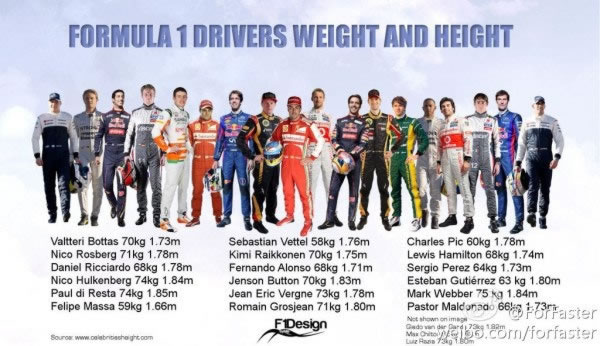
This represented a particular problem for heavier drivers. Lighter drivers had the luxury of being able to position ballast around the car to optimise weight distribution. Heavier drivers did not have this option. A driver such as Felipe Massa, weighing 59 kg, held an advantage over a taller driver like Nico Hulkenberg, who weighed in at 74 kg. The preference is always for the car and driver to weigh in below the minimum weight so that ballast can make up the difference. The heavier a driver, the less ballast the team has available to work with. This meant taller drivers like Hulkenberg faced the risk of being overlooked for competitive seats simply because of their weight.
The Weight-Lap Time Relationship
One kilogram of weight equates to approximately 0.035 seconds per lap on an average circuit. For example, Sebastian Vettel (65 kg) would be roughly 0.35 seconds faster per lap than Nico Hulkenberg (75 kg), all other things being equal. A taller driver is also at a disadvantage because their weight is positioned higher in the car.
The sport has evolved a great deal since Carel Godin de Beaufort raced in the late 1950s and 1960s in his own car. He was of such a size – at one point exceeding 100 kg – that he was nicknamed “Fatty Porsche.”