Aquaplaning
Definition
Aquaplaning is the loss of road holding (traction and steering capabilities) caused by tyres skimming over the surface of a wet track. When aquaplaning occurs during a race, there is no question of skill. Before a driver’s internal senses register that something is wrong, the car is already in trouble.
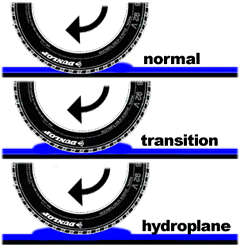
It occurs when a tyre’s tread pattern is unable to disperse sufficient water from the road surface. Levels of traction (and therefore control) decrease as the size of the contact patch decreases. Aquaplaning causes the tyre(s) to lose contact with the road, making the vehicle uncontrollable.
How Aquaplaning Occurs
Most drivers will, at some stage, experience this effect to varying degrees. As the tyre travels forward, it relies mainly on the tread pattern to evacuate water from the road surface and maintain contact with the tread. Several factors affect a tyre’s resistance to aquaplaning, including vehicle speed, depth of water, tyre pressures, and most importantly, tread depth.
In wet weather, racing tyres that have been properly designed and are in good condition can cut through water and maintain contact with the road at high speeds. However, when wet racing tyres are excessively worn or under-inflated, or the water is very deep, aquaplaning may still occur at lower speeds.
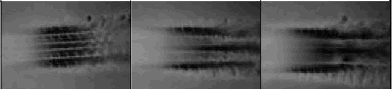
Speed and Groove Depth Experiments
| Water depth: 5mm, new tires | ||||
|---|---|---|---|---|
| Driving speed | 20 km/h | 60 km/h | 80 km/h | 100 km/h |
| Ground contact surface photo |
| |||
Tire fully in contact with ground | Tire almost fully in contact with ground | Tire is partially floating up | Almost all tire is floating on water layer | |

| Speed: 80 km/h, Water depth: 5mm | |||
|---|---|---|---|
| Tire Groove depth | New - 7.5 mm | 3,2 mm | 1.6 mm |
| Ground contact surface photo |
| ||
Tire is partially floating up | Much of the tire is floating up | Almost all tire is floating on water layer | |
The Three Zones of Aquaplaning
At higher speeds, the wedge of water in front of the tyres may pass under them, causing the tyres to ride on a cushion of water and resulting in a possible complete loss of traction.
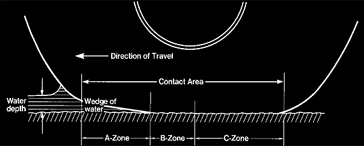
A) Sinkage zone: water forms a wedge that lifts the tread - no contact
B) Transition zone - partial contact
C) Contact zone - the tread is in contact with the ground
Aquaplaning in Formula 1
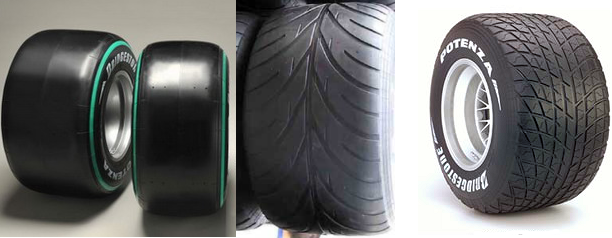
In F1 racing, specific tyres are used for different wet conditions: full wet tyres for heavy rain, intermediate tyres for a damp track or light rain, and dry slicks for dry conditions with no grooves.
Rain tyres are very heavily grooved, and the angle of these grooves is set to provide the best water evacuation and wet performance possible at very high speeds. Cuts in their surface can clear 60 litres of water per second at full speed. Even with this enormous water-clearing capacity, aquaplaning can occur through sheer volume of torrential rain or from isolated puddles or rivers of water across the track.
Unlike aquaplaning in road cars, the problem with an F1 car is that water can build up both between the tyres and the track and, if there is too much water, between the car’s underbody and the track. In either case, the grip between tyres and track is lost as the car runs on a film of water rather than grippy asphalt, and there is no way to regain control once aquaplaning begins.
| ||
|---|---|---|
Bridgestone Potenza slick tires for dry track | Bridgestone Potenza Intermediate tires for light rain | Bridgestone Potenza full wet tires |
Underbody Aquaplaning
The other risk from aquaplaning in a Formula 1 car occurs when the car is literally lifted off the track by the barrier of water between the track and its underbody. Teams want to run the plank as close to the ground as possible for aerodynamic reasons, and with such little ground clearance the risk of aquaplaning increases. In wet conditions, teams raise the ride height to lessen the risk of plank aquaplaning. This is part of what is called a “wet setup”. This adjustment comes at the expense of downforce generation under the car, but in the wet, aerodynamics become far less of a concern.