
Angle of Attack
Definition
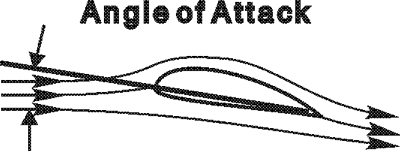
The angle of attack is the angle at which an airfoil passes through the air. This angle is measured between the chord of the airfoil and the relative wind direction.
The chord is an imaginary line from the leading edge to the trailing edge of an airfoil. Increasing the angle of attack deflects the airstream and causes an upward or downward pressure (depending on the position of the longer surface of the aerofoil) on the underside or upper side of the airfoil. This in turn increases the speed of airflow over the longer side of the airfoil. As air-flow speed increases, pressure on the foil’s top side is further reduced. The upward pressure on the foil’s underside and pressure reduction on the top side combine to furnish lift or downforce.
The angle of incidence (on a fixed-wing aircraft or car) is the angle between the airfoil chord line and the longitudinal axis or other selected reference plane of the aircraft or car.
Both the angle of attack and the angle of incidence are measured in degrees.
Lift and Drag Coefficients
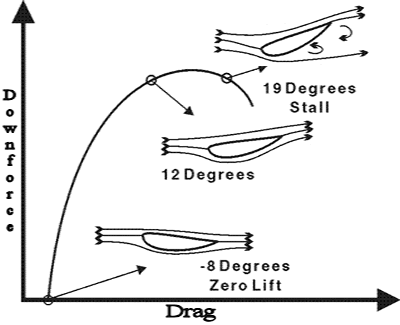
The Coefficient of Lift and the Coefficient of Drag represent the changes in lift and drag as the angle of attack changes. CL and CD are not expressed in any physical unit; they are dimensionless numbers obtained from either wind tunnel tests or derived mathematically.
Initially, both CL and CD increase as the angle of attack increases. At a certain point, the lift (or downforce) begins to drop while the drag increases sharply. This point is defined as the Critical Angle of Attack. If the angle of attack increases beyond the Critical Angle of Attack, all lift will eventually be lost while drag continues to increase. This event is called wing stall.