Stall of the Wing
Coefficient of Lift and Drag
The Coefficient of Lift and the Coefficient of Drag represent the changes in lift and drag as the angle of attack changes. CL and CD are not expressed in any physical unit; they are absolute numbers obtained from either wind tunnel tests or derived mathematically.
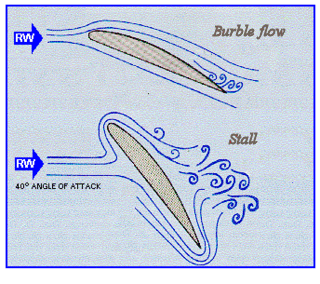
Initially, both CL and CD increase as the angle of attack increases. At a certain point, the lift (or downforce) begins to drop while the drag increases sharply. This point is defined as the Critical Angle of Attack. If the angle of attack increases past the Critical Angle of Attack, all lift will eventually be lost while the drag continues to increase.
Beyond this angle, airflow can no longer follow the contour of the aerofoil’s upper surface. After the burble point, when airflow starts to separate from the aerofoil, the wing goes into full stall.
Where Stall Occurs
Stall can happen with all aerodynamic profiles and any other object used to produce lift or downforce. It can occur with aeroplane propellers, ship propellers, pump impellers, sails, fans, and all kinds of wings.
Stall in Formula 1
In F1 car design, stall can happen on all wings, venturis, flip-ups, or diffusers.
Aerodynamic devices can be subjected to stall at all times, regardless of the speed of the air across the profile, or stall may occur only at certain speeds or in certain situations.
For example, a diffuser can work perfectly on a straight line over a smooth surface, but may stall during cornering or over bumps. A wing aerofoil can work perfectly up to a certain speed and then suddenly stall.
It is the job of the aerodynamicist to solve these problems using experience, CFD, and the wind tunnel.