Aerodynamic Grip
Definition
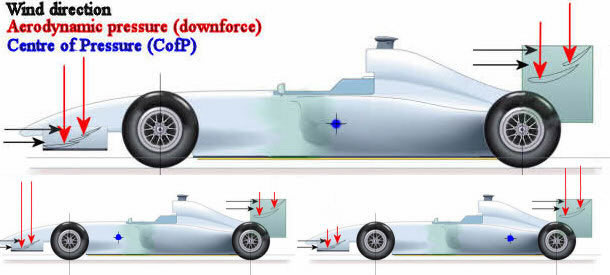
Aerodynamic grip is the grip between tyres and track pavement provided entirely by aerodynamic forces produced by wings, the rear diffuser, and practically all of the F1 bodywork – collectively known as downforce.
The higher the speed of the car, the greater the aerodynamic grip. In Formula 1, meaningful aerodynamic grip begins to develop at around 70-80 km/h, and by approximately 120-130 km/h the aerodynamically produced downforce is roughly equal to the Formula 1 car’s weight.
Both aerodynamic grip and mechanical grip are critically important. A good F1 car must have a strong balance of both. Without sufficient mechanical grip, the car will be slow and difficult to drive in slow corners and at circuits such as Monaco or the Hungaroring. Without adequate aerodynamic grip, the car will be unstable and difficult to manage on the fast parts of the track.
The Importance of Downforce vs Drag
***The following text is courtesy of:
Willem Toet, Head of Aerodynamics,
Sauber F1 Team*, Sauber Motorsport AG**
(…) Removing downforce increases lap time by more than 20 seconds. Reducing the drag of the car to just 25% of its real value yields less than 5 seconds of lap time gain, and only 2 seconds if there is no downforce.
Why does the gain vary with downforce level? If a car is at the cornering limit because it has no downforce, a drag reduction will not help much until it reaches a straight, and only then once it has enough grip to use all available power. Alternatively, if the car can fly around corners because it has grip, its average speed is higher and it must fight drag more, using power – so a drag reduction will help more in those circumstances.
In low-speed corners, little power is needed to maintain speed, so reducing drag has almost no effect. In high-speed corners, the influence of drag can become quite significant. However, it accounts for roughly 10% of the difference that can be achieved with downforce, and that is with lower drag than can actually be achieved in practice.
In extreme cases, such as when all cars are easily flat through a given very high-speed corner, only drag becomes important. Teams take this into consideration when selecting the downforce level for a given race track, as the ideal compromise changes from circuit to circuit.
The design of race tracks in many ways drives the compromise teams use for selecting the drag level of the car in their development work.
Calculated Speed Variables by Corner Type
Calculated speed variables depending on corner speed*:*
| Corner Type | Speed without downforce | Speed with downforce | Speed increase because of downforce | Speed increase possible in corners because of drag reduction to 25% of normal value | |
|---|---|---|---|---|---|
| A | High speed | 139.5 kph | 235.5 kph | 69% | 7.0% |
| B | Medium speed | 101.4 kph | 127.6 kph | 25% | 0.34% |
| C | Low speed | 76.6 kph | 86.2 kph | 12% | 0.2% |
(…)