Aerodynamic Efficiency
Definition
Aerodynamic efficiency is a term used to describe the relationship between the downforce a car generates and the drag it produces.
Straight-line speed depends on aerodynamic efficiency. Normally, as more downforce is generated by the wings, more drag is also generated.
Certain parts of the F1 car can be exceptions to this rule. The diffuser and undertray, for example, are highly efficient at creating downforce with relatively small drag penalties.
The Complexity of Modern F1 Aerodynamics
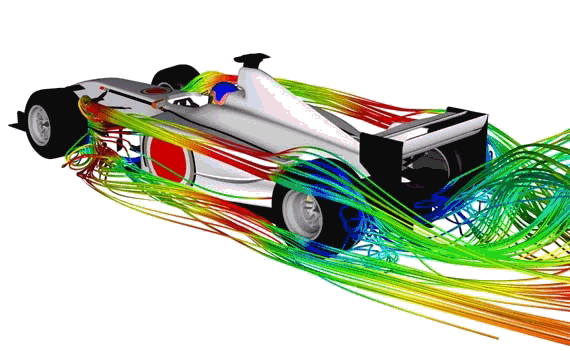
A modern F1 car has numerous complex interactions between vortices, streams, wakes, and other flow structures. This area is extremely sensitive; a vortex stream shifting by just a few centimetres can significantly change the characteristics of the car. It is impossible to produce downforce without producing drag, but the job of the aerodynamicist is to produce as much downforce for as little drag as possible.
At a given circuit, all the cars on the grid tend to set their drag levels to very similar values. However, at the same drag level, the cars at the front of the grid may have more than 30% extra downforce compared to those at the back.
Measuring Efficiency Gains
Aerodynamicists often talk about efficiency gains in “points.” For example, the shape of rear-view mirrors can yield less than 0.005 in aerodynamic efficiency (the downforce-to-drag ratio), or half a “point” in aerodynamicist terminology. However small this may seem, every half-point gain is welcome.
For reference, 3 points of aerodynamic efficiency equates to approximately one tenth of a second in lap time.