Aerodynamic Components for Road-Going Cars
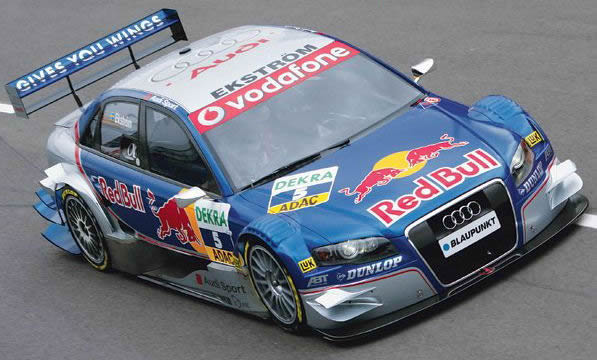
Audi TT, competing in Germany’s DTM
Overview
There is often limited understanding of how or why aerodynamic aids work; people tend to bolt them on and feel a downforce placebo effect. Having covered the basics of drag, lift, and flow elsewhere, this article discusses how several common aerodynamic aids work to make a car both slippery and planted.
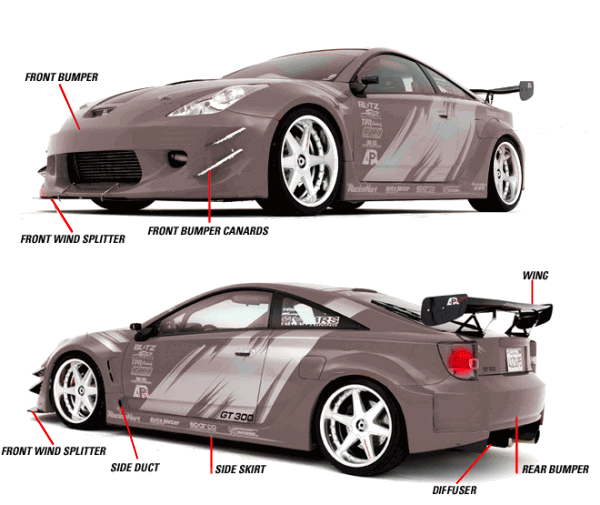
For cutting-edge aerodynamics on production-based cars, look no further than Germany’s DTM and Japan’s Super GT series. Both have rules allowing significant use of aero aids (such as multi-element wings, diffusers, super-low side skirts, air dams and splitters, canards and vortex generators) while keeping reasonably faithful to the cars’ original lines.
These components combine to produce huge amounts of downforce, but there is a price: drag. Redirecting the energy of the airflow to hold a car down creates more resistance for the car to push against. If not well optimised, this simply kills power.
The key is to produce just enough downforce to maximise the average speed around the track. Too much downforce and the increased drag will slow the car excessively; too little downforce will hurt cornering speeds. Finding the sweet spot where performance is optimised typically requires a large amount of experimentation with wing settings and other components.
By using some of the various aids described below, the aerodynamic characteristics of a car can be properly tuned not only for downforce, but also for cooling and stability. Some of these parts might be excessive for anything but competition, but all are readily available as bolt-on parts for most cars.
Choosing the Right Aerodynamic Components
Aerodynamic parts are as important as any other modification for performance gain. Just like any other performance modification, aerodynamic components require fine tuning to enable the driver to extract the most benefit. Below is a look at some common vehicle layouts and the aerodynamic components best suited to each.
Front Aerodynamic Components
Lip spoilers, front diffusers, splitters, side skirts, and canards are all components that can produce downforce at the front of the vehicle. These components are especially useful for the following configurations.
Front-Engine/Front-Wheel Drive:
Power output from front-engine/front-wheel-drive cars comes from the front of the vehicle. At high speeds, vehicles tend to lift, and this lifting effect reduces traction. To prevent the loss of traction, front-engine/front-wheel-drive cars can utilise components such as front splitters and front canards to add more downforce to the front, allowing greater power delivery to the ground from the engine.
Mid-Engine/Rear-Wheel Drive:
Since the centre of gravity of mid-engine/rear-wheel-drive cars is near the centre of the car, these vehicles tend to be lighter at the front. This gives them a tendency to oversteer or snap (quickly kicking the rear out). To counterbalance this effect, the use of front aerodynamic components can provide more traction at the front.
Rear Aerodynamic Components
Rear wings, spoilers, and diffusers are all components that can produce downforce at the rear of the vehicle. These are especially useful for the following configurations.
Front-Engine/Front-Wheel Drive:
Because vehicles of this type are lighter at the rear, it is important to add more downforce there to achieve more mechanical grip and aerodynamic balance. Rear wings and spoilers can accomplish both of these goals.
Front-Engine/Rear-Wheel Drive:
The engine output from front-engine/rear-wheel-drive cars is delivered through the rear wheels. Aerodynamic components such as rear wings and diffusers can help create downforce to give the rear wheels more traction.
Fine Tuning and Quality
All aerodynamic components require fine tuning and aerodynamic testing before any gain can be expected. The shape and angle of any surface on a car is intended to produce downforce. If it is shaped incorrectly or angled wrongly, it can create lift instead, making the car more unstable and more difficult to control. As is well known in high-performance racing, every component of the car must work together (the aerodynamic upgrade, body, and undertray), otherwise the results can be unpredictable.
Another important point is manufacturing quality and materials. An aerodynamically loaded component manufactured from low-quality material cannot be expected to withstand everyday punishment. Consider what would happen if, at high speed, on a well-balanced car, a side canard or rear wing were to break suddenly.
The best approach is to buy parts specifically designed for a given car. Several aftermarket manufacturers can guarantee the quality of their products. Parts should be made of high-quality materials (carbon fibre or high-quality glass fibre composites). Each aerodynamic kit must be meticulously designed and produced to ensure that gaps between bumpers, fenders, and side skirts adhere to high standards.
Do Aero Devices on Road Cars Actually Work?
*Whether aero devices installed on road-going cars are a genuine performance enhancement or simply a cosmetic modification?
How do you know if they work?
How can you measure the lift they are reducing?
Also is there any science behind the shape and attack angles? *
First of all, on street cars travelling at legal or even near-legal speeds, such devices would make only a very tiny difference if any. If a driver is travelling in such a manner that this tiny difference affects the ability to control the vehicle, that practice should be stopped on public roads.
The amount of downforce generated is related to the speed of air passing over or under the wing. Faster speeds mean more downforce. Racing vehicles that use this technology travel two to three times faster than any street-legal vehicle should be travelling, and they are dealing in hundredths of seconds for victories worth millions of dollars.
People who attach these wings or other aero aids to street-legal vehicles are either using them purely for decoration or are modifying their vehicle with the intention of using it for racing. In some rare cases, such elements are built into the design of a street-legal sports car. These vehicles are designed from the outset to be street-legal but fully capable of competing in races right from the factory.
Many racing car manufacturers, however, are focusing on the shape of the underside of their vehicles either to maximise downforce or to minimise fuel consumption. A serious racer will work on this area first before attaching any wings to the car.
If after reading this article there is still a desire to know exactly how much downforce a canard or wing will generate, the packaging should state it, or the manufacturer’s website should provide the information. If they do not, the part is most likely purely decorative and will actually increase drag without improving performance.
Further Reading
For more about aerodynamic devices and components, see these articles: