Aerodynamic Balance (Centre of Pressure)
Definition
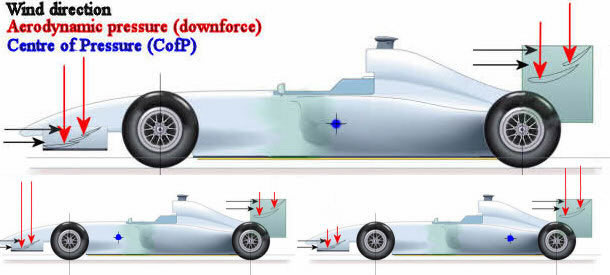
Aerodynamic balance describes a state of equilibrium between the downforce on the front wheels and the downforce on the rear wheels. Too much aerodynamic pressure at the front causes oversteer, while too much at the rear causes understeer.
Winning races requires more than simply adding wings to the car. The most important factor, beyond the wing level that helps a car negotiate corners, is achieving the correct overall balance. When the balance is right, the driver can feel comfortable and confident in the car.
Centre of Pressure (CofP)
An F1 car’s downforce is produced largely by the front wing, rear wing, and the floor, with the front and rear wings serving as the main tuning elements. By adjusting the front and rear downforce, teams alter the car’s Centre of aerodynamic Pressure.
Centre of Pressure (CofP) is the balance of downforce at the front and rear axles. As such, it is analogous to the aerodynamic equivalent of the longitudinal Centre of Gravity. CofP is also commonly referred to as aero balance.
Typically, the CofP position closely matches that of the Centre of Gravity.
Low-Speed vs High-Speed Behaviour
An F1 car is largely limited on corner entry by the rear grip available. In low- to mid-speed turns, the car needs a slight rear bias to the CofP to prevent corner entry oversteer, where the car wants to spin as it approaches the apex. Too much front wing in these corners will make the car too pointy and hinder lap times.
In faster turns, the front wing can lead the car. Drivers turn in more gently into fast turns, which creates less lateral acceleration at the rear axle. It is therefore rare for the rear to step out on turn-in during fast corners. Thus, at higher speeds, the CofP can be biased towards neutral or slightly towards the front.
Impact on Tyre Wear
Better control of the aerodynamic platform can be a valuable tool in reducing the stress placed upon the tyres. The centre of aerodynamic pressure is the aerodynamic equivalent of weight distribution.
When the car is braking, the centre of pressure moves forward. When braking is reduced and released, the centre of pressure moves back.
Ground Effect and Consistency
The modern generation of cars with ground effect underbodies, deriving so much of their downforce from the floor, has a centre of pressure positioned quite far rearward, given that the lowest point of the floor is towards the back, just before the diffuser. With the flat-bottom generation of cars, the lowest point of the floor was at its leading edge. Consequently, the centre of pressure tends to shift more with these cars as they brake and unbrake.
This can create problems with the rear tyres, as the inconsistent loads cause them to degrade faster. Improving the consistency of the airflow along the floor, and thus making it more robust, helps reduce load variation on the rear tyres. If the airflow is not adequately controlled, some of the downforce generated when the car is pointed straight may be lost when it is in yaw or when steering lock is applied. This too tends to overwork the rear tyres.