Advanced Braking Technique
Track driving techniques and road driving techniques are fundamentally different and should never be confused with one another. This article covers advanced braking techniques used in motorsport. For normal street braking, see the article on normal street braking technique. The Heel and Toe article may also be a useful reference.
Braking on the Track
Braking and accelerating when racing on a road course, even in dry conditions, should be treated with a similar smoothness to driving on a wet surface – gently and progressively.
Braking and accelerating are used in conjunction with the corners: brake before entering and accelerate coming out. Because the objective is to have the car moving as fast as possible through the corner, the tyres will be utilising most of the available traction – ideally 100% or as close to it as possible.
Total available traction is a finite value for a particular part of the track and changes constantly for different sections. Tyre traction capacity is also finite and remains constant. Very rarely can all of that tyre traction be used, because some spare total available traction must be reserved for gear changes, additional braking, steering angle adjustments, and all other actions that involve weight transfer. More on this topic can be found in the article on the Traction circle.
The driver must be very smooth with the brakes going into the corner and with the throttle coming out. A sharp change in braking or power at these points will upset the car’s traction balance as quickly as if the car were being driven on ice. Working within the last 1% of traction means there is no reserve to call upon if something goes wrong. Even professional drivers very rarely recover a car that has lost control – not because they do not know how, but because there is simply no available traction left to work with. Learning to be consistently smooth in braking and accelerating on a road course is imperative.
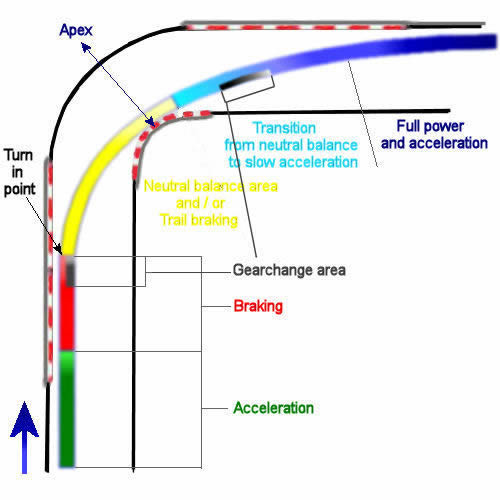
The Three Phases of Competitive Braking
There are three phases in competitive braking.
Phase 1: Braking begins with a rapid, but not instantaneous, application of as much braking force as possible. How rapidly the brakes can be applied depends on the suspension and the track surface. The stiffer the springs and dampers, the more rapidly maximum braking can be applied. Soft springs will produce significant forward roll, requiring a longer and smoother ramp-up of braking to keep the car stable.
Phase 2: Once the car settles onto the front tyres, the goal is to minimise the length of the braking zone, which requires taking the tyres to the edge of locking up. Careful attention to the feedback vibrations through the pedal and the steering wheel is essential to feel that fine difference. Racing shoes are highly recommended – standard trainers simply do not provide enough pedal feel. The car will travel some distance under fairly constant brake pedal pressure.
Phase 3: Towards the end of the braking zone, the vehicle has been slowed to near its final speed. During this phase, the driver can downshift to the appropriate gear for the required power output to exit the turn. Pressure on the pedal is gradually released, making the transition from full to zero braking force as smooth as possible. During braking, the front tyres are under heavy load, which increases the available traction. However, this drastically reduces the available traction on the rear tyres. A sudden release of the brakes would abruptly reduce the load on the front tyres, reducing their traction potential at the very point it is needed for turning into the corner.
Turn-In Sensitivity
The turn-in is one of the points where the car is most sensitive to sudden weight transfer transitions. Indecisive braking resulting in a last-second extra tap, or a sudden release of the brake pedal, will unsettle the car’s handling and force the driver to slow down to regain control and hopefully avoid a spin or worse.
As the braking zone concludes and the driver eases off the brake pedal, some throttle must be applied to reach a steady state of neither acceleration nor deceleration. Depending on the shape of the turn, the steady throttle zone will vary, but with a typical late-apex corner, it runs from turn-in to just before the apex. In this phase, the heel and toe technique can improve stability.
Adapting to Real Conditions
The description above is the straightforward explanation of braking before a corner when everything goes according to plan. On the race track, however, the ideal situation is rare, and the driver must modify the braking technique instantly in response to numerous variables: another car ahead destroying aero downforce, an accident, a change in wind direction, oil or dirt on the tarmac, tyre condition, or the balance of the car. All of these factors influence braking style.
Most racing cars do not use ABS brakes, and in some situations it is very easy to lose grip, lock a wheel, and spin. ABS senses when a wheel is about to lock up under braking, releases the braking effect at that particular wheel, and then re-applies the brake many times per second.
A revolving tyre in contact with the road surface delivers maximum braking efficiency at the point where it is on the knife-edge of locking up but is still revolving. A skilled driver can sense when and where this point occurs and hold the pedal position to maintain that threshold without locking the wheels. This allows the car to stop in a shorter distance than if equipped with ABS being activated.
Several braking techniques are used by racing drivers in critical situations. All of these techniques can be applied with road cars, but the ABS system is generally sufficient for such situations.
Threshold Braking
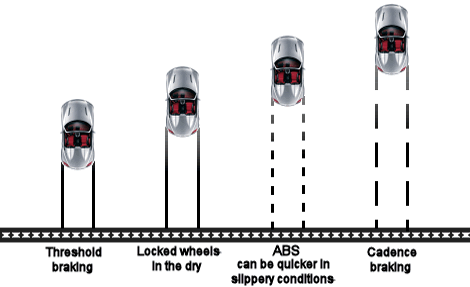
Threshold braking, or limit braking, is a technique used in motor racing to slow the car at the optimum rate using the brakes. It is used in vehicles without ABS.
The technique involves the driver controlling brake pedal pressure to maximise the braking force developed by the tyres. The optimal braking force is developed at the point when the tyre just begins to slip. Braking beyond this point causes the tyre to lock and slide, reducing the grip between the tyre and the driving surface. The purpose of threshold braking is to keep tyre slip at the optimal value that produces maximum grip and braking force.
When wheels are slipping significantly (kinetic friction), the friction available for braking is typically substantially less than when the wheels are not slipping (static friction), thereby reducing braking force. Peak friction occurs between the static and dynamic friction endpoints, and this is the point that threshold braking aims to maintain.
Because available friction at any given moment depends on many factors including road surface material, temperature, tyre rubber compound, and wear, threshold braking is nearly impossible to achieve consistently during normal driving.
To approximate threshold braking:
1- Press the brake pedal as if braking normally.
2- Smoothly increase brake pedal pressure until the wheels lock up. On all but the highest-grip surfaces, the front wheels will lock first by design.
3- Reduce brake pedal pressure by a small amount, enough for the locked wheels to regain traction and start rotating again.
4- If more braking is desired at this point, the driver can switch to cadence braking.
In a situation where a car needs to turn or swerve to avoid a collision but is travelling too fast, this technique allows the driver to retain steering control while rapidly decelerating.
Cadence Braking
Cadence braking is an advanced driving technique that allows a car to both steer and brake simultaneously. If the front wheels are locked under heavy braking, the car can no longer steer. ABS automatically keeps the tyres on the point of locking so that steering remains possible while slowing down.
Without ABS, or in a racing car, cadence braking is used instead. The driver locks the wheels, then releases the brakes to regain steering, brakes again, releases and steers again in sequence until the hazard has been avoided. This is particularly useful on slippery surfaces, but it takes considerable practice and quick thinking to release the brakes when sliding towards a hazard.
It needs to be learned and practised.
Cadence braking involves pumping the brake pedal fairly rapidly but deliberately to make the wheels lock and unlock. This is done primarily to maintain steering control, at least in part. While cadence braking is effective on most surfaces, it is less effective at slowing the vehicle than keeping the tyres continually at the optimum braking point (threshold braking).
Cadence braking (or any other type of braking) will not help much on extremely slippery surfaces such as ice. Also, on very loose surfaces, a quicker stop can be achieved by simply locking the wheels, causing a wedge of loose material to build up ahead and create a substantial braking force. In such conditions, cadence braking, like ABS, actually increases stopping distances.
On poor surfaces, rally drivers historically timed the pulsing of brakes to take advantage of load transfer as the vehicle pitches forward and backward in response to braking. With modern over-damped, stiffly sprung suspensions, this technique is less effective.
Threshold braking, or a good ABS system, generally (but not always) results in the shortest stopping distance in a straight line.
Trail Braking
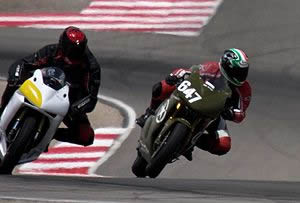
Trail braking is a technique, used primarily in motorcycle riding but also in car racing, where the brakes are applied beyond the entrance to a turn and gradually released up to the apex. (The heel and toe technique is often used in conjunction.)
Trailing off the braking pressure either while braking in a straight line or after turn-in has begun allows for a less abrupt and more accurate final corner-entry speed adjustment.
Some corner entries, such as decreasing-radius turns, are particularly well suited to the trail braking technique. In turns where quicker steering action is more appropriate, trailing the brake while turning in is unnecessary.
Motorcycle Application: Motorcycle riders approach turns applying both front and rear brakes to reduce speed. As they enter the turn, they slowly ease off the brakes, gradually decreasing or “trailing” off brake pressure as lean angle increases. At this point, the rear tyre often begins to slide slightly outward without locking. This technique is used for several reasons. First, it provides more traction because the front tyre is forced into the pavement under weight transfer. Second, as brakes are applied and weight shifts forward, the forks compress, changing the motorcycle’s steering geometry, decreasing stability in a way that makes the motorcycle want to lean and change direction. Thus, trail braking can be used as a method to help the motorcycle change direction.
Additionally, decreasing speed decreases the motorcycle’s cornering radius, while accelerating during a turn increases it. Traditionally, trail braking is performed exclusively with the front brake, even though trailing the rear brake will also effectively slow the motorcycle and decrease the turning radius.
A rider’s ability to correctly choose turn-in, apex, and exit points reduces or eliminates the necessity of prolonged trail braking into turns. The longer the rider trails the brake into a corner, the later the throttle application. The throttle is responsible for the machine’s ultimate stability and traction, making it desirable to begin throttle application as soon as possible once an acceptable racing line is established.
Finally, trailing off the brakes while entering blind or tight corners allows the rider to slow further if something unexpected blocks the path. Because the motorcycle is already on the brakes and the front tyre has additional traction from higher load, the rider can slow even more with very little risk, depending on surface conditions. However, applying brakes after the motorcycle is already leaned over can be extremely risky depending on surface conditions and lean angle, since approximately 70% of the bike’s weight is already transferred forward from being off the throttle.
This technique is commonly used in racing but can also enhance control and add evasive options for street riders. Worth noting is that most racing crashes during the 2000-2008 period among world-class MotoGP riders occurred while trail braking into turns.
Four-Wheel Application: In four-wheeled vehicles, trail braking pertains to using the brakes past the corner entrance (as opposed to the normally taught practice of releasing brakes before starting the turn). This practice creates weight transfer towards the front tyres, increasing their traction and reducing understeer. During trail braking, the front and outside tyres are loaded – this type of motion is sometimes referred to as warp. It works best in light vehicles with front-biased brake distribution and is often used in conjunction with the heel and toe technique.
To be performed properly, the driver must have an excellent sense of the car’s behaviour and be able to keep the braking effort within very tight limits. Excessive braking effort may result in heavy understeer, or if the brake bias is set to nearly neutral, in the rear wheels locking, effectively causing the vehicle to spin as in a handbrake turn.
Once a driver has mastered trail braking, it can help enter corners at higher speeds or avoid an accident if the driver has entered a corner at a speed exceeding the car’s or the driver’s capabilities.
Opponents of trail braking claim that because of the steep learning curve, trail braking should be exclusively a race track technique. However, proponents believe that knowing how to slow while entering a corner gives the driver a greater safety margin, particularly in blind, decreasing-radius, or downhill corners.
Reverse Trail Braking
Reverse trail braking is a variation of trail braking that can assist a motorcycle rider in turning the machine more quickly through closely linked S-curves or chicanes. In this technique, the rider applies some front brake as the steering change is being made. Because a motorcycle tends to “stand up” from front brake application, it more rapidly and efficiently brings the machine over to the opposite side when used in conjunction with standard counter-steering inputs. This is an advanced technique applicable only to track riding and racing.
Brake Drift
A drift-inducing technique called the “brake drift” is used in racing, involving a series of light trail-braking pulses (usually 2 or 3), followed by a momentary full-force brake application and sharp release. Mastering continuous trail braking as used under road conditions is a prerequisite for learning brake drifting. This is one of the most commonly used drifting techniques in rally racing because, if done properly, it allows the driver to enter and exit the corner at full throttle.
Coasting
At the beginning of 2014, with increased fuel-saving strategies, a new term entered the F1 vocabulary: “coasting.” This means the driver chooses not to use the brakes to prepare for corner entry, instead using the drag of the car to slow it to the desired corner-entry speed.
In other words (referring to the corner diagram at the beginning of this article), the driver lifts off the accelerator at some point before the normal braking point and allows drag to slow the car to the desired speed. In this way, less fuel is consumed because the driver is not accelerating for as long. This technique costs lap time for the same reason – the driver is not accelerating for as long. The driver therefore trades fuel savings against lap time. This technique is practical when the driver has a sufficient advantage over the next car behind.