2014 Nose Cone Design
The Regulation Change
After the 2014 rule changes – perhaps the most sweeping in Formula 1 history – the key visual feature of most cars was an oddly shaped “anteater” nose. This came about because the FIA, in issuing the new rules, did not fully anticipate the aesthetic consequences. The rules were written in good faith to improve car safety in the event of 90-degree T-bone crashes and to prevent cars from launching off the back of other cars. If a following car were to hit the rear tyre of a car in front, it would be kicked up into the air, but a lower nose would prevent that. These unusual noses were a talking point in the early part of the season as fans adjusted to their appearance.
A low nose tip would ideally have been introduced as part of rules that included a lower chassis all the way from the nose to the cockpit. However, the teams opposed this idea because it would have meant entirely new aerodynamics and entirely new suspension, which on top of the many other regulatory changes was a step too far. The regulations subsequently lowered the nose tip to a specific 185 mm height and reduced the front bulkhead by 100 mm, from 625 mm to a maximum of 525 mm. This compromise saved the teams an expensive redesign but left opportunities for exploiting the intent of the rule for aerodynamic benefit.
Aerodynamic Importance of the Nose
The nose cone is highly influential in shaping the airflow all the way back along the car and is a limiting factor in directing air passing under the nose and under the floor. The nose tip is the first point where airflow meets the car before passing rearward. Since the Tyrrell 019 first introduced the high nose, teams had progressively raised the nose to the maximum permissible height. The aerodynamic gain was so great that the high centre of gravity and unfavourable front suspension geometry were accepted in favour of better lap times.
With the new regulations and the nose tip now so low, limiting the quantity of air passing under the car, teams had to find ways to improve on that situation and allow more air under the car.
Picture By Steven De Groote from F1Technical forum
Technical Requirements
The nose shape is also heavily influenced by the need to pass a crash test and mount the front wing to the chassis. A complicated set of requirements defines the chassis height at certain points, along with the height and minimum dimensions of the nose tip.
The nose must meet a minimum tip height: the area 50 mm behind the actual tip must be centred at 185 mm above the car’s reference plane. Additionally, this cross section must not be lower than 135 mm or 10 mm above the front wing, or above 300 mm. To comply with Article 15.4.3 of the Technical Regulations, the cross section of the nose 50 mm behind the tip must be larger than 9,000 mm2, which equates to a 97 x 97 mm square, a 107 mm diameter circle, a rectangle of 9 by 10 centimetres, one that is 15 cm wide and just 6 cm high, or indeed any shape with 9,000 mm2 – meaning that the actual shape is relatively free within these parameters.
The nose must also not be higher than a diagonal line passing from 300 mm height at the nose tip to 625 mm at the front bulkhead, preventing noses from being arched excessively upward to aid airflow under the car. In terms of length, the nose cannot be shorter than the front wing centre section and can extend forward beyond the front wing. Rules also demand that the nose cone be a single open section, which was intended to prevent the slotted noses Ferrari introduced in 2008.
These rules forced teams to think about how to design the nose shape to stay as much as possible out of the way of airflow passing under the raised chassis, or how to make it as small an obstruction as possible.
Team Interpretations
Not everyone appreciated the appearance of the 2014 cars, but as the covers came off each new machine at Jerez, no one could doubt the diversity on display at the front. All the shapes were aimed at getting as much air under the car as possible for aerodynamic reasons while satisfying the requirement for a lower nose.
There were some interesting and varied interpretations of the technical regulations in the nose section. The Ferrari was totally different and actually quite elegant. The reason for such variety was that the nose rules allowed considerable geometrical freedom, and teams explored that freedom extensively. Some solutions were clearly more aesthetically pleasing than others. The “finger” nose proved particularly popular, but even those showed considerable variety – the front of the Force India, for example, looked quite different from the Toro Rosso.
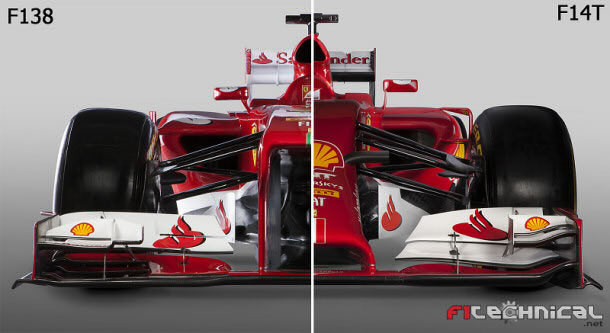
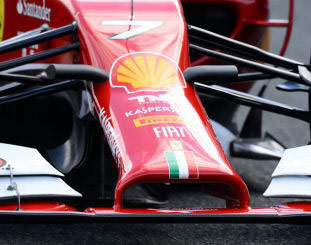
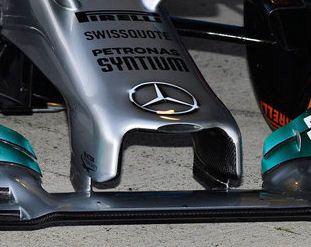
| Ferrari’s solution was a sculpted but significant step down from the front bulkhead, leading to a relatively wide and flat nose. The virtually non-existent connecting pylons were shaped to enlarge the airflow passage beyond the narrow opening created between the mainplane and nose tip. Retaining the chassis height also enabled Ferrari to keep the pull-rod front suspension used since the F2012. Mercedes also steered clear of an unusual-looking nose. The new car featured an elegant but aggressive design, not identical to Ferrari’s but similar in philosophy. Ferrari and Mercedes clearly chose a wide nose, creating a fairly flat top (with Ferrari’s being more rounded) rather than a bulge protruding ahead of the front wing. The proximity of these noses to the front wing’s central neutral plate also created a venturi with the front wing itself, attempting to speed up airflow underneath the nose cone. This would reduce pressure and generate downforce. The rounded edges of the upper side of the nose suggested that both teams were trying to direct airflow from the higher-pressure area on top of the nose to the lower-pressure area underneath – beneficial since teams were still aiming to get as much air as possible toward the floor to help the diffuser. Ferrari retained a very high monocoque that only slightly tapered down at the front to meet the regulations. |
| |
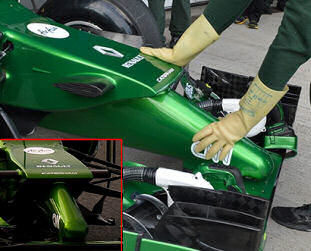
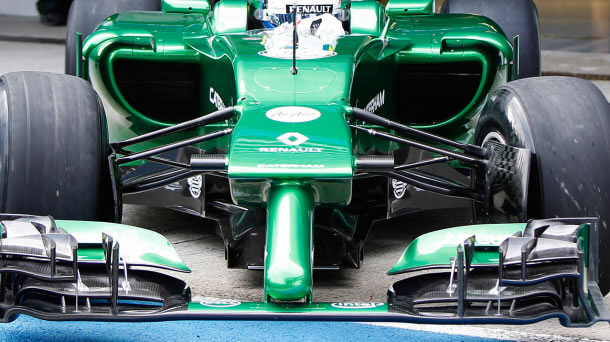
| Caterham’s CT05 took a different approach from any other team. A narrow nose tip grew like a finger from the wider upper nose area, with edges shaped to push and channel air below the chassis and floor. The front wing support pylons were fitted to the nose tip itself – the only team with this solution at that time (1 February 2014). Narrow-spaced front wing pylons can limit their use as aerodynamic devices. Here it was obvious that the two demands for the nose – aerodynamic performance and regulatory compliance – were split into two different sections: an upper nose for aerodynamics and the lower nose for legality and crash testing. The narrow nose tip placed the minimum cross section low down to aid airflow to the rear of the car. |
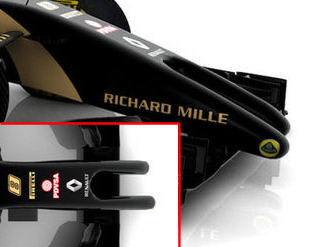
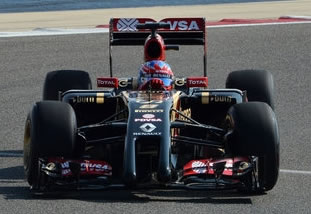
| The Lotus E22 was the solution that left most people scratching their heads over the 2014 nose tip regulations. The car featured a very clever and different approach to the new safety regulations. Instead of a single narrow appendage to lower the tip, Lotus employed a two-pronged solution with a gap to allow airflow to reach the floor of the car. Two protruding pillars – essentially a double nose – sloped down over the front wing, forming both the crash structures and the front wing mountings. Curiously, these prongs were of different lengths, with the right prong longer than the left. Lotus had created a mandatory nose tip (in terms of cross section and height) using just one prong – the right one – which was at least 90 mm wide to meet regulatory requirements. To avoid the twin-prong design being considered as having more than one nose tip (explicitly excluded in the rules), the left prong was shorter to avoid being in the same plane as the right-hand prong tip. The E22 itself generated plenty of intrigue, but the design was legal and unlikely to be protested. |
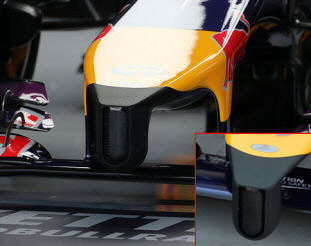
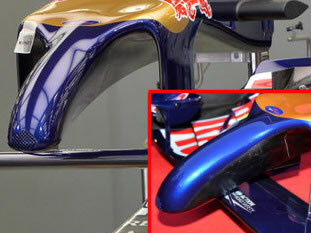
| Red Bull, characteristically, found their own solution to the new nose regulations. The RB10 featured a slightly neater take on the “anteater” style seen on most cars that year. Technical director Adrian Newey, not a fan of the regulation, described the noses as “an awful shame.” The mandatory low nose tip comprised a rectangular section, but being narrower and more vertically oriented than the rounder or squarer noses of other teams, Newey blended this section backward into the underside of the upper nose in a teardrop profile and then curved the shape upward. To be legal, this area needed to be structural and form part of the crash zone. Probable benefits of this design included better performance in yaw, with the shorter tail of the nose tip presenting less side area to the airflow. This was also an evolution of the “S-duct” seen on the previous year’s RB9. Air entered through ducts on the nose and underneath the chassis, passing through the bulkhead area and exiting via a duct on top of the chassis. This could reduce airflow separation – a byproduct of the low nose/stepped chassis combination. |
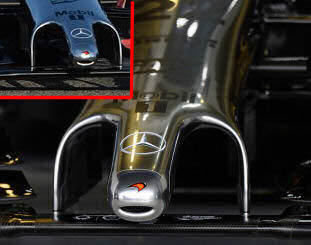
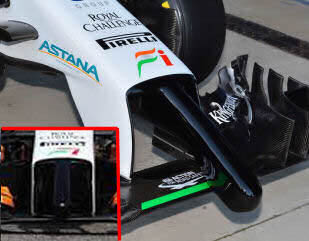
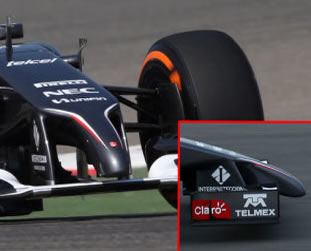
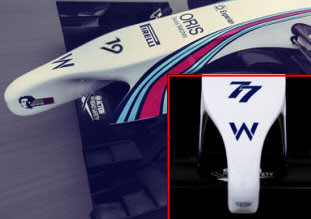
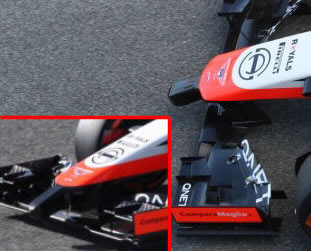
| Another design solution, used by McLaren, Force India, Scuderia Toro Rosso, Sauber, Williams, and Marussia, was to make the wedge-shaped upper nose a structural part that supported the front wing. This may have been a more complex design, as the crash structure needed to transition from a thin initial section to a much thicker section as the upper nose was impacted during testing, changing the decelerations with the change in cross section. This solution may also have been heavier due to the complex shape. However, the design allowed the front wing to be mounted via taller, wider-spaced pylons, providing some aerodynamic gains – separating the front tyre wake from the chassis and creating a low-pressure area for some downforce on the central part of the front wing. McLaren MP4-29 was the first team to release images of the actual car featuring its own variation on the “drooping” nose design. The car looked tidy, albeit with considerable complexity on the front nose and wing assembly. See here for McLaren’s new and innovative rear suspension. Force India VJM07 also featured a prominent low and narrow “anteater” style nose. Toro Rosso STR9 featured a sharp dip at the nose in a “finger” or anteater style, with a prominent low and narrow nose to meet the new regulations regarding chassis height. Toro Rosso appeared to have gone further than most teams in keeping as much of the nose as high as possible before starting the narrower tip that complied with the new rules. Sauber C33 was the third Formula 1 car to be officially launched that year and again featured an odd-looking, snout-like, very low front end to satisfy the safety regulations. The nose was similar in style to Williams and Force India, with elongated hangers to the front wing. Williams FW36 and Marussia MR03, like the other anteater noses, had a low finger extension on the nose protruding from the characteristic wide section with underbody turning vanes. |
| |
| |
| |
| |
|
Vanity Plates and Structural Reality
Many of these shaped noses were only vanity plates – very thin, non-structural covers over the crash structure. These vanity plates gave the car nose its definitive aerodynamic shape and were also easy to change during later development phases.
Examining the original Caterham CT05 nose cone after the vanity plates were removed illustrates the difference in shape between the green non-structural and black structural parts of the nose cone.
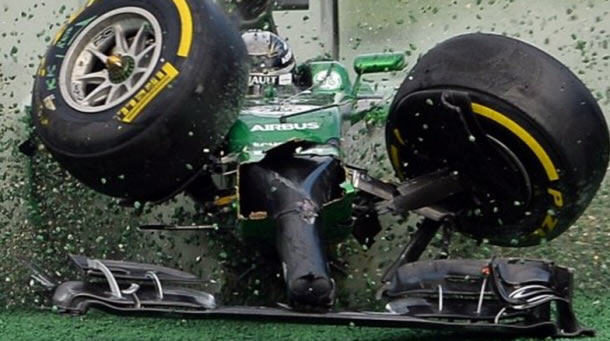
Kobayashi’s accident at the first race of the 2014 season in Melbourne – first lap, first corner crash.
For more on nose cone design, see this article.
2015 Regulation Revisions
Few denied that the 2014 regulations had produced a generation of cars that were unattractive, sapping the sport of aesthetic appeal. The FIA’s response was a set of changes for the following year, aimed at pushing designers away from creating cars with the unmistakably odd interpretations of the regulations.
For 2015, the new FIA regulations required the following:
The nose tip cross section remains at 9,000 mm2.
The nose is lowered further and must sit 135 mm to 220 mm above the floor.
The tip must be no wider than 140 mm.
The nose must widen to a second cross section 150 mm behind its tip, which must be no less than 20,000 mm2.
A maximum width of 330 mm is stated at this second cross section.
Both cross sections must be symmetrical about the centre line.
The remaining length of the nose going back toward the chassis must have a tapering cross section.
The nose tip must start about midway along the front wing.
In practical terms, the rules now specified two cross sections, tapered between each other to avoid unusual shapes as the nose cone merged with the front bulkhead. The tip also had a maximum width requirement of 140 mm. Teams would likely design an oval or rectangular nose tip that then merged into the chassis, resulting in a shorter, somewhat stubbier, and hopefully less unattractive nose than some of the designs seen in 2014.